Cookstown Dental Centre
The Cookstown Dental Centre team caring for a patient in a treatment room

Cosmetic Dentistry · Cookstown

Understand where the crossbite occurs and what is driving it.

A crossbite can involve front or back teeth, one side, or a jaw relationship. Explore assessment, treatment choices, specialist input, and realistic goals.

Request an appointment

Let’s find a time that works.

Need urgent dental help? Call (705) 291-2222.

Treatment for Crossbite in Cookstown

A reversed tooth relationship needs more than a cosmetic label.

A crossbite occurs when upper and lower teeth meet in a reversed relationship at part of the bite. It may involve front teeth or back teeth, one tooth or several, and one side or both. Some cases mainly involve tooth position; others relate more to the width or relationship of the jaws. Those differences influence the appropriate assessment and treatment route.

At Cookstown Dental Centre, we look at where the crossbite occurs, how the jaw closes, and whether there are associated symptoms or changes. Age, growth, oral health, and the wider bite all matter. A limited cosmetic approach should not be assumed to correct a jaw relationship. We explain the findings and whether orthodontic specialist care is recommended before selecting an appliance or discussing a timeline.


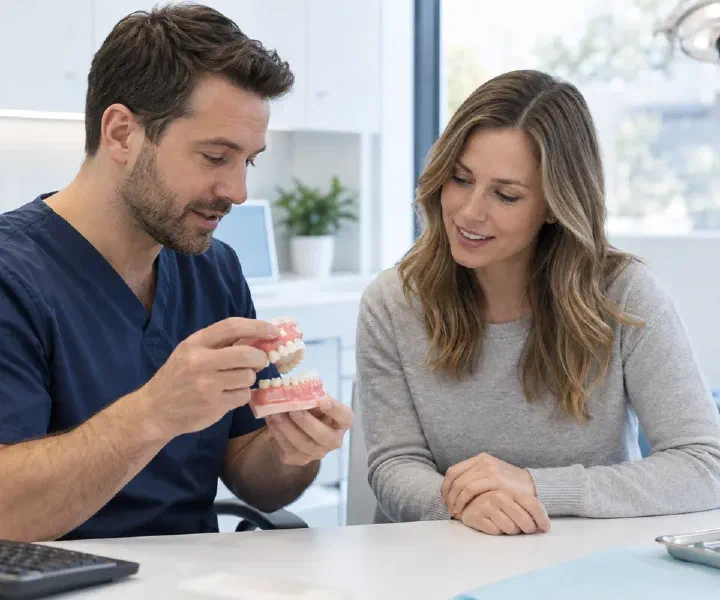
A dentist explaining front and back tooth relationships on a dental model

Good to know

Locate the relationship before discussing correction.

The word crossbite covers several patterns, so a precise description helps make the options understandable.

A front-tooth crossbite

One or more upper front teeth may sit behind their lower counterparts when biting. The clinician checks whether the pattern is mainly dental or part of a broader jaw relationship. A single visible tooth does not automatically establish that only that tooth needs treatment or that a small cosmetic adjustment is sufficient.

A back-tooth crossbite

The upper and lower back teeth may meet in a reversed transverse relationship. The pattern can involve one side or both, and the available space or jaw width may be relevant. Assessment of the whole bite is needed before assuming that moving one crown will resolve the relationship.

A shift as the jaw closes

Some people change the way the jaw closes to bring teeth together around an interference. Describe any slide, uneven contact, or change in chewing. The clinician assesses the closure and its significance; a photograph with teeth apart cannot fully show how the bite functions.

What we consider

Consider the factors that change treatment planning.

The same visible pattern can lead to different recommendations in different mouths.

Age and growth

A growing child and an adult do not have identical treatment possibilities. If the concern is in a child, the timing of orthodontic assessment may be important. For adults, treatment must account for completed growth and the existing tissues rather than promising the same expansion or correction strategy used in a younger patient.

Teeth, supporting tissues, and restorations

Gum health, bone support, missing teeth, and existing dental work influence the proposed movement. These findings may change the sequence or require care first. The clinician explains whether the available information supports treatment locally or whether additional specialist assessment is needed before a plan is agreed.

The broader jaw relationship

A crossbite may be associated with a skeletal difference that tooth movement alone cannot fully correct. The distinction should be explained clearly. More complex cases may require coordinated specialist care, and any proposed limited compromise needs to be identified as such rather than described as a complete jaw correction.

Understanding the options

Choose a route that matches the diagnosis.

An appliance should be selected for the required correction and clinical circumstances, not because one method is marketed as universally suitable.

Orthodontic correction where appropriate

Braces, aligners, or other orthodontic approaches may be considered according to the specific findings. Some cases require specialist-led treatment. Ask which relationship the plan would change, what the appliance is expected to do, and how progress and bite contacts will be monitored during care.

A broader specialist plan or an accepted limit

When jaw structure or complexity changes the options, a specialist can explain the potential scope, including whether coordinated surgical assessment is relevant. Not every crossbite needs surgery. The important point is to understand when a tooth-only plan represents a compromise and what would remain unchanged.

A closer look

Move from diagnosis to a monitored result.

The process should make the purpose of each stage visible and keep the functional concerns in view.

  1. Document the starting bite

    The clinician examines contacts, closure, and relevant oral health findings and selects records that answer the clinical questions. Explain any chewing difficulty, wear, or discomfort. Symptoms need their own assessment; crossbite correction should not be promised as a guaranteed cure for jaw pain or every functional complaint.

  2. Review the proposed correction

    Discuss the method, likely stages, limitations, and alternatives, including the implications of observation where appropriate. The plan should identify whether the goal is a full correction or a limited improvement. Ask who will supervise treatment and how any need for a different approach will be handled.

  3. Check the endpoint and retention

    The result is assessed in the mouth, including relevant contacts and the agreed goals. Retention and ongoing review are then planned according to the treatment. A front-view improvement alone is not enough to establish that the wider crossbite concern or a shift on closure has been addressed.

Frequently asked questions

Questions about treatment for crossbite

Is a crossbite the same as an underbite?

The terms can overlap in some front-tooth relationships, but crossbite also includes back-tooth and one-sided patterns. The clinician should describe your specific finding. Treatment depends on the dental and jaw relationships rather than the label alone.

Can clear aligners correct a crossbite?

They may be suitable for selected cases, but not every crossbite can be managed the same way. The location, severity, jaw relationship, and supporting tissues matter. An orthodontic assessment helps determine whether aligners, another appliance, or a broader plan is appropriate.

Does a crossbite always require surgery?

No. Many cases are assessed for orthodontic approaches, while certain skeletal relationships may warrant a surgical opinion. The clinician explains why that discussion is or is not relevant. A visible crossbite alone is not enough to determine the need for surgery.

Should a child’s crossbite be assessed early?

Yes, an orthodontic assessment can help determine whether timing matters while growth is occurring. Early assessment does not mean every child immediately needs treatment. It identifies the pattern and the appropriate monitoring or intervention rather than waiting on an assumption that it will self-correct.

Will correcting it cure jaw pain?

That should not be promised. Jaw pain has multiple possible causes and needs its own assessment. The clinician can discuss the bite finding and symptoms together while explaining what treatment is intended to change and which benefits remain uncertain.

Can the teeth be filed to fix the crossbite?

Do not assume that removing enamel is an appropriate correction. The relationship may involve tooth position or jaw structure that filing cannot address. Any bite adjustment requires a specific diagnosis and explanation rather than a cosmetic attempt to make the teeth meet differently.

What happens after active correction?

The clinician reviews the achieved bite and establishes retention and follow-up suited to the plan. Continuing dental care remains important. Report a change in contacts or appliance fit rather than assuming the corrected relationship will never need monitoring.

Real patient results

Before & after smile gallery.

Drag the centre line to compare each real case treated by our dental team. Every smile begins with a personal assessment and a plan shaped around the patient.

Areas We Serve

Neighbourhood dental care, close to home.

Located in Cookstown, Innisfil, our dental team welcomes patients from communities across South Simcoe, Barrie, and northern York Region.

Get directions
  • Cookstown
  • Innisfil
  • Simcoe
  • Lake Simcoe
  • Alcona
  • Stroud
  • Lefroy–Belle Ewart
  • Gilford
  • Churchill
  • Sandy Cove
  • Innisfil Heights
  • Fennell’s Corners
  • Bradford
  • Bradford West Gwillimbury
  • Bond Head
  • Newton Robinson
  • New Tecumseth
  • Alliston
  • Beeton
  • Tottenham
  • Adjala–Tosorontio
  • Everett
  • Loretto
  • Barrie
  • Essa
  • Thornton
  • Baxter
  • Angus
  • Egbert
  • Ivy
  • Utopia
  • York Region
  • East Gwillimbury
  • Queensville
  • Holland Landing
  • Sharon
  • Schomberg
  • Nobleton

Don’t see your community listed? Contact us—we regularly welcome patients from throughout the surrounding region.

Google reviews

Kind words from our patients.

Read what patients have shared about their visits to Cookstown Dental Centre.

A dentist having a friendly consultation with a patient in a bright dental clinic

Your next step

Ready to feel good about your next dental visit?

Whether you are new to the clinic or returning for care, our team is here to make booking simple and answer your questions.

Call Book Now WhatsApp

How can we help?

The Cookstown Dental team is here for you.

Need an appointment, have a question, or want to talk through your options? Choose the next step that works best for you.

Send us a note

We’ll get back to you as soon as we can.