Cookstown Dental Centre
The Cookstown Dental Centre team caring for a patient in a treatment room

Specialized Care · Cookstown

Plan a surgical extraction around the tooth and its surroundings.

Surgical tooth extractions in Cookstown require assessment of access, roots, nearby anatomy, comfort needs, and healing before treatment or referral is arranged.

Request an appointment

Let’s find a time that works.

Need urgent dental help? Call (705) 291-2222.

Surgical Tooth Extractions in Cookstown

The surgical approach is chosen for access and control.

Some teeth cannot be removed predictably through a straightforward accessible approach. A tooth may be broken below the gum, impacted, or shaped in a way that requires planned surgical access. The procedure may involve lifting gum tissue, removing a limited amount of bone, or dividing the tooth, depending on the anatomy. The purpose is controlled removal suited to the site, not a more intensive procedure for its own sake.

Assessment includes the reason for extraction, alternatives, imaging, medical history, and the relationship to nearby structures. The clinician also considers who should provide the procedure and in what setting. Local treatment may be suitable for some cases, while others benefit from oral surgery referral. Before proceeding, you should understand the proposed approach, relevant risks, comfort plan, and the recovery instructions specific to your treatment.


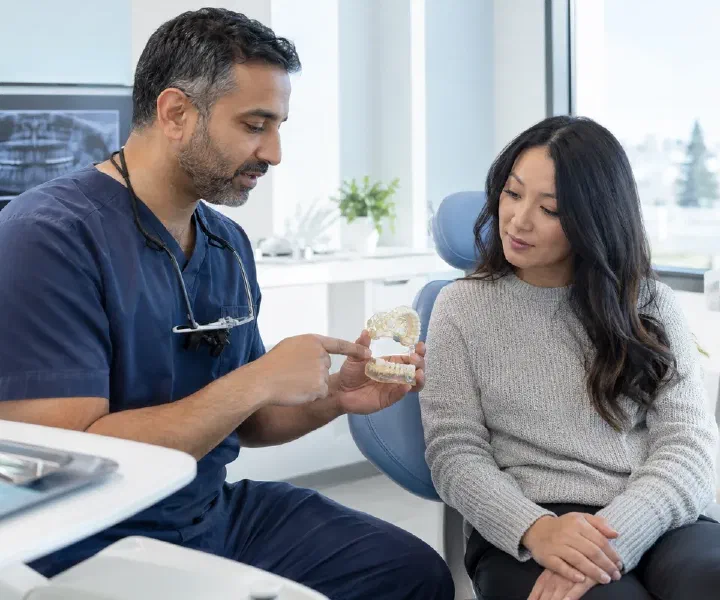
Dentist explaining surgical extraction anatomy on a jaw model to an adult patient

What we consider

The findings that shape the procedure

The visible part of the tooth does not show every factor involved in removal.

Tooth position and root anatomy

An impacted tooth, a fractured crown, curved roots, or previous treatment can affect access. Appropriate imaging helps estimate the relationship between the roots, surrounding bone, and adjacent teeth. Additional imaging is considered when it answers a meaningful planning question, rather than ordered automatically for every surgical extraction.

Nearby structures and overall health

Nerves, the sinus, neighbouring restorations, and the condition of supporting bone may influence risk and referral. Medical conditions and medicines can affect bleeding, healing, and anaesthesia planning. Share a complete history and do not stop prescriptions yourself; any necessary changes require a coordinated plan with the responsible clinicians.

Understanding the options

Removal is considered alongside preservation and observation

The reason for surgery should be specific to the tooth and your circumstances.

When another option remains reasonable

Some damaged teeth may be restored or treated endodontically, while selected asymptomatic impacted teeth may be monitored after assessment. The likely benefit and burden of those options need to be compared with extraction. Surgery should not be presented as inevitable merely because a tooth is difficult to access or has unusual roots.

When extraction offers the clearer benefit

An unrestorable tooth, recurrent disease, or damage to nearby structures may support removal. The clinician explains how the expected benefit compares with surgical risks and the consequences of the resulting space. If replacement is relevant, discuss it early so the extraction plan can account for future restorative goals.

A closer look

Preparing for the appointment

Planning makes the procedure and the recovery more predictable without promising a risk-free outcome.

  1. Confirm the provider and comfort plan

    Complex anatomy, medical needs, or the extent of surgery may favour referral. Discuss local anaesthetic and any additional anxiety-management or sedation options that are actually appropriate and available. Sedation requires separate assessment and instructions; it should not be assumed to be part of every surgical extraction.

  2. Understand the procedure-specific risks

    Ask about the risks relevant to your site, which may include bleeding, infection, dry socket, injury to nearby structures, or altered sensation. The likelihood and significance depend on the anatomy and procedure. A clear consent discussion explains those individual considerations rather than relying on a generic list without context.

  3. Arrange recovery and follow-up

    Confirm eating, medication, transport, and activity instructions, including an escort if sedation requires one. Ask whether stitches or a planned review are expected and how to contact the treating team. If grafting or a future implant is being considered, clarify how that changes the procedure and subsequent appointments.

Practical guidance

Protecting the surgical site afterward

The treating clinician’s directions take priority because wounds and procedures differ.

Follow the cleaning and activity instructions

The site may need temporary changes to brushing, rinsing, diet, and exercise. Avoid probing the wound, pulling at stitches, or placing household substances into the socket. Instructions may be different when a graft, sinus-related precaution, or more extensive flap is involved, so ask if any part of the written plan is unclear.

Use medicines according to the agreed plan

Pain relief should account for your health and existing medicines. Antibiotics are not automatic after every procedure and should be used only when prescribed for the clinical situation. Contact the team if symptoms are not controlled or a medication concern arises rather than increasing doses or adding leftover prescriptions yourself.

Good to know

Know when recovery needs reassessment

The pattern of symptoms matters more than judging the wound by appearance alone.

Call for unexpected or worsening changes

Increasing pain after initial improvement, persistent bleeding, worsening swelling, or altered sensation beyond the expected course should be discussed with the treating clinician. A review can distinguish different causes and provide appropriate care. Do not assume all post-extraction pain is infection or that antibiotics will solve every complication.

Seek urgent care for serious symptoms

Breathing or swallowing difficulty, rapidly spreading swelling, uncontrolled heavy bleeding, or serious systemic illness needs urgent medical assessment. These concerns should not wait for a routine follow-up. Once immediate risks are addressed, the dental or surgical team can coordinate the ongoing care of the extraction site.

Frequently asked questions

Questions about surgical tooth extractions

How is a surgical extraction different from a simple extraction?

A surgical approach may require access through the gum, limited bone removal, or dividing the tooth. It is selected according to position, root anatomy, and access rather than simply the amount of pain the tooth is causing.

Will I need a specialist?

That depends on complexity, nearby anatomy, medical needs, and the appropriate treatment setting. The assessment can establish whether care locally or referral is suitable, with the provider and arrangements confirmed before treatment is scheduled.

Does surgery always require sedation?

No. Local anaesthetic is central to numbing the site, while additional sedation is considered separately according to suitability, preference, and available care. Sedation requires its own assessment and instructions and should not be assumed to be routine.

Can an impacted tooth ever be monitored instead?

In selected circumstances, observation may be appropriate after assessing disease, risk, and nearby structures. The decision compares the benefits and risks of removal with a defined monitoring plan rather than assuming every impacted tooth must be removed.

How long will healing take?

Recovery varies with the tooth, surgical extent, medical factors, and whether additional procedures were performed. The clinician can explain the expected course for your case and which symptoms should prompt a review rather than giving one timeline for every extraction.

Should I stop medication before surgery?

Do not change prescriptions independently. Provide a complete medication list, including blood thinners and bone-related medicines. The dental clinician can coordinate any necessary precautions with your medical team based on the planned procedure.

What if I develop worsening pain several days later?

Contact the treating team for assessment. Dry socket, infection, and other causes require different management, so the timing and examination matter. Serious swelling, breathing difficulty, or uncontrolled bleeding requires urgent medical care.

Real patient results

Before & after smile gallery.

Drag the centre line to compare each real case treated by our dental team. Every smile begins with a personal assessment and a plan shaped around the patient.

Areas We Serve

Neighbourhood dental care, close to home.

Located in Cookstown, Innisfil, our dental team welcomes patients from communities across South Simcoe, Barrie, and northern York Region.

Get directions
  • Cookstown
  • Innisfil
  • Simcoe
  • Lake Simcoe
  • Alcona
  • Stroud
  • Lefroy–Belle Ewart
  • Gilford
  • Churchill
  • Sandy Cove
  • Innisfil Heights
  • Fennell’s Corners
  • Bradford
  • Bradford West Gwillimbury
  • Bond Head
  • Newton Robinson
  • New Tecumseth
  • Alliston
  • Beeton
  • Tottenham
  • Adjala–Tosorontio
  • Everett
  • Loretto
  • Barrie
  • Essa
  • Thornton
  • Baxter
  • Angus
  • Egbert
  • Ivy
  • Utopia
  • York Region
  • East Gwillimbury
  • Queensville
  • Holland Landing
  • Sharon
  • Schomberg
  • Nobleton

Don’t see your community listed? Contact us—we regularly welcome patients from throughout the surrounding region.

Google reviews

Kind words from our patients.

Read what patients have shared about their visits to Cookstown Dental Centre.

A dentist having a friendly consultation with a patient in a bright dental clinic

Your next step

Ready to feel good about your next dental visit?

Whether you are new to the clinic or returning for care, our team is here to make booking simple and answer your questions.

Call Book Now WhatsApp

How can we help?

The Cookstown Dental team is here for you.

Need an appointment, have a question, or want to talk through your options? Choose the next step that works best for you.

Send us a note

We’ll get back to you as soon as we can.