Cookstown Dental Centre
The Cookstown Dental Centre team caring for a patient in a treatment room

Specialized Care · Cookstown

Act on the injury, then plan for the tooth’s future.

Sports-related dental injury care in Cookstown addresses broken, displaced, or knocked-out teeth, associated injuries, follow-up, and protective planning.

Request an appointment

Let’s find a time that works.

Need urgent dental help? Call (705) 291-2222.

Sports-Related Dental Injury Treatment in Cookstown

The first decision may be medical as well as dental.

A collision, fall, stick, ball, or elbow can injure teeth and the surrounding mouth tissues. The visible damage may be only part of the injury: a tooth can be displaced or have damaged supporting tissues without a large chip, and a blow to the face can also involve the jaw or head. Stop play and assess the person’s overall condition before focusing only on the tooth.

A knocked-out permanent tooth is particularly time-sensitive, while other injuries also need prompt assessment to establish what has moved, fractured, or become tender. Significant head-injury symptoms, breathing problems, uncontrolled bleeding, or major facial trauma require urgent medical care. Dental treatment then addresses the affected teeth and tissues, with follow-up because changes in the pulp or supporting structures may develop after the first appointment.


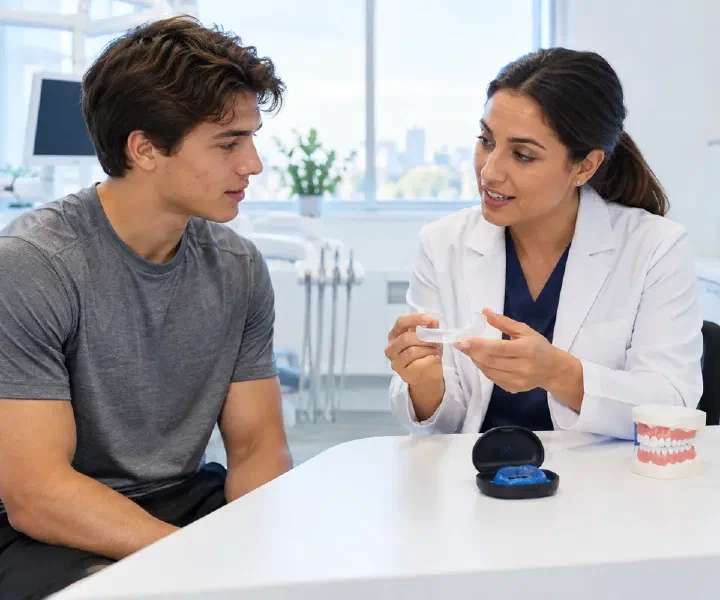
Dentist discussing a sports-related tooth injury with an adult athlete holding a sports mouthguard

Step by step

At the scene of the injury

Protect the person first, then preserve useful information and any tooth fragments.

  1. Check for a broader injury

    Stop activity and seek urgent medical assessment when there is concern about a head injury, serious facial trauma, breathing difficulty, or uncontrolled bleeding. A damaged tooth should not distract from those priorities. Do not send someone back into play simply because the mouth bleeding has slowed or the tooth looks mostly intact.

  2. Handle a knocked-out tooth carefully

    For a permanent tooth, contact a dentist immediately, handle it by the crown rather than the root, and keep it moist, for example in milk, while obtaining urgent instructions. Do not scrub the root or let the tooth dry out. A baby tooth should not be replanted; seek prompt advice for the child’s injury.

  3. Keep fragments and describe the event

    Bring any broken tooth pieces and explain when and how the impact occurred. Tell the clinician if a piece is missing, particularly when there is a lip or cheek wound. Avoid pushing displaced teeth, gluing fragments, or testing a loose tooth repeatedly while waiting for professional assessment.

What we consider

What the dental examination investigates

The clinician checks the injured tooth in relation to the surrounding structures.

Position, fractures, and supporting tissues

The assessment looks for movement, displacement, crown or root damage, gum injuries, and changes in the bite. Appropriate imaging may help reveal injuries below the surface. Several teeth can be affected by one impact, so neighbouring teeth need attention even if only one is visibly chipped or painful.

The pulp and a baseline for follow-up

Tests help establish the tooth’s initial condition, but a response immediately after trauma may not give the complete long-term picture. The age and development of the tooth also influence decisions. Records and planned reviews allow the clinician to watch for healing or later complications rather than assuming a single early test settles the prognosis.

Understanding the options

Treatment follows the type of injury

A small-looking injury and a dramatic-looking injury can need very different care.

Repair and stabilization

A broken edge may be restored or a fragment reattached when suitable, while a displaced or mobile tooth may need repositioning and stabilization by the treating clinician. The approach depends on the injury and supporting tissues. A temporary measure may protect the area initially without completing every restorative decision at the emergency visit.

Pulp treatment, monitoring, or referral

Some injuries require root canal treatment, while others are monitored for healing, especially when tooth development and the injury pattern support that approach. Complex trauma may need specialist care. The clinician should explain what is known, what remains uncertain, and which future changes would alter the treatment recommendation.

Practical guidance

Recovery includes the surrounding mouth

Follow the plan for chewing, cleaning, and protecting the injured structures.

Care for a stabilized or restored tooth

Use the eating and oral-hygiene instructions provided, and do not test a splint or repeatedly bite on the injured tooth to check its strength. Report a loose stabilization device, a changed bite, or increasing pain. The follow-up schedule is part of trauma treatment, even if the tooth begins to feel comfortable quickly.

Watch for delayed changes

A tooth may later become discoloured, tender, swollen, or more mobile, and those changes deserve review. Soft-tissue wounds also need monitoring for unexpected symptoms. Keep records of the injury and treatment so another clinician can understand the history if you move, travel, or require care away from the original office.

Good to know

Returning to sport and reducing future risk

Protection is planned around healing and the sport rather than a fixed promise of safety.

Ask when participation is appropriate

The dental clinician can advise about the injured teeth and any appliance, while medical clearance may be needed for a head or broader facial injury. Return-to-play decisions should consider both. Do not assume a mouthguard makes it safe to resume contact activity before the injury has been assessed and the recovery plan explained.

Review the mouthguard after treatment

A guard may need adjustment or replacement after dental changes, orthodontic treatment, or growth. A well-fitting sports mouthguard can help reduce dental injury risk, but it cannot prevent every injury or replace appropriate sports safety practices. Bring an existing guard to review so fit can be checked against the current teeth and treatment.

Frequently asked questions

Questions about sports-related dental injury treatment

What should I do with a knocked-out permanent tooth?

Seek immediate dental advice, handle the tooth by its crown, and keep it moist, for example in milk. Do not scrub the root or allow it to dry. Time matters, and significant accompanying injuries may also require urgent medical care.

Should a knocked-out baby tooth be put back?

No. Do not replant a baby tooth. Arrange prompt dental assessment for the child and any associated injury, and seek urgent medical help if there are concerning head-injury symptoms, breathing problems, or uncontrolled bleeding.

Can a tooth be injured without a visible chip?

Yes. Supporting tissues, roots, and the pulp can be affected even when the crown looks intact. Pain, mobility, displacement, or a changed bite after an impact needs assessment and may require follow-up.

Will every injured adult tooth need a root canal?

No. The injury type, tooth development, tests, and healing response guide treatment. Some teeth are monitored while others need pulp treatment. Planned reviews help detect complications that may not be clear immediately after the injury.

Why do I need follow-up when the pain has stopped?

Comfort does not establish that the pulp and supporting tissues have fully recovered. Later changes can occur after trauma, so follow-up tests and imaging when indicated help assess healing and identify problems before symptoms become severe.

Can I play again if I wear a mouthguard?

A mouthguard does not replace assessment or clearance after an injury. Ask the dental clinician about the tooth and any stabilization, and follow medical advice for head or facial injuries before returning to contact activity.

Should my old mouthguard be replaced after a repair?

It should be checked. A new restoration, displaced tooth, splint, or other treatment can change the fit. A guard that presses on an injured area or no longer seats properly may need modification or replacement.

Real patient results

Before & after smile gallery.

Drag the centre line to compare each real case treated by our dental team. Every smile begins with a personal assessment and a plan shaped around the patient.

Areas We Serve

Neighbourhood dental care, close to home.

Located in Cookstown, Innisfil, our dental team welcomes patients from communities across South Simcoe, Barrie, and northern York Region.

Get directions
  • Cookstown
  • Innisfil
  • Simcoe
  • Lake Simcoe
  • Alcona
  • Stroud
  • Lefroy–Belle Ewart
  • Gilford
  • Churchill
  • Sandy Cove
  • Innisfil Heights
  • Fennell’s Corners
  • Bradford
  • Bradford West Gwillimbury
  • Bond Head
  • Newton Robinson
  • New Tecumseth
  • Alliston
  • Beeton
  • Tottenham
  • Adjala–Tosorontio
  • Everett
  • Loretto
  • Barrie
  • Essa
  • Thornton
  • Baxter
  • Angus
  • Egbert
  • Ivy
  • Utopia
  • York Region
  • East Gwillimbury
  • Queensville
  • Holland Landing
  • Sharon
  • Schomberg
  • Nobleton

Don’t see your community listed? Contact us—we regularly welcome patients from throughout the surrounding region.

Google reviews

Kind words from our patients.

Read what patients have shared about their visits to Cookstown Dental Centre.

A dentist having a friendly consultation with a patient in a bright dental clinic

Your next step

Ready to feel good about your next dental visit?

Whether you are new to the clinic or returning for care, our team is here to make booking simple and answer your questions.

Call Book Now WhatsApp

How can we help?

The Cookstown Dental team is here for you.

Need an appointment, have a question, or want to talk through your options? Choose the next step that works best for you.

Send us a note

We’ll get back to you as soon as we can.