Cookstown Dental Centre
The Cookstown Dental Centre team caring for a patient in a treatment room

Restorative Dentistry · Cookstown

Understand how a snap-in denture stays in place and comes out for care.

Snap-in dentures use implant attachments for removable retention. Explore handling, fit, attachment wear, daily cleaning, and the assessment before treatment.

Request an appointment

Let’s find a time that works.

Need urgent dental help? Call (705) 291-2222.

Snap-In Dentures in Cookstown

Snap-in is a familiar name for a removable implant-retained design.

A snap-in denture usually refers to a removable denture that connects to implant attachments. You remove it for cleaning using the method demonstrated by the dental team. The term overlaps with implant-retained overdenture care; it does not describe a separate technology that avoids implant assessment, surgery, or ongoing maintenance.

At Cookstown Dental Centre, the discussion starts with the stability you want to improve and whether this type of appliance fits your mouth and daily routine. The number and arrangement of implants, attachment system, tissue support, and denture design are planned together. A secure connection should also be manageable: you need to be able to remove, clean, and reinsert the denture safely, with assistance if appropriate.


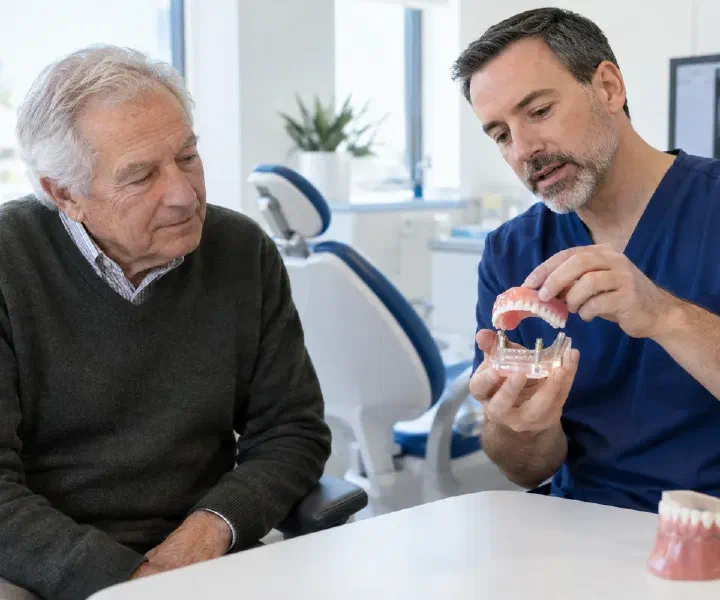
A dentist demonstrating a removable snap-in denture on an implant model

Care that fits

Consider the daily experience before choosing the design.

Retention is useful when it supports comfortable function and practical care.

Less movement with a removable routine

Implant attachments can improve retention in suitable cases, but the denture’s base and bite still matter. Some designs continue to receive support from the tissues. Discuss what movement or comfort limits may remain rather than assuming the word snap-in means the appliance behaves exactly like fixed natural teeth.

Handling that suits your ability

The connection needs to be secure without making removal unmanageable. Hand strength, coordination, vision, and caregiver support can influence the plan. Try the demonstrated method and explain any difficulty so retention and instructions are considered in the context of everyday use, not only at the fitting visit.

What we consider

Assess the support and space for the attachments.

The appliance cannot be designed independently of the mouth beneath it.

Bone and implant planning

The ridge, anatomy, and proposed implant positions are assessed with appropriate records and imaging. Some cases may need preparatory treatment or a different option. The number of implants is determined by the jaw, design, and clinical findings rather than a universal package for every patient.

Denture space and tissue relationships

The appliance needs room for its base, teeth, and attachment arrangement while maintaining suitable bite and appearance. The gums and ridge also affect fit. An existing denture may not have the design or material needed for conversion, even if it currently looks acceptable.

Health and ongoing care needs

Medical history, medications, smoking, dental disease, and cleaning ability remain relevant to implant suitability. Discuss access to maintenance visits and practical constraints. The plan should include the long-term responsibilities of the implants and attachments as well as the expected improvement in retention.

Understanding the options

Distinguish snap-in dentures from fixed implant teeth.

Both use implants, but they are handled and maintained differently.

A removable attachment-retained appliance

You take the denture out as instructed to clean the appliance and implant-side components. Wearing attachment parts may need professional replacement. Fit procedures such as relining may also be relevant when tissue support changes, so attachment maintenance is only one part of keeping the appliance functional.

A fixed implant restoration

A fixed design stays in place during daily care and requires cleaning around and beneath it. Removal is professional when indicated. Its support, space, and servicing requirements differ, and suitability should be assessed rather than selecting fixed or removable care solely from the sound of the label.

The appointment

Plan implant care, denture fitting, and handling instruction.

The final connection follows a sequence that depends on healing and design.

  1. Confirm the complete treatment pathway

    Discuss the proposed implants, appliance, surgery, temporary arrangements, and any provider coordination. If your current denture may be used during healing, ask whether it needs modification or limits. Immediate attachment or unrestricted chewing should not be assumed before the clinical plan is established.

  2. Fit and check the completed appliance

    The clinician evaluates seating, tissue adaptation, bite, and retention. An attachment can feel secure while another part of the denture still needs adjustment. Explain pressure, rocking, or difficulty removing it so these issues can be assessed before they become part of your normal routine.

  3. Practise care and establish review

    Learn insertion, removal, and cleaning with the actual appliance. Ask which products and tools suit its materials and components. The follow-up schedule should monitor comfort, implant tissues, fit, and attachment wear, with clear instructions for contacting the clinic about changes between visits.

Practical guidance

Respond to changes without altering the attachments yourself.

Wear and fit changes need identification of the affected part.

A denture that has become easier to lift out

Attachment wear may be involved, but base fit, component damage, or seating problems can also reduce retention. Arrange assessment rather than buying stronger inserts or bending parts. Compatible professional servicing should address the cause and preserve your ability to remove the appliance for daily cleaning.

A denture that will not seat or causes soreness

Do not bite down hard to force it into place. Debris, damage, tissue change, or another issue may be responsible. Contact the clinic and bring any detached parts. Bleeding or swelling around implants also needs assessment, even when the denture still seems to snap in normally.

Frequently asked questions

Questions about snap-in dentures

Are snap-in dentures removable?

Yes, the term generally describes a removable implant-retained denture. You take it out using the demonstrated technique for cleaning. This differs from a fixed implant restoration, which stays in place for daily care and is removed professionally when indicated.

Are snap-in and implant-supported dentures different services?

The terms overlap. Snap-in usually refers to a removable attachment-retained design within the broader range of implant denture care. The actual support, attachments, and handling should be explained rather than treating the labels as separate procedures everyone needs.

Can my existing denture be converted?

Possibly, but its fit, condition, design, and available space must be assessed. Some appliances are unsuitable and a new denture may be needed. The decision should be made as part of the implant and prosthetic plan, not assumed before examination.

Do the attachments need replacing over time?

Some attachment components can wear and require professional replacement. The interval varies with the system, fit, and use. A loss of retention should be assessed because the denture base or another component may also be contributing.

Will it be difficult to remove for cleaning?

Handling depends on the design and your ability. The team should demonstrate the method and check that you can manage it safely. Maximum tightness is not always the right goal, especially when hand strength or caregiver needs affect daily care.

Can I sleep with a snap-in denture in place?

Follow the instructions for your appliance and treatment stage. Routine care includes cleaning the denture and implant-side components, and wear recommendations should be explicit. Recent surgery can require different early instructions from a long-term routine.

What if it stops clicking into place?

Do not force it by biting down or adjust the components yourself. Contact the clinic for assessment of the attachments, fit, and tissues. Keep any detached part and describe whether the change was sudden, gradual, painful, or associated with a recent repair.

Real patient results

Before & after smile gallery.

Drag the centre line to compare each real case treated by our dental team. Every smile begins with a personal assessment and a plan shaped around the patient.

Areas We Serve

Neighbourhood dental care, close to home.

Located in Cookstown, Innisfil, our dental team welcomes patients from communities across South Simcoe, Barrie, and northern York Region.

Get directions
  • Cookstown
  • Innisfil
  • Simcoe
  • Lake Simcoe
  • Alcona
  • Stroud
  • Lefroy–Belle Ewart
  • Gilford
  • Churchill
  • Sandy Cove
  • Innisfil Heights
  • Fennell’s Corners
  • Bradford
  • Bradford West Gwillimbury
  • Bond Head
  • Newton Robinson
  • New Tecumseth
  • Alliston
  • Beeton
  • Tottenham
  • Adjala–Tosorontio
  • Everett
  • Loretto
  • Barrie
  • Essa
  • Thornton
  • Baxter
  • Angus
  • Egbert
  • Ivy
  • Utopia
  • York Region
  • East Gwillimbury
  • Queensville
  • Holland Landing
  • Sharon
  • Schomberg
  • Nobleton

Don’t see your community listed? Contact us—we regularly welcome patients from throughout the surrounding region.

Google reviews

Kind words from our patients.

Read what patients have shared about their visits to Cookstown Dental Centre.

A dentist having a friendly consultation with a patient in a bright dental clinic

Your next step

Ready to feel good about your next dental visit?

Whether you are new to the clinic or returning for care, our team is here to make booking simple and answer your questions.

Call Book Now WhatsApp

How can we help?

The Cookstown Dental team is here for you.

Need an appointment, have a question, or want to talk through your options? Choose the next step that works best for you.

Send us a note

We’ll get back to you as soon as we can.