Cookstown Dental Centre
The Cookstown Dental Centre team caring for a patient in a treatment room

Specialized Care · Cookstown

Check whether dental sleep treatment is suitable for you.

A sleep apnea dental assessment in Cookstown reviews teeth, gums, jaw function, and appliance suitability while keeping medical diagnosis and testing central.

Request an appointment

Let’s find a time that works.

Need urgent dental help? Call (705) 291-2222.

Sleep Apnea Dental Assessments in Cookstown

The dental examination answers a different question from a sleep study.

Obstructive sleep apnea is a medical condition involving repeated airway obstruction during sleep. Snoring, tiredness, or the appearance of the mouth cannot establish the diagnosis or measure its severity. Medical assessment and appropriate sleep testing guide that part of care. A dental sleep assessment asks whether the mouth and jaw can support a suitable oral appliance and what oral risks need to be addressed.

If you have a diagnosis or a recommendation from a sleep clinician, bring the relevant report and treatment history. If sleep apnea is only suspected, the next step may be medical referral before an appliance decision. The dental findings, your preferences, and the medical treatment plan are considered together. An ordinary nightguard is not a substitute for a prescribed sleep apnea appliance, and reduced snoring does not by itself show that apnea is controlled.


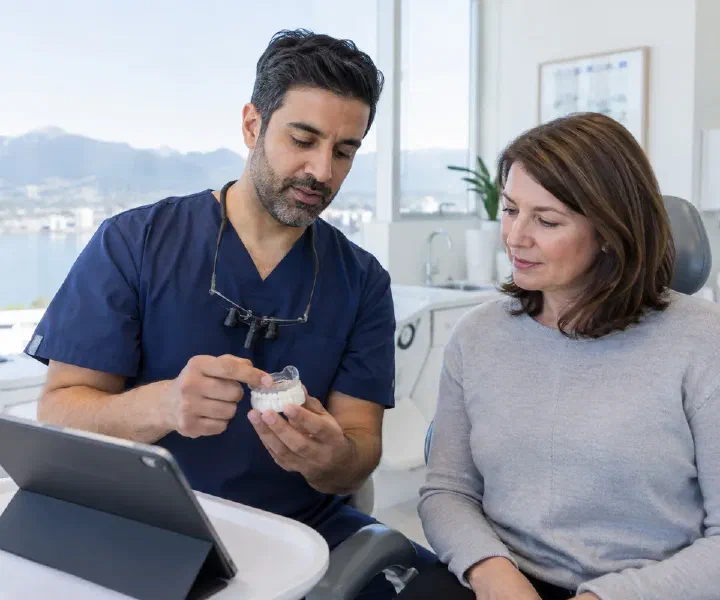
Dentist reviewing dental suitability for a sleep appliance with a patient and a jaw model

Planning together

Bring the sleep history into the appointment

Existing information can prevent the dental plan from starting with an incomplete picture.

Diagnosis and current treatment

Bring sleep-study results, the name of the clinician managing your sleep condition, and details of prescribed treatment such as CPAP. Describe what you have tried and any difficulties with use. Do not stop an existing prescribed therapy in anticipation of a dental appliance; changes belong in a coordinated medical plan.

Symptoms, medicines, and practical goals

Discuss witnessed pauses in breathing, sleepiness, snoring, relevant health conditions, and medicines. Explain whether your main concern is comfort, travel, adherence, or another practical issue. Those preferences matter when comparing options, but they do not replace objective information about the condition or determine appliance suitability by themselves.

What we consider

What the dental assessment examines

The appliance needs dependable support and a jaw that can tolerate the proposed design.

Teeth, gums, and restorations

The clinician assesses periodontal support, decay, loose teeth, crowns, bridges, implants, and other restorations that may affect retention or loading. Dental disease may need treatment before an appliance is made. A device must fit the actual condition of your mouth, including any planned restorative changes that could soon alter its fit.

Jaw movement, comfort, and the bite

Baseline jaw symptoms, range of movement, tooth contacts, and existing appliances are reviewed. These findings help identify limitations and provide a reference if symptoms or bite changes arise later. A history of jaw pain does not settle suitability on its own, but it needs careful consideration before a device advances the jaw during sleep.

Understanding the options

Screening, diagnosis, and suitability are separate

Understanding these roles keeps the treatment pathway clear.

When sleep apnea is suspected

A dental visit may identify symptoms or risk features that warrant medical evaluation. Screening can support referral, but it cannot determine severity or rule out the condition. The appropriate clinician decides whether sleep testing is needed and how results should guide treatment, including whether a dental appliance is an appropriate option.

When a medical diagnosis is established

The dental assessment can focus on whether a custom appliance is feasible, what preparatory care is needed, and which risks should be discussed. The medical recommendation and patient preference still matter. The resulting plan should identify who will prescribe or recommend therapy, who will provide the device, and who will assess effectiveness.

Step by step

Turning the findings into a treatment plan

A suitable candidate still needs a coordinated sequence rather than a device delivered in isolation.

  1. Discuss options and oral risks

    The consultation should cover expected benefits, alternatives, limits, and potential effects on teeth, gums, jaw comfort, and the bite. Ask how the proposed appliance differs from a general nightguard. If dental support is inadequate or treatment needs are complex, further care or referral may be needed before proceeding.

  2. Arrange records, fitting, and verification

    If treatment is appropriate, records and a custom appliance may follow, with fitting and gradual adjustment under professional guidance. Follow-up sleep testing is used to assess effectiveness through the medical team. The plan should also include ongoing dental monitoring, because a device that initially fits well can create problems as teeth or health circumstances change.

Good to know

Questions that may change the next step

The assessment is valuable even when it does not lead directly to an appliance.

Missing teeth or extensive dental work

Retention can be more complex when teeth are missing, support is reduced, or large restorations are planned. Some situations require specialized approaches or a different treatment pathway. Do not assume that a device shown online is suitable for your mouth; the clinician needs to evaluate the structures that would hold and support it.

New symptoms or changing health

Weight changes, worsening daytime sleepiness, cardiovascular concerns, or changes in sleep symptoms should be shared with the medical team. Dental review cannot determine every medical implication of those changes. An existing appliance may need reassessment, but modifying it without coordinated evaluation is not a reliable response to suspected worsening sleep apnea.

Frequently asked questions

Questions about sleep apnea dental assessments

Can a dentist diagnose sleep apnea by looking at my mouth?

No. Oral findings and symptom screening can suggest a need for medical assessment, but they do not establish the diagnosis or severity. Appropriate medical evaluation and sleep testing guide the sleep apnea diagnosis and treatment plan.

Do I need a sleep study before an appliance assessment?

If you already have one, bring the report. If apnea is suspected but unconfirmed, medical evaluation may be the next step. The dental team can still identify oral considerations, but appliance treatment should fit an established medical pathway.

Is a sleep appliance the same as a grinding guard?

No. A sleep apnea appliance is designed for a specific airway-related treatment purpose and requires appropriate prescribing, fitting, adjustment, and follow-up. An ordinary protective nightguard should not be assumed to treat sleep apnea.

Can I use an appliance instead of CPAP?

That decision depends on the medical diagnosis, treatment options, your circumstances, and professional guidance. Do not stop CPAP simply because you are considering an appliance. Coordinate any change with the clinician managing your sleep condition.

What if I have gum disease or loose teeth?

Those findings can affect appliance support and safety. They need assessment and may require treatment before an appliance is considered. Suitability depends on the extent of the problem and the proposed design, not just the number of teeth present.

How will we know whether an appliance works?

Comfort and reduced snoring are useful observations, but they do not confirm control of apnea. Follow-up sleep testing through the medical team is used to assess effectiveness, alongside dental monitoring of fit, tissues, and bite.

Does an assessment mean I will definitely receive an appliance?

No. It may identify preparatory dental care, a need for medical testing, referral, or a reason another treatment is more appropriate. The value of the assessment is a clear, coordinated recommendation rather than an automatic device order.

Real patient results

Before & after smile gallery.

Drag the centre line to compare each real case treated by our dental team. Every smile begins with a personal assessment and a plan shaped around the patient.

Areas We Serve

Neighbourhood dental care, close to home.

Located in Cookstown, Innisfil, our dental team welcomes patients from communities across South Simcoe, Barrie, and northern York Region.

Get directions
  • Cookstown
  • Innisfil
  • Simcoe
  • Lake Simcoe
  • Alcona
  • Stroud
  • Lefroy–Belle Ewart
  • Gilford
  • Churchill
  • Sandy Cove
  • Innisfil Heights
  • Fennell’s Corners
  • Bradford
  • Bradford West Gwillimbury
  • Bond Head
  • Newton Robinson
  • New Tecumseth
  • Alliston
  • Beeton
  • Tottenham
  • Adjala–Tosorontio
  • Everett
  • Loretto
  • Barrie
  • Essa
  • Thornton
  • Baxter
  • Angus
  • Egbert
  • Ivy
  • Utopia
  • York Region
  • East Gwillimbury
  • Queensville
  • Holland Landing
  • Sharon
  • Schomberg
  • Nobleton

Don’t see your community listed? Contact us—we regularly welcome patients from throughout the surrounding region.

Google reviews

Kind words from our patients.

Read what patients have shared about their visits to Cookstown Dental Centre.

A dentist having a friendly consultation with a patient in a bright dental clinic

Your next step

Ready to feel good about your next dental visit?

Whether you are new to the clinic or returning for care, our team is here to make booking simple and answer your questions.

Call Book Now WhatsApp

How can we help?

The Cookstown Dental team is here for you.

Need an appointment, have a question, or want to talk through your options? Choose the next step that works best for you.

Send us a note

We’ll get back to you as soon as we can.