Cookstown Dental Centre
The Cookstown Dental Centre team caring for a patient in a treatment room

Specialized Care · Cookstown

Understand a straightforward extraction before it begins.

Simple tooth extractions in Cookstown start with assessing the tooth, medical history, and alternatives, followed by comfort planning and clear aftercare.

Request an appointment

Let’s find a time that works.

Need urgent dental help? Call (705) 291-2222.

Simple Tooth Extractions in Cookstown

A familiar procedure still deserves an individual plan.

A simple extraction generally refers to removal of a tooth that can be accessed without a planned surgical approach through the gum or bone. The visible crown is only part of the picture: root shape, tooth strength, surrounding support, and nearby structures also influence how removal is approached. Examination and appropriate imaging help estimate what is likely to be involved.

Before an extraction, the clinician should explain why removal is recommended and whether a reasonable tooth-preserving option exists. The discussion also includes local anaesthetic, relevant risks, aftercare, and what might happen if the tooth cannot be removed as anticipated. A procedure described as simple is not a guarantee that the tooth will behave predictably, nor a reason to overlook medical history or the effect of the resulting space on your future dental care.


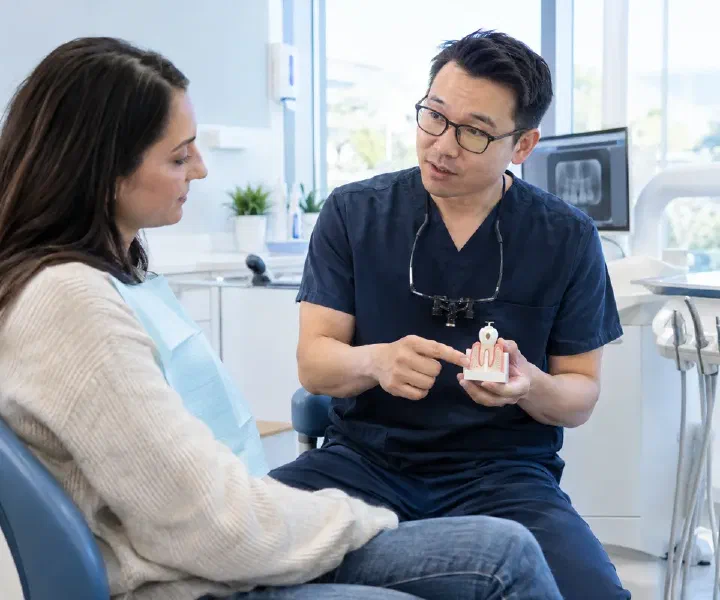
Dentist reviewing a tooth model and extraction plan with an adult patient before treatment

Understanding the options

Deciding whether removal is the right choice

The condition of the tooth and its role in your mouth both matter.

Consider a realistic preservation option

Depending on the problem, a filling, crown, root canal treatment, or periodontal care may offer a way to retain the tooth. The likely durability, treatment burden, and cost need to be considered together. A tooth-preserving option is useful only if the remaining structure and support make it a reasonable choice for your circumstances.

Understand the consequence of the space

Some extraction sites need no replacement, while others affect chewing, appearance, or the stability of a larger restorative plan. Discuss possible replacement options before removal when practical. If future implant treatment is a consideration, the site and timing may need additional planning rather than being left until after healing is complete.

What we consider

What makes an extraction more or less straightforward

An apparently small tooth can still have features that affect treatment.

The tooth and its roots

The clinician considers how much sound tooth remains, whether it is fractured, and the number, shape, and position of the roots. An X-ray can reveal features not visible above the gum. These findings help estimate whether a simple approach is appropriate or whether surgical treatment or referral should be planned from the start.

Your health and previous experiences

Medicines, allergies, bleeding history, diabetes, bone-related medications, and previous extraction experiences can influence precautions. Tell us about anxiety and any difficulty with local anaesthetic. Do not stop blood thinners or other prescribed medicines yourself; any necessary adjustment requires an agreed plan with the appropriate medical and dental clinicians.

The appointment

The appointment in practical terms

Communication and consent continue throughout the procedure.

  1. Confirm the tooth and achieve numbness

    The clinician confirms the treatment site and reviews the agreed plan before local anaesthetic is given. Numbness is checked before removal begins. Pressure and movement may be felt, but sharp pain should be reported immediately so anaesthesia and the approach can be reassessed rather than asking you to endure it.

  2. Remove the tooth and assess the socket

    The tooth is loosened and removed using an approach suited to its anatomy, then the site is assessed and bleeding managed. If the tooth fractures or access proves more difficult than expected, a different approach may be needed. That possibility should be discussed beforehand, with additional consent or referral considered as appropriate.

  3. Leave with a clear aftercare plan

    You receive instructions tailored to the site and your health history, including bleeding control, cleaning, eating, and medicines when indicated. Confirm how to contact the office and whether a review is planned. If sedation was arranged, its recovery and escort requirements apply in addition to the extraction instructions.

Practical guidance

Protect the early healing site

Follow your clinician’s directions rather than testing the socket or adding home remedies.

Cleaning, food, and daily activity

Use the recommended approach to oral hygiene and choose foods that are comfortable and do not repeatedly disturb the wound. Take care while numb to avoid biting or burning the lip and cheek. Ask when to resume strenuous activity and normal cleaning around the site, especially if the procedure became more involved than expected.

Medication and bleeding questions

Use pain relief only as advised for your health history and follow any prescription instructions. Antibiotics are not automatically needed after every extraction. If bleeding restarts, use the pressure measures you were given and seek advice if it does not settle; do not independently stop a prescribed medicine to manage it.

Good to know

Review the healing and the longer-term plan

A completed extraction is followed by recovery and, when appropriate, replacement planning.

Recognize a change that needs assessment

Pain or swelling that becomes unexpectedly worse, persistent bleeding, or other symptoms outside the instructions should be reported. Dry socket and infection are different conditions and need clinical assessment. Difficulty breathing or swallowing, rapidly spreading swelling, or uncontrolled heavy bleeding requires urgent medical attention rather than waiting for a routine review.

Revisit the space after healing

If replacement is planned, the next step may involve a denture, bridge, or implant assessment, depending on suitability and your priorities. Healing can affect timing and fit. Keep any arranged follow-up so the restorative plan can be based on the condition of the site rather than an assumed recovery schedule.

Frequently asked questions

Questions about simple tooth extractions

What makes an extraction “simple”?

The term usually describes a tooth that can be removed through a straightforward accessible approach without planned surgical exposure. Examination and imaging help estimate this, but root anatomy or tooth fracture can change the approach needed during treatment.

Will the extraction hurt?

Local anaesthetic is used to numb the area. Pressure and movement can be normal sensations, but sharp pain should be reported immediately. Comfort planning may need adjustment based on the tooth, inflammation, and your previous experiences.

Can a simple extraction become a surgical extraction?

Yes, if the tooth fractures or access and root anatomy make the original approach unsuitable. The clinician should discuss that possibility before treatment and explain any change in plan, including whether referral is appropriate.

Do I need to stop blood thinners?

Do not stop prescribed blood-thinning medication yourself. Tell the dentist what you take and why. The clinician can assess the procedure and, when needed, coordinate a plan with the healthcare professional managing the medication.

Are antibiotics required afterward?

Not routinely for every extraction. Their use depends on the diagnosis, signs of infection, and relevant medical factors. Follow the individual prescription if one is given, and do not take leftover antibiotics as a precaution.

When can I eat normally again?

That depends on numbness, comfort, and the procedure. Follow the written instructions, protect the wound, and return gradually to foods you can manage. Contact the office if pain or another concern prevents you from drinking or eating adequately.

Does the missing tooth always need replacement?

No. The need depends on the tooth’s position, your bite, appearance, function, and the rest of your treatment plan. Discuss the likely effect of the space and suitable options before extraction when possible.

Real patient results

Before & after smile gallery.

Drag the centre line to compare each real case treated by our dental team. Every smile begins with a personal assessment and a plan shaped around the patient.

Areas We Serve

Neighbourhood dental care, close to home.

Located in Cookstown, Innisfil, our dental team welcomes patients from communities across South Simcoe, Barrie, and northern York Region.

Get directions
  • Cookstown
  • Innisfil
  • Simcoe
  • Lake Simcoe
  • Alcona
  • Stroud
  • Lefroy–Belle Ewart
  • Gilford
  • Churchill
  • Sandy Cove
  • Innisfil Heights
  • Fennell’s Corners
  • Bradford
  • Bradford West Gwillimbury
  • Bond Head
  • Newton Robinson
  • New Tecumseth
  • Alliston
  • Beeton
  • Tottenham
  • Adjala–Tosorontio
  • Everett
  • Loretto
  • Barrie
  • Essa
  • Thornton
  • Baxter
  • Angus
  • Egbert
  • Ivy
  • Utopia
  • York Region
  • East Gwillimbury
  • Queensville
  • Holland Landing
  • Sharon
  • Schomberg
  • Nobleton

Don’t see your community listed? Contact us—we regularly welcome patients from throughout the surrounding region.

Google reviews

Kind words from our patients.

Read what patients have shared about their visits to Cookstown Dental Centre.

A dentist having a friendly consultation with a patient in a bright dental clinic

Your next step

Ready to feel good about your next dental visit?

Whether you are new to the clinic or returning for care, our team is here to make booking simple and answer your questions.

Call Book Now WhatsApp

How can we help?

The Cookstown Dental team is here for you.

Need an appointment, have a question, or want to talk through your options? Choose the next step that works best for you.

Send us a note

We’ll get back to you as soon as we can.