Cookstown Dental Centre
The Cookstown Dental Centre team caring for a patient in a treatment room

Specialized Care · Cookstown

Treat the deposits that a toothbrush cannot reach.

Scaling and root planing in Cookstown targets affected root surfaces below the gums, with comfort planning, healing review, and a long-term maintenance strategy.

Request an appointment

Let’s find a time that works.

Need urgent dental help? Call (705) 291-2222.

Scaling and Root Planing in Cookstown

A nonsurgical step in managing periodontal disease.

Scaling and root planing is used to remove plaque and hardened deposits from affected tooth and root surfaces, including areas below the gum margin. It is often described as deep dental cleaning. The reason for recommending it should come from a periodontal assessment, not simply from how long it has been since your last cleaning appointment.

The procedure is one part of a broader plan to control inflammation and protect tooth support. Treatment may be organized by area and include local anaesthetic for comfort. Daily cleaning, risk-factor management, and a planned reassessment remain essential because removing deposits does not by itself establish that every pocket has become healthy or maintainable. The review helps determine whether an area can move into maintenance or needs further treatment or a periodontal opinion.

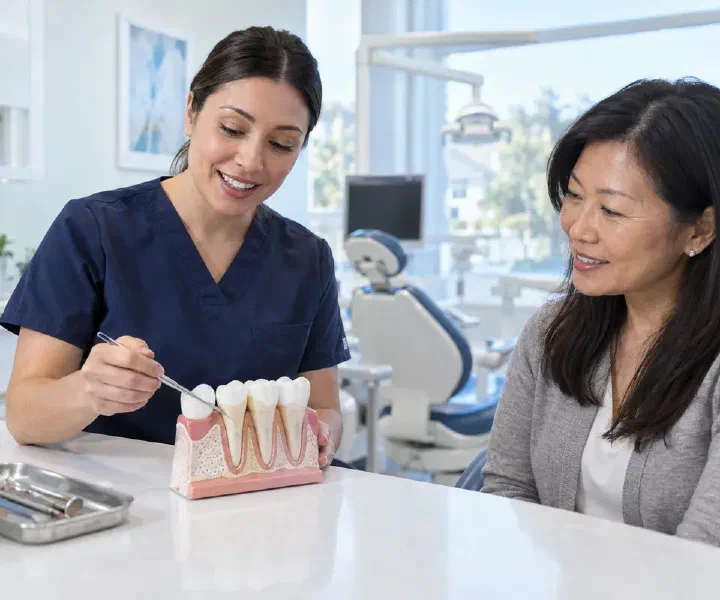
Dental hygienist explaining root-surface cleaning to a patient with a periodontal model

A closer look

Before instruments reach the root surface

The diagnosis establishes both the reason for treatment and its intended extent.

  1. Map the affected sites

    Periodontal measurements, bleeding, recession, and appropriate imaging help identify where support has been affected and where deeper deposits may be present. The pattern matters: some patients need localized treatment, while others have more widespread disease. Ask which areas are being treated and what findings led to the recommendation.

  2. Discuss the outlook and the sequence

    The clinician explains whether any teeth have a guarded prognosis and how the appointments will be arranged. Medical history, anxiety, sensitivity, and the amount of treatment influence planning. A staged approach can make care more manageable, but the timing should still support control of the disease and a meaningful reassessment.

Care that fits

What the treatment is intended to do

Access and comfort help the clinician address surfaces that are difficult to maintain while inflamed.

Remove deposits from affected surfaces

Hand and powered instruments may be used to remove deposits above and below the gum line. The approach is selected for the site and anatomy rather than a promise that one instrument is always better. The treatment aims to create conditions that support healing and daily plaque control, not to rebuild all lost bone.

Make the appointment tolerable

Local anaesthetic may be recommended for sensitive or deeper areas, with breaks and communication suited to your needs. Tell the clinician if you are uncomfortable rather than trying to tolerate sharp pain. The plan can be adjusted to support thorough care while respecting your comfort and ability to manage the appointment.

Practical guidance

The days between treatment and review

Home care supports healing and gives the review a fair picture of the response.

Clean the treated areas as instructed

Tender tissues may need a gentle technique, but abandoning plaque control can allow inflammation to persist. Ask for a demonstration of the brush and interdental aids that fit your spaces. If discomfort prevents cleaning, contact the team so the method or timing can be adjusted instead of repeatedly avoiding the same area.

Expect the appearance to change

As swollen tissue becomes less inflamed, the gum margin may look different and spaces between teeth can become more noticeable. Exposed roots may be sensitive. These changes should be discussed beforehand, and persistent or severe symptoms deserve review rather than being assumed to be an unavoidable part of successful treatment.

What we consider

What we measure at reassessment

The response helps separate a stable result from a site that still needs attention.

Inflammation and pocket measurements

The clinician rechecks bleeding, pocket depths, and other relevant findings after an appropriate healing interval. Improvement is evaluated against the baseline rather than judged only by how clean the teeth feel. A site that remains inflamed may need a review of deposit removal, home access, root anatomy, or another local factor.

Practical maintenance and remaining risk

We assess whether you can keep the treated areas clean and whether smoking, diabetes, or other factors need further attention. Persistent deep sites may warrant additional treatment or referral. The maintenance interval is then chosen around the disease history and current findings instead of automatically returning every patient to a standard cleaning schedule.

Understanding the options

How this differs from other gum-care visits

Related services have different purposes even when some instruments are similar.

Routine cleaning and periodontal maintenance

A routine cleaning supports prevention in an appropriate clinical setting, while periodontal maintenance follows a history of treated periodontal disease. Scaling and root planing specifically addresses affected sites as part of active therapy. The name of the appointment should reflect the diagnosis and work needed, not simply its length or intensity.

Periodontal surgery and adjunctive treatments

Surgery may be considered when a site remains difficult to treat or maintain after initial care. Antibiotics, lasers, or other adjuncts are not automatic additions or replacements for diagnosis and deposit removal. If another intervention is proposed, ask what problem it addresses and what benefit is expected for your particular site.

Frequently asked questions

Questions about scaling and root planing

Is scaling and root planing the same as deep cleaning?

Deep cleaning is a common informal name for this nonsurgical periodontal treatment. The important distinction is why it is needed, which sites are affected, and how the response will be reviewed rather than the label alone.

Will I need local anaesthetic?

It may be recommended depending on sensitivity, pocket depth, and the extent of treatment. Comfort planning is individualized, and you should let the clinician know if the procedure becomes painful so the approach can be adjusted.

Does the treatment replace bone that has been lost?

No. Its main purpose is to remove deposits and help control inflammation. Some selected periodontal defects may have other treatment options, but routine scaling and root planing does not promise regeneration of lost supporting bone.

Why might treatment be divided into several visits?

The amount and distribution of disease, comfort needs, medical considerations, and available treatment time can affect the sequence. The clinician should explain the planned areas and how the visits connect to the later reassessment.

Are antibiotics always part of scaling and root planing?

No. They are not a routine substitute for mechanical treatment and daily plaque control. Any recommendation for an antimicrobial should be based on the clinical situation and include an explanation of its purpose and limitations.

What if some pockets remain deep after treatment?

Residual sites are assessed individually. Further nonsurgical care, improved cleaning access, or a periodontal referral may be appropriate. A measurement alone does not decide the next procedure; inflammation, anatomy, prognosis, and maintainability also matter.

How do I maintain the result?

Follow the daily cleaning plan and attend the recommended periodontal maintenance visits. Report renewed bleeding, swelling, or changes in tooth stability. The schedule and tools can be revised as your gum condition and practical needs change.

Real patient results

Before & after smile gallery.

Drag the centre line to compare each real case treated by our dental team. Every smile begins with a personal assessment and a plan shaped around the patient.

Areas We Serve

Neighbourhood dental care, close to home.

Located in Cookstown, Innisfil, our dental team welcomes patients from communities across South Simcoe, Barrie, and northern York Region.

Get directions
  • Cookstown
  • Innisfil
  • Simcoe
  • Lake Simcoe
  • Alcona
  • Stroud
  • Lefroy–Belle Ewart
  • Gilford
  • Churchill
  • Sandy Cove
  • Innisfil Heights
  • Fennell’s Corners
  • Bradford
  • Bradford West Gwillimbury
  • Bond Head
  • Newton Robinson
  • New Tecumseth
  • Alliston
  • Beeton
  • Tottenham
  • Adjala–Tosorontio
  • Everett
  • Loretto
  • Barrie
  • Essa
  • Thornton
  • Baxter
  • Angus
  • Egbert
  • Ivy
  • Utopia
  • York Region
  • East Gwillimbury
  • Queensville
  • Holland Landing
  • Sharon
  • Schomberg
  • Nobleton

Don’t see your community listed? Contact us—we regularly welcome patients from throughout the surrounding region.

Google reviews

Kind words from our patients.

Read what patients have shared about their visits to Cookstown Dental Centre.

A dentist having a friendly consultation with a patient in a bright dental clinic

Your next step

Ready to feel good about your next dental visit?

Whether you are new to the clinic or returning for care, our team is here to make booking simple and answer your questions.

Call Book Now WhatsApp

How can we help?

The Cookstown Dental team is here for you.

Need an appointment, have a question, or want to talk through your options? Choose the next step that works best for you.

Send us a note

We’ll get back to you as soon as we can.