Cookstown Dental Centre
The Cookstown Dental Centre team caring for a patient in a treatment room

Restorative Dentistry · Cookstown

Reassess a previously treated tooth before deciding on retreatment.

Root canal retreatment investigates persistent or returning disease in a treated tooth. Explore access through old restorations, alternatives, and the final reseal.

Request an appointment

Let’s find a time that works.

Need urgent dental help? Call (705) 291-2222.

Root Canal Retreatment in Cookstown

A new symptom does not explain by itself why earlier treatment needs attention.

A tooth that has already had root canal treatment may later develop symptoms or findings that need reassessment. Possible reasons include persistent or new infection, previously untreated anatomy, or a problem with the restoration’s seal. Other issues, such as a crack or a bite problem, can produce symptoms that do not necessarily call for retreatment.

At Cookstown Dental Centre, the first step is to clarify the diagnosis and whether the tooth remains restorable. Previous records, current examination, and indicated imaging help with that review. Retreatment may involve removing old canal filling material and treating the canal system again, but the access, complexity, and prognosis vary. The discussion should include specialist care where appropriate, alternatives, and the restoration needed after the internal treatment is complete.


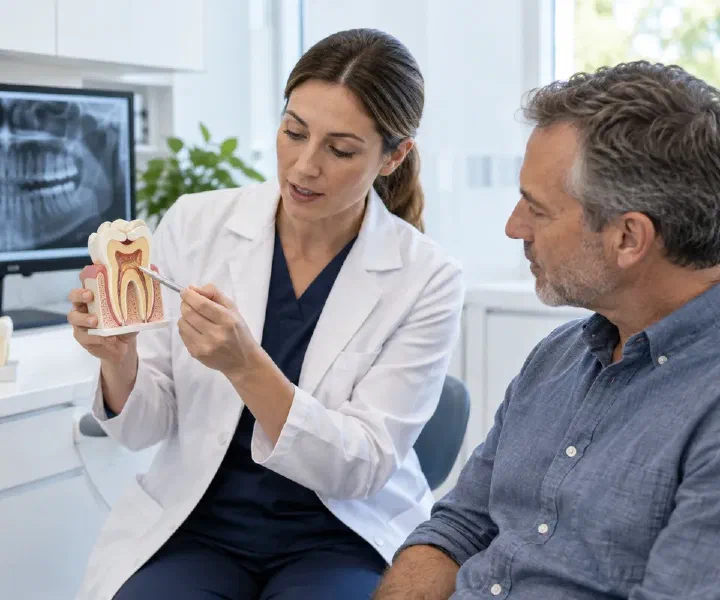
A dentist reviewing records of a previously root-treated tooth with a patient

What we consider

Investigate the reason the tooth is being reconsidered.

Symptoms, images, and structural findings need to be interpreted together.

Persistent or returning disease

A lesion or symptoms may indicate an endodontic problem that needs further evaluation. Previous images and the timing of treatment can help interpret the situation. A single image or period of discomfort should not be used in isolation to assume the same cause in every previously treated tooth.

Canal anatomy and the existing filling

Missed or complex anatomy, limitations of previous treatment, and other internal factors may affect the options. The clinician assesses access and feasibility, sometimes with additional imaging or specialist input. The purpose is to identify a reasonable treatment route rather than simply repeat the original procedure without a diagnosis.

The crown, tooth, and surrounding support

A leaking restoration, decay, crack, or periodontal problem can change the prognosis. These findings may need treatment alongside or instead of retreatment. The tooth must be considered as a restorable structure, not only as a canal system that could technically be entered again.

Good to know

Understand how an existing restoration affects access.

Crowns, cores, and posts can influence the sequence and complexity.

Access through or after removing a restoration

The provider considers whether the canals can be reached through an existing crown or whether removal is more appropriate. The condition and fit of the restoration matter. Discuss the chance that it may need repair or replacement, including any temporary protection during the retreatment process.

Posts and difficult internal obstructions

An existing post or other obstruction can make access more complex and introduce additional risks. Specialist assessment may be recommended. The clinician should explain the reason and likely sequence before attempting access, rather than assume every old component can be removed without affecting the tooth.

Understanding the options

Review the available ways to manage the diagnosis.

The appropriate choice depends on access, structural condition, and expected benefit.

Nonsurgical retreatment

When suitable, the canals are accessed again, existing material is managed, and the system is cleaned and treated. The aim is to address the identified endodontic problem while retaining the tooth. The expected outlook and limitations should be discussed for the particular anatomy and condition.

Other treatment or monitoring when appropriate

Endodontic surgery, extraction, or observation in selected circumstances may be considered according to the diagnosis. These are not interchangeable shortcuts. Ask what question each option addresses and how the tooth’s structure, support, symptoms, and previous records influence the recommendation.

Step by step

Coordinate retreatment with protection and final restoration.

The tooth needs a defined plan before, during, and after canal care.

  1. Establish the diagnosis and provider roles

    Review the findings, alternatives, and any specialist recommendation. Bring original records and details of previous symptoms if available. Clarify who manages access, temporary protection, the final restoration, and follow-up so a shared-care plan remains coherent across appointments.

  2. Carry out the indicated retreatment sequence

    The clinician uses appropriate anaesthesia, isolation, and techniques for the case. Multiple visits or interim medication within the tooth may be considered when indicated. Follow instructions for the temporary restoration and contact the provider about a lost seal, a fracture, or worsening symptoms between visits.

  3. Restore the seal and review healing

    The final restorative work is completed according to the tooth’s needs, followed by the recommended monitoring. Healing is assessed with clinical findings and images when indicated. A comfortable tooth still needs a suitable restoration and follow-up, while persistent symptoms deserve review rather than indefinite reassurance without reassessment.

Practical guidance

Prepare for a decision based on prognosis, not certainty.

Retreatment aims to preserve a useful tooth but cannot promise every outcome.

Ask about the factors specific to your tooth

The provider should explain the influence of cracks, remaining structure, anatomy, previous procedures, and support. This helps you compare further preservation efforts with alternatives. A general success statement does not replace an individualized discussion of what is favourable or uncertain in the current case.

Report significant changes while care is arranged

A tooth awaiting retreatment may have a leaking restoration or an unresolved source of symptoms. Report new drainage, increasing pain, swelling, or a broken temporary instead of waiting for the booked consultation. Protect the tooth from hard chewing. Rapidly spreading swelling or difficulty breathing or swallowing requires emergency care before the planned dental visit.

Frequently asked questions

Questions about root canal retreatment

Why might a tooth need another root canal procedure?

Persistent or new infection, untreated anatomy, or a problem with the restoration’s seal can be among the reasons. Other conditions can mimic those symptoms. A new assessment establishes whether retreatment is appropriate rather than assuming every painful treated tooth needs it.

Does retreatment mean the original treatment was careless?

Not necessarily. Complex anatomy, healing, new decay, restoration changes, and other factors can affect a tooth over time. The review should focus on the current diagnosis and options, with previous records helping clarify the history rather than assigning blame without evidence.

Will the crown have to be removed?

It depends on the crown’s condition, fit, and access requirements. Some cases may allow access through it; others need removal or replacement. The provider should discuss these possibilities and temporary protection before treatment begins.

Can a post make retreatment impossible?

A post can increase complexity, but it does not automatically rule out further treatment. Its design, position, and the remaining tooth affect feasibility and risk. An endodontist may be recommended to assess access and compare retreatment with other options.

Is surgery the same as retreatment?

Nonsurgical retreatment and endodontic surgery approach the problem differently. Their suitability depends on the diagnosis, anatomy, and access. The clinician explains why one may be preferred and what it is intended to achieve for the particular tooth.

How will we know whether it has worked?

Follow-up considers symptoms, clinical findings, and appropriate images over time. Healing is not judged only by immediate comfort. The provider should explain the review plan and what findings would lead to further assessment or a change in treatment.

What if the tooth cannot be restored afterward?

Restorability should be assessed before treatment as far as possible. If the tooth has an unsuitable prognosis, alternatives need discussion. Unexpected findings can still change the plan, and the clinician should explain their significance and the available next steps.

Real patient results

Before & after smile gallery.

Drag the centre line to compare each real case treated by our dental team. Every smile begins with a personal assessment and a plan shaped around the patient.

Areas We Serve

Neighbourhood dental care, close to home.

Located in Cookstown, Innisfil, our dental team welcomes patients from communities across South Simcoe, Barrie, and northern York Region.

Get directions
  • Cookstown
  • Innisfil
  • Simcoe
  • Lake Simcoe
  • Alcona
  • Stroud
  • Lefroy–Belle Ewart
  • Gilford
  • Churchill
  • Sandy Cove
  • Innisfil Heights
  • Fennell’s Corners
  • Bradford
  • Bradford West Gwillimbury
  • Bond Head
  • Newton Robinson
  • New Tecumseth
  • Alliston
  • Beeton
  • Tottenham
  • Adjala–Tosorontio
  • Everett
  • Loretto
  • Barrie
  • Essa
  • Thornton
  • Baxter
  • Angus
  • Egbert
  • Ivy
  • Utopia
  • York Region
  • East Gwillimbury
  • Queensville
  • Holland Landing
  • Sharon
  • Schomberg
  • Nobleton

Don’t see your community listed? Contact us—we regularly welcome patients from throughout the surrounding region.

Google reviews

Kind words from our patients.

Read what patients have shared about their visits to Cookstown Dental Centre.

A dentist having a friendly consultation with a patient in a bright dental clinic

Your next step

Ready to feel good about your next dental visit?

Whether you are new to the clinic or returning for care, our team is here to make booking simple and answer your questions.

Call Book Now WhatsApp

How can we help?

The Cookstown Dental team is here for you.

Need an appointment, have a question, or want to talk through your options? Choose the next step that works best for you.

Send us a note

We’ll get back to you as soon as we can.