Cookstown Dental Centre
The Cookstown Dental Centre team caring for a patient in a treatment room

Restorative Dentistry · Cookstown

Complete root canal care with the protection the tooth needs.

A crown after root canal treatment is planned around remaining tooth structure, bite, and sealing needs. Explore timing, foundations, and alternatives to full coverage.

Request an appointment

Let’s find a time that works.

Need urgent dental help? Call (705) 291-2222.

Root Canal Crown Restoration in Cookstown

Treating the canals and restoring the tooth are connected stages.

Root canal treatment addresses disease within the tooth, but the remaining tooth still needs an appropriate final restoration. A crown may be recommended when substantial structure has been lost or when weakened surfaces need protection. It is not an automatic requirement for every root-treated tooth: location, remaining walls, existing damage, and biting demands influence the choice.

At Cookstown Dental Centre, we assess the tooth and coordinate the final restoration with the endodontic treatment. If another provider completed the root canal, relevant records help clarify the status and follow-up needs. The plan should explain whether a core, post, onlay, crown, or another restoration is appropriate, and what temporary protection is needed until completion. A tooth that no longer hurts can still be vulnerable if this stage is left unfinished.


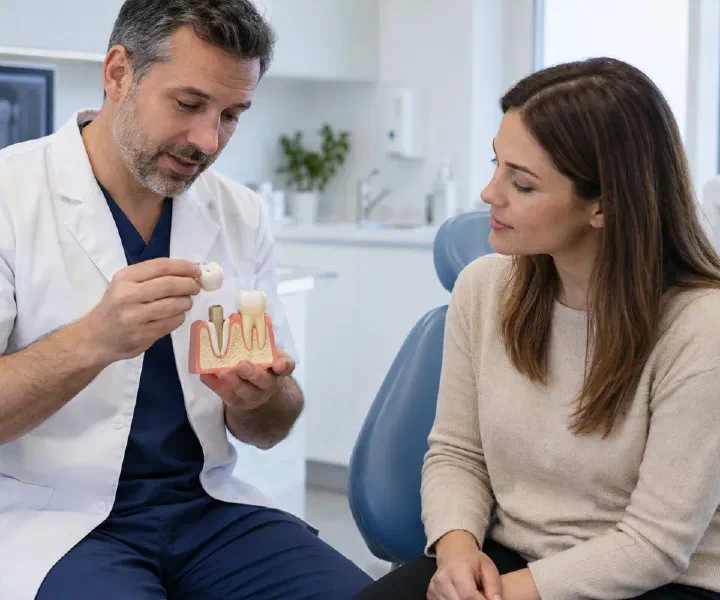
A dentist showing the final crown restoration of a root-treated tooth on a model

What we consider

Choose protection according to the structure that remains.

The root canal history is only one part of the restorative assessment.

Tooth position and functional demands

Front teeth, premolars, and molars experience different patterns of use. The dentist considers contacts, available space, and the tooth’s role in the bite. A recommendation for coverage should relate to those demands and the defect, rather than rely on a rule that all treated teeth need identical crowns.

Remaining walls, cusps, and cracks

Large old fillings, missing cusps, and suspected cracks can influence the type and extent of protection. The clinician assesses whether the tooth can support a useful restoration. Root canal treatment does not heal a structural crack or make every severely damaged tooth suitable for a final crown.

The seal and endodontic status

The current temporary or filling, available treatment records, symptoms, and relevant images are reviewed. An unresolved concern may need coordination with the treating clinician before definitive work. The final restoration should be planned with a clear understanding of the tooth’s condition and any ongoing healing review.

Understanding the options

Discuss full coverage alongside other suitable designs.

The amount of restoration should match the clinical need.

A crown for broader protection

A crown covers the prepared tooth and may be appropriate when substantial walls or cusps need protection. The dentist explains the preparation, material, and expected sequence. It still requires a suitable foundation and ongoing care; coverage is not a guarantee against future decay, fracture, or endodontic problems.

An onlay or direct restoration where appropriate

Selected teeth may be restored with more limited coverage or a direct filling when the remaining structure supports that choice. These options have their own indications and limits. Ask why one design is recommended and what structural finding would make a different approach preferable.

Good to know

Understand whether the tooth needs a core or post.

The foundation is planned to retain the final restoration, not as an automatic extra.

A core to rebuild missing structure

A core restores the foundation needed for the planned crown or other restoration. Its form depends on how much tooth remains and where it is located. The clinician should distinguish the core from the final crown so the full treatment sequence and purpose of each stage are clear.

A post only when retention requires it

In selected root-treated teeth, a post may help retain the core. It does not automatically strengthen the root and is not necessary in every case. The dentist considers the root, remaining structure, and possible future treatment needs before deciding whether its benefits justify the preparation.

The appointment

Move from temporary protection to a checked final restoration.

Timing should be agreed rather than left dependent on whether the tooth hurts.

  1. Review the completed canal treatment and plan

    Bring relevant records if the root canal was performed elsewhere. The dentist assesses the tooth and discusses the restoration, appearance goals, and any uncertainty. If further endodontic review is needed, clarify how interim protection and appointments will be coordinated.

  2. Prepare the foundation and restorative records

    The planned core and preparation are completed as appropriate, with impressions or scans, bite records, and shade information for the restoration. A temporary may protect the tooth during fabrication. Follow its care instructions and report detachment or a break rather than waiting until the fitting appointment.

  3. Fit the restoration and verify the bite

    The clinician checks fit, margins, contacts, appearance, and function before completion. You receive cleaning and use instructions and any follow-up recommendations. A high bite or persistent discomfort should prompt review; it is not something to correct by chewing harder until the crown feels different.

Practical guidance

Keep the restored tooth within your preventive routine.

The tooth remains part of the natural mouth even after its pulp has been treated.

Clean the margins and report structural changes

Brush and clean between teeth using a method that reaches the crown or restoration margins. A root-treated tooth can still develop decay. Report movement, a chip, food trapping, or swelling even without cold sensitivity, because not every future problem will produce familiar temperature symptoms.

Follow both restorative and healing reviews

The final crown and the root canal result may need different types of follow-up. Clarify which provider monitors each aspect when care is shared. If a protective appliance is recommended for relevant loading factors, its fit should be checked against the new restoration and maintained as instructed.

Frequently asked questions

Questions about root canal crown restoration

Does every root canal tooth need a crown?

No. The remaining structure, tooth position, bite, and existing damage guide the decision. Many weakened back teeth need coverage, while some teeth may be suitable for another restoration. The dentist should explain the finding behind the recommendation.

Why is a final restoration needed if the pain is gone?

Relief of symptoms does not restore missing walls or ensure that temporary protection will last. The tooth still needs an appropriate seal and functional restoration. Follow the agreed completion plan rather than using comfort alone to decide whether further care is necessary.

How long can I wait before getting the crown?

Timing depends on the tooth and treatment plan. Discuss practical constraints with the dentist and follow the advised schedule. Leaving a vulnerable tooth under temporary protection indefinitely can expose it to problems even when it currently feels comfortable.

Will I need a post as well?

Only selected teeth need a post to help retain a core. It is not a routine requirement after root canal treatment and does not automatically strengthen the root. The amount of remaining tooth and the final restoration determine whether it is useful.

Can another dentist make the crown after specialist treatment?

Yes, care is often coordinated between providers. Relevant treatment records and any recommendations help with planning. Clarify who completes the restoration and who reviews endodontic healing so the transition does not leave either part of care unclear.

Can the tooth decay under a crown after a root canal?

The remaining natural tooth can still develop decay, particularly around restoration margins. Cleaning and regular reviews remain important. The absence of a vital pulp does not protect the tooth from decay or make every problem painful at an early stage.

What if the crown feels high after fitting?

Contact the clinic for assessment rather than trying to wear it down. The bite may need adjustment, and symptoms should be described clearly. Persistent discomfort deserves review even if both the root canal and crown procedures have been completed.

Real patient results

Before & after smile gallery.

Drag the centre line to compare each real case treated by our dental team. Every smile begins with a personal assessment and a plan shaped around the patient.

Areas We Serve

Neighbourhood dental care, close to home.

Located in Cookstown, Innisfil, our dental team welcomes patients from communities across South Simcoe, Barrie, and northern York Region.

Get directions
  • Cookstown
  • Innisfil
  • Simcoe
  • Lake Simcoe
  • Alcona
  • Stroud
  • Lefroy–Belle Ewart
  • Gilford
  • Churchill
  • Sandy Cove
  • Innisfil Heights
  • Fennell’s Corners
  • Bradford
  • Bradford West Gwillimbury
  • Bond Head
  • Newton Robinson
  • New Tecumseth
  • Alliston
  • Beeton
  • Tottenham
  • Adjala–Tosorontio
  • Everett
  • Loretto
  • Barrie
  • Essa
  • Thornton
  • Baxter
  • Angus
  • Egbert
  • Ivy
  • Utopia
  • York Region
  • East Gwillimbury
  • Queensville
  • Holland Landing
  • Sharon
  • Schomberg
  • Nobleton

Don’t see your community listed? Contact us—we regularly welcome patients from throughout the surrounding region.

Google reviews

Kind words from our patients.

Read what patients have shared about their visits to Cookstown Dental Centre.

A dentist having a friendly consultation with a patient in a bright dental clinic

Your next step

Ready to feel good about your next dental visit?

Whether you are new to the clinic or returning for care, our team is here to make booking simple and answer your questions.

Call Book Now WhatsApp

How can we help?

The Cookstown Dental team is here for you.

Need an appointment, have a question, or want to talk through your options? Choose the next step that works best for you.

Send us a note

We’ll get back to you as soon as we can.