Cookstown Dental Centre
The Cookstown Dental Centre team caring for a patient in a treatment room

Cosmetic Dentistry · Cookstown

Assess whether resin infiltration suits an intact white spot.

Resin infiltration may soften the contrast of selected white enamel spots. Explore lesion assessment, treatment limits, alternatives, and follow-up care.

Request an appointment

Let’s find a time that works.

Need urgent dental help? Call (705) 291-2222.

Resin Infiltration for White Spots in Cookstown

A white patch needs a diagnosis before a masking treatment.

Some white spots are associated with porous enamel that scatters light differently from the surrounding surface. Resin infiltration uses a low-viscosity resin to enter suitable pores in selected intact lesions. It can reduce the visible contrast in appropriate cases and has a role in managing certain early lesions, but it is not a universal treatment for every white mark or a way to rebuild a cavitated tooth.

At Cookstown Dental Centre, we assess the likely cause, surface condition, activity, and depth of the area before discussing whether infiltration is relevant. The appearance alone cannot establish suitability. Developmental enamel differences and deeper defects may behave differently from an early lesion after plaque accumulation. The plan should separate control of any active disease from the cosmetic goal and explain the possibility of an incomplete colour change.


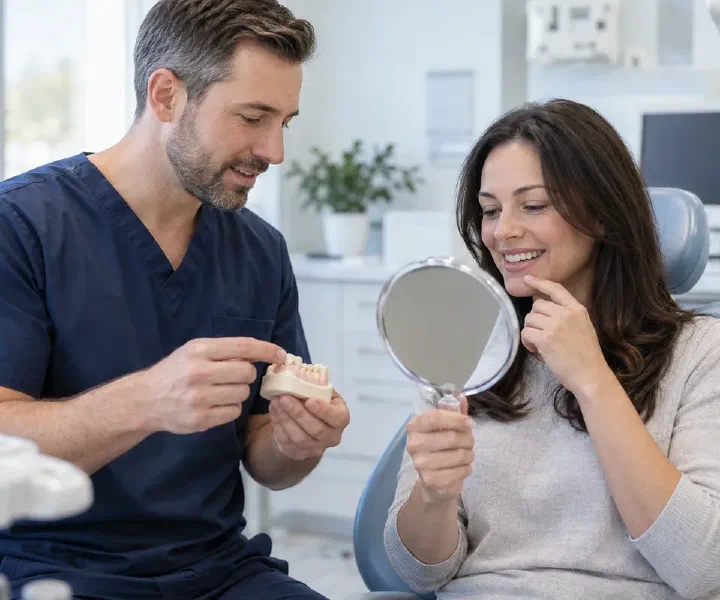
A dentist and patient examining a white enamel spot using a mirror and tooth model

What we consider

Check the lesion, not only its colour.

Several findings influence whether infiltration is a reasonable option or another approach should come first.

Surface integrity and depth

The clinician checks whether the enamel surface is intact and whether there is structural breakdown. Infiltration is not a replacement for a restoration when missing tooth structure needs repair. Deeper or differently formed opacity may not respond like a selected porous surface lesion, even when the visible colour appears similar.

Cause and activity

A spot after orthodontic treatment, a developmental mark, and a newly changing chalky area may have different implications. The dentist considers history and clinical findings rather than assigning one diagnosis to every white patch. Any ongoing decay risk or active process needs management alongside decisions about improving appearance.

Location and practical access

The area must be suitable for the proposed technique and isolation. Existing restorations, tissue condition, and the position of the lesion can affect treatment planning. The clinician explains whether the surface can be managed appropriately and whether another method would offer a more realistic or conservative option.

A closer look

Understand what the procedure is trying to do.

The aim is to influence a selected porous lesion, not to cover every tooth with a new outer layer.

  1. Prepare the selected surface

    The clinician follows the relevant clinical protocol to condition and prepare the area while protecting surrounding tissues. The process is different from simply brushing on a whitening product. Ask what the preparation involves and why it is suitable for the diagnosed lesion before agreeing to treatment.

  2. Allow resin to enter suitable pores

    The infiltration material is intended to penetrate the prepared porosity and alter how the lesion interacts with light. The degree of visible improvement depends on the lesion and technique. An immediate change can occur in suitable cases, but complete disappearance should not be promised from a photograph or product example.

  3. Finish and review the area

    The surface is finished and the result is assessed in context with the surrounding tooth. Follow-up considers appearance, surface condition, and the original risk factors. The treatment does not remove the need for plaque control, fluoride advice where indicated, or monitoring of other areas that may be developing similar changes.

Understanding the options

Place infiltration among the other options.

The least invasive appropriate choice depends on the diagnosis and your goal, including whether cosmetic treatment is needed at all.

Prevention, monitoring, or another conservative approach

Some areas need risk management and observation before a cosmetic decision. Other selected marks may be considered for different surface treatments or colour management. The dentist explains what each option can address and whether waiting provides useful information about activity, stability, or the appearance after routine care.

Restorative treatment for a different defect

A cavitated area, a substantial structural defect, or an opacity unsuitable for infiltration may need another discussion. Bonding or another restoration changes the tooth differently and brings its own maintenance requirements. A more extensive procedure should be justified by the findings and your priorities rather than offered automatically when a white spot remains visible.

Planning together

Set expectations before and after treatment.

A good decision includes the possible limits as well as the hoped-for cosmetic change.

Agree on the target area and degree of improvement

Identify the spots being considered and discuss whether reduced contrast would be a worthwhile result even if a mark remains. Different areas on the same tooth may respond differently. Clinical examples can explain possibilities, but they do not establish an exact outcome for your lesion.

Coordinate any whitening or restoration plans

If you also want a broader shade change, discuss the sequence before treatment. Altering surrounding tooth colour can affect the perceived contrast of a white spot. The clinician should coordinate methods and timing rather than treating infiltration, bleaching, and restoration as interchangeable or independent steps.

Keep prevention in the follow-up plan

If plaque accumulation or decay risk contributed, address those factors with individualized advice. Cosmetic improvement does not prove that every risk has resolved. Continue reviews and report a changing surface, sensitivity, or new marks so monitoring responds to the underlying condition as well as the appearance.

Frequently asked questions

Questions about resin infiltration for white spots

Can resin infiltration remove every white spot?

No. Suitability and response depend on the cause, depth, surface condition, and other findings. Some spots may become less noticeable without disappearing completely. The dentist should explain the likely limits before using examples of successful treatment to set expectations.

Is infiltration the same as a filling?

No. It is intended for selected porous lesions and does not rebuild a cavity with missing structure in the way a restoration does. If the surface has broken down, another treatment may be needed. Diagnosis determines which approach is appropriate.

Can it help white spots after braces?

It may be considered for selected lesions after assessment, but not every post-orthodontic mark has the same condition or depth. Ongoing plaque control and decay-risk management remain important. The clinician distinguishes disease management from the cosmetic goal.

Will the tooth need to be drilled?

The technique differs from conventional cavity preparation, but it still involves professional surface preparation and material application. Ask what is proposed for your lesion. A description such as minimally invasive should not be interpreted as no intervention or no need for assessment.

Should I whiten first or have infiltration first?

The sequence depends on the diagnosis, desired colour change, and treatment plan. Discuss both goals before starting either. The dentist can explain how changing the background shade may affect contrast and how the chosen procedures should be coordinated.

Can developmental enamel spots be treated this way?

Some may be considered, but developmental defects vary and may respond differently from selected early demineralization lesions. An examination is needed to assess likely depth and structure. Infiltration should not be promised solely because the spot is white.

What care is needed afterward?

Follow the clinician’s instructions and continue the preventive plan appropriate to your risk. Reviews can assess surface condition, appearance, and any new lesions. Infiltration does not replace brushing, interdental cleaning, or indicated fluoride and dental follow-up.

Real patient results

Before & after smile gallery.

Drag the centre line to compare each real case treated by our dental team. Every smile begins with a personal assessment and a plan shaped around the patient.

Areas We Serve

Neighbourhood dental care, close to home.

Located in Cookstown, Innisfil, our dental team welcomes patients from communities across South Simcoe, Barrie, and northern York Region.

Get directions
  • Cookstown
  • Innisfil
  • Simcoe
  • Lake Simcoe
  • Alcona
  • Stroud
  • Lefroy–Belle Ewart
  • Gilford
  • Churchill
  • Sandy Cove
  • Innisfil Heights
  • Fennell’s Corners
  • Bradford
  • Bradford West Gwillimbury
  • Bond Head
  • Newton Robinson
  • New Tecumseth
  • Alliston
  • Beeton
  • Tottenham
  • Adjala–Tosorontio
  • Everett
  • Loretto
  • Barrie
  • Essa
  • Thornton
  • Baxter
  • Angus
  • Egbert
  • Ivy
  • Utopia
  • York Region
  • East Gwillimbury
  • Queensville
  • Holland Landing
  • Sharon
  • Schomberg
  • Nobleton

Don’t see your community listed? Contact us—we regularly welcome patients from throughout the surrounding region.

Google reviews

Kind words from our patients.

Read what patients have shared about their visits to Cookstown Dental Centre.

A dentist having a friendly consultation with a patient in a bright dental clinic

Your next step

Ready to feel good about your next dental visit?

Whether you are new to the clinic or returning for care, our team is here to make booking simple and answer your questions.

Call Book Now WhatsApp

How can we help?

The Cookstown Dental team is here for you.

Need an appointment, have a question, or want to talk through your options? Choose the next step that works best for you.

Send us a note

We’ll get back to you as soon as we can.