Cookstown Dental Centre
The Cookstown Dental Centre team caring for a patient in a treatment room

Restorative Dentistry · Cookstown

Plan premolar root canal care around anatomy and remaining tooth structure.

Premolar root canals require diagnosis, attention to variable canal anatomy, and a suitable final restoration. Explore treatment, referral, and follow-up care.

Request an appointment

Let’s find a time that works.

Need urgent dental help? Call (705) 291-2222.

Premolar Root Canals in Cookstown

The tooth between the front and back teeth has its own restorative demands.

Premolars help with chewing and sit between the canine teeth and molars. When the pulp inside a premolar is irreversibly inflamed or infected, root canal treatment may be considered if the tooth can be restored. Their root and canal anatomy varies, so treatment should not be planned on the assumption that every premolar has one simple canal.

At Cookstown Dental Centre, the examination considers the symptoms, pulp and surrounding tissues, existing fillings, possible cracks, and remaining support. The final restoration is part of the discussion from the beginning. A premolar may have limited walls or cusps after decay and previous treatment, and protecting those structures can be as important as addressing the internal disease. We explain the diagnosis, options, and any referral needs before defining the sequence.


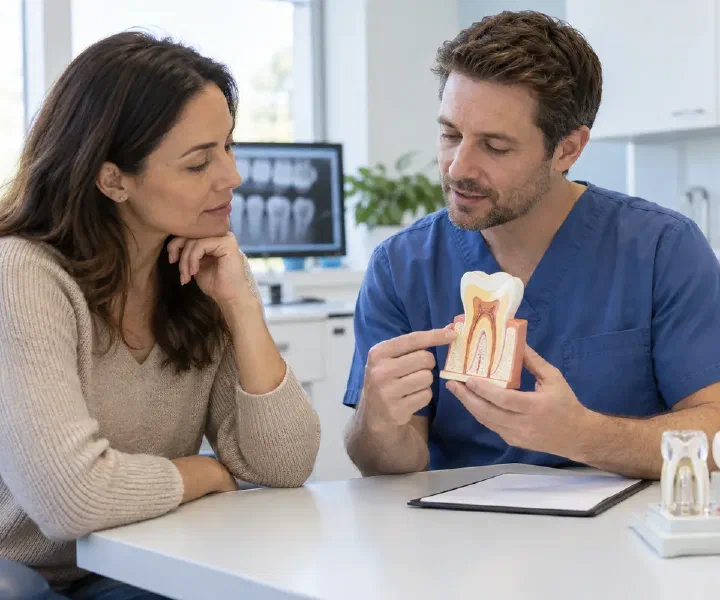
A dentist discussing premolar root canal anatomy using a tooth model

Planning together

Connect the symptoms to a diagnosis before choosing treatment.

Sensitivity or biting discomfort alone does not identify the condition inside the tooth.

Temperature and spontaneous symptoms

Describe what triggers discomfort, how long it lasts, and whether pain occurs without a trigger. Clinical testing and indicated images help interpret that history. A deep restoration can be relevant, but it does not automatically mean the pulp needs treatment or that every symptom comes from that tooth.

Pain during chewing or after a fracture

A cracked cusp, high contact, or other structural problem may produce biting symptoms. The dentist examines these possibilities alongside the pulp. If the tooth is cracked, the extent can affect whether root canal treatment and restoration offer a reasonable preservation option.

What we consider

Assess anatomy, structure, and support together.

The treatment plan should reflect the individual premolar.

Variable canal arrangements

Premolars can have different numbers and shapes of roots and canals. The clinician evaluates the anatomy and any features that increase complexity. Additional imaging or referral may be appropriate when indicated, rather than treating the tooth according to a fixed diagram of what a premolar usually contains.

Remaining cusps and walls

The amount of sound structure affects how the tooth can be restored after canal treatment. A narrow or undermined cusp may need protection. The dentist should explain the structural findings that support a filling, onlay, or crown, instead of choosing the final restoration solely because a root canal was performed.

Periodontal support and tooth position

The gums, bone support, bite, and role of the tooth within the arch influence the overall prognosis. Existing crowding, large restorations, or changes in opposing teeth can matter. Keeping the tooth should be assessed in terms of usable future function as well as technical canal access.

Step by step

Coordinate diagnosis, canal care, and completion.

Treatment may involve several stages and sometimes more than one provider.

  1. Agree on the plan and any specialist role

    The dentist explains the findings, preservation outlook, and alternatives. If an endodontist is recommended, clarify the reason and how records and restorative care will be coordinated. Ask what temporary protection will be used so that referral does not leave the tooth without a clear interim plan.

  2. Treat and seal the canal system

    The procedure uses appropriate anaesthesia, isolation, and clinical techniques to clean and treat the internal spaces. Timing depends on the case. Tell the provider about discomfort or access difficulties during the appointment, and follow the instructions for any temporary restoration between treatment stages.

  3. Restore the tooth for everyday function

    The final restoration is selected according to the remaining structure and loading. Its fit, contacts, and bite are checked, and the recommended completion timing is explained. A comfortable tooth still needs the planned definitive seal and protection rather than an indefinite temporary filling.

Understanding the options

Review the preservation option alongside its limits.

A useful decision includes the work needed beyond the canal procedure.

Retain a suitably restorable premolar

Root canal treatment and an appropriate restoration can be considered when the tooth has a reasonable outlook. The plan includes the endodontic and structural findings, not a guarantee of lifelong service. Ask what uncertainties remain and which follow-up checks are needed to assess the result.

Consider alternatives when preservation is unsuitable

A severe crack, inadequate remaining structure, or other problem may limit restoration. Extraction and appropriate replacement options can then be discussed. The comparison should account for the space, adjacent teeth, function, and future care rather than presenting removal as a decision with no subsequent implications.

Good to know

Look after the tooth during recovery and long-term use.

Instructions depend on the stage and restoration provided.

Protect the tooth while it is temporarily restored

Avoid hard chewing on the treated area until cleared according to the plan. Report a lost temporary, fractured cusp, or bite that feels high. Increasing pain or swelling needs contact; spreading swelling or difficulty swallowing or breathing requires urgent medical attention.

Keep the final restoration under review

Clean the crown or filling margins and attend recommended dental and healing reviews. A root-treated tooth can still decay, fracture, or develop another problem. Report movement or new biting symptoms even if it does not react to cold, because temperature response is no longer a reliable warning for every issue.

Frequently asked questions

Questions about premolar root canals

Do premolars always have one canal?

No. Premolar anatomy varies, and there can be more than one canal or a complex arrangement. The clinician assesses the individual tooth. Imaging and specialist input may be used when indicated rather than relying on a fixed expectation for every premolar.

Can a cracked premolar be saved with a root canal?

Some cracked teeth may be treated and restored, while others have a crack that makes preservation unsuitable. Root canal treatment does not heal the crack itself. The extent, remaining support, and restorability need assessment before deciding on the plan.

Will I need a crown after treatment?

The answer depends on the remaining walls, cusps, bite, and defect. Coverage may be recommended to protect weakened structure, but the exact restoration is individualized. Ask why a crown, onlay, or filling is appropriate for that tooth.

Why might I be referred to an endodontist?

Complex canal anatomy, difficult access, previous treatment, or other findings may make specialist assessment useful. The dentist should explain the reason for referral and coordinate the final restoration so you understand which provider handles each stage.

Can I postpone treatment if the pain stops?

A change in pain does not necessarily mean the underlying condition has resolved. Follow the plan based on the diagnosis, and discuss timing concerns with the provider. Do not use the absence of symptoms alone to decide that assessment or treatment is no longer needed.

How many visits will it take?

The number depends on the tooth, infection or inflammation, anatomy, and restorative sequence. Canal treatment and the final crown or other restoration may involve separate visits. The provider can outline the expected stages after assessment rather than promise one schedule for every case.

What if biting remains uncomfortable afterward?

Contact the clinic, particularly if discomfort is increasing or the bite feels high. Some tenderness can occur after treatment, but persistent symptoms need review. Avoid repeatedly testing the tooth and explain when the pain occurs during ordinary use.

Real patient results

Before & after smile gallery.

Drag the centre line to compare each real case treated by our dental team. Every smile begins with a personal assessment and a plan shaped around the patient.

Areas We Serve

Neighbourhood dental care, close to home.

Located in Cookstown, Innisfil, our dental team welcomes patients from communities across South Simcoe, Barrie, and northern York Region.

Get directions
  • Cookstown
  • Innisfil
  • Simcoe
  • Lake Simcoe
  • Alcona
  • Stroud
  • Lefroy–Belle Ewart
  • Gilford
  • Churchill
  • Sandy Cove
  • Innisfil Heights
  • Fennell’s Corners
  • Bradford
  • Bradford West Gwillimbury
  • Bond Head
  • Newton Robinson
  • New Tecumseth
  • Alliston
  • Beeton
  • Tottenham
  • Adjala–Tosorontio
  • Everett
  • Loretto
  • Barrie
  • Essa
  • Thornton
  • Baxter
  • Angus
  • Egbert
  • Ivy
  • Utopia
  • York Region
  • East Gwillimbury
  • Queensville
  • Holland Landing
  • Sharon
  • Schomberg
  • Nobleton

Don’t see your community listed? Contact us—we regularly welcome patients from throughout the surrounding region.

Google reviews

Kind words from our patients.

Read what patients have shared about their visits to Cookstown Dental Centre.

A dentist having a friendly consultation with a patient in a bright dental clinic

Your next step

Ready to feel good about your next dental visit?

Whether you are new to the clinic or returning for care, our team is here to make booking simple and answer your questions.

Call Book Now WhatsApp

How can we help?

The Cookstown Dental team is here for you.

Need an appointment, have a question, or want to talk through your options? Choose the next step that works best for you.

Send us a note

We’ll get back to you as soon as we can.