Cookstown Dental Centre
The Cookstown Dental Centre team caring for a patient in a treatment room

Specialized Care · Cookstown

Consider oral appliance therapy within a complete sleep-care plan.

Oral appliance therapy for snoring or sleep apnea needs appropriate diagnosis and coordination. Compare its role, dental requirements, treatment limits, and review.

Request an appointment

Let’s find a time that works.

Need urgent dental help? Call (705) 291-2222.

Oral Appliance Therapy in Cookstown

The device is one part of therapy; diagnosis and effectiveness monitoring are equally important.

In sleep-related care, oral appliance therapy refers to using a prescribed dental device to help manage selected breathing conditions during sleep. Many appliances position the lower jaw according to an individualized plan. The term can also be used broadly for other dental devices, so the intended purpose should be made explicit: a grinding guard and an appliance for obstructive sleep apnea are not interchangeable.

A consultation at Cookstown Dental Centre can help clarify the dental assessment and the available treatment or referral pathway. Sleep-apnea diagnosis and medical treatment decisions require the appropriate sleep clinician. The discussion should compare feasible options, assess the mouth’s ability to support a device, and plan how response will be measured. A comfortable appliance or reduced snoring does not by itself demonstrate that sleep apnea is adequately controlled.

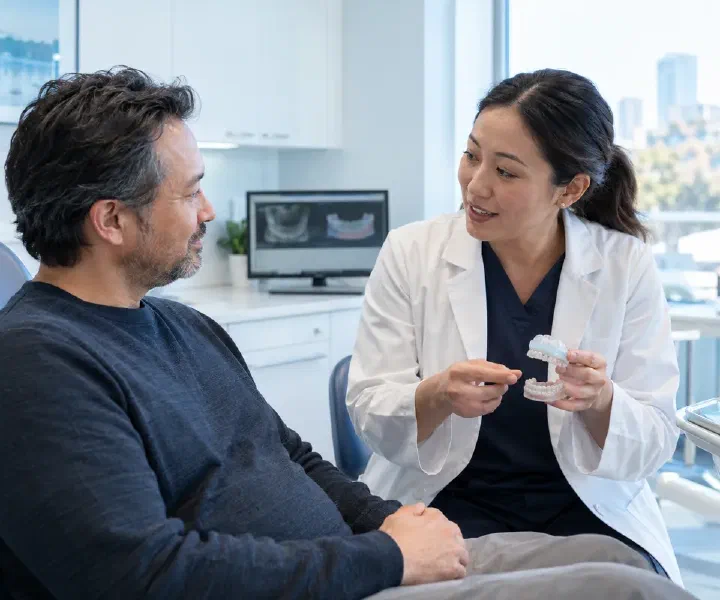
A dentist and patient discussing a custom sleep appliance and coordinated care

Understanding the options

Place appliance therapy alongside the other appropriate sleep treatments.

The choice depends on the diagnosis and circumstances, not only convenience.

A prescribed oral appliance for a suitable patient

An appliance may be considered for selected adults according to medical recommendations, preferences, and treatment needs. Dental suitability is then assessed separately. The plan should explain the expected role and limitations rather than promise that a small removable device provides the right answer for every severity or type of sleep disorder.

Other medical therapies and coordinated alternatives

Positive airway pressure and other approaches may be recommended by the sleep clinician according to the condition. Difficulty with an existing treatment should be discussed rather than managed by stopping it independently. An appliance consultation can form part of that discussion without replacing medical advice or assuming all alternatives are equally effective for every patient.

Planning together

Clarify the diagnosis and provider responsibilities first.

A clear pathway avoids fitting a device before its purpose is established.

Medical assessment and relevant sleep records

Bring available sleep-study results, treatment recommendations, and information about current therapy. If sleep apnea has not been assessed, screening symptoms may lead to medical referral. Snoring alone does not establish primary snoring or exclude obstructive sleep apnea, so the diagnostic step should not be skipped.

Dental assessment and confirmed service arrangements

The dentist evaluates teeth, gums, restorations, movement, and practical handling needs. Confirm who provides fabrication, fitting, adjustment, and follow-up and whether referral is needed. The service title should not be taken as proof that every stage or device is available without a suitability and provider discussion.

What we consider

Assess the factors that influence everyday use.

The device must work within the mouth as well as the sleep-treatment plan.

Retention and oral health

Sound supporting teeth, periodontal condition, restoration stability, and the proposed design influence suitability. Some dental problems need care before records or fitting. An appliance should not be used to bypass treatment of a compromised foundation or assumed compatible with every existing denture, implant, or restoration arrangement.

Jaw comfort and potential side effects

Tooth pressure, muscle or joint symptoms, salivation changes, and bite changes may need monitoring. Baseline findings help interpret later concerns. The provider should explain how side effects are managed and when use or settings need review rather than present custom fabrication as a guarantee of trouble-free adaptation.

Consistency, handling, and maintenance

Practical use involves insertion, removal, cleaning, travel, and follow-up access. Discuss barriers before choosing treatment. A plan that looks convenient in theory can fail to meet its purpose if the device is not usable or if problems with fit and comfort cannot be addressed promptly.

The appointment

Connect fabrication with supervised adjustment and effectiveness assessment.

Therapy is not complete when the appliance is collected.

  1. Record and fit the prescribed design

    The dental provider takes the needed records and checks the completed device in the mouth. Instructions cover handling, wear, and cleaning. Any adjustment mechanism is explained according to the prescribed plan, rather than left for the patient to advance by trial and error.

  2. Review tolerance and the agreed settings

    Follow-up addresses comfort, fit, symptoms, and practical use. Adjustments are made or directed within the treatment plan. More advancement is not automatically better, and pain or a persistent bite change should prompt review instead of simply increasing the setting to chase quieter snoring.

  3. Confirm the medical response

    The sleep clinician arranges appropriate follow-up assessment or testing to evaluate effectiveness. The results may lead to further adjustment or another treatment choice. Subjective improvement is useful information but should not replace objective evaluation when assessing control of obstructive sleep apnea.

Practical guidance

Plan for changes, repairs, and long-term oversight.

The mouth and sleep condition can change after initial success.

Keep both dental and medical reviews

The dental team monitors oral effects and device condition while medical care assesses the sleep disorder. Update both providers about new restorations, health changes, symptoms, or reduced use. A previously effective device may need reassessment rather than assuming the original setting remains appropriate indefinitely.

Manage interruptions through the treating team

A broken or poorly fitting appliance should not be glued, heated, or reshaped at home. Contact the provider and ask how to manage treatment while it is unavailable. Do not substitute a sports guard, ordinary nightguard, or unprescribed device for a medically coordinated sleep-apnea plan.

Frequently asked questions

Questions about oral appliance therapy

What does oral appliance therapy mean on this page?

It refers to a prescribed device used within care for selected sleep-related breathing conditions. Other dental appliances have different purposes. A standard grinding guard or sports mouthguard should not be assumed equivalent to an appliance prescribed for obstructive sleep apnea.

Can I choose it without a sleep assessment?

Suspected sleep apnea requires appropriate medical evaluation, and primary snoring should not be assumed without considering it. The dental examination assesses oral suitability. Diagnosis and treatment selection need the relevant clinical pathway before fabrication is treated as the next step.

Is it always as effective as CPAP?

Effectiveness varies by condition and patient, and equivalence should not be promised. The sleep clinician compares appropriate options and monitors response. Do not stop an existing prescribed therapy independently because an oral device appears more convenient.

How is treatment success checked?

Symptoms and use are reviewed, and appropriate follow-up sleep testing or medical assessment evaluates effectiveness. Less snoring or a comfortable fit alone does not establish control of sleep apnea. The dental and medical reviews answer complementary questions.

Can the appliance cause dental changes?

Tooth, jaw, and bite effects are possible and should be monitored. Report pain, persistent changes, or difficulty seating the device. Regular dental oversight helps identify issues and guide appropriate adjustment, repair, or a revised plan.

Will I need ongoing appointments after fitting?

Yes, appropriate follow-up is part of therapy. Early visits address fit and adjustment, while ongoing dental and medical reviews assess side effects and the sleep condition. The interval and scope follow the prescribed plan and current findings.

What if the appliance breaks while I am travelling?

Contact the treating provider for advice and a repair pathway. Do not use household glue or substitute another device without guidance. Ask how the interruption should be managed within the medical treatment plan, especially if the appliance is your prescribed sleep-apnea therapy.

Real patient results

Before & after smile gallery.

Drag the centre line to compare each real case treated by our dental team. Every smile begins with a personal assessment and a plan shaped around the patient.

Areas We Serve

Neighbourhood dental care, close to home.

Located in Cookstown, Innisfil, our dental team welcomes patients from communities across South Simcoe, Barrie, and northern York Region.

Get directions
  • Cookstown
  • Innisfil
  • Simcoe
  • Lake Simcoe
  • Alcona
  • Stroud
  • Lefroy–Belle Ewart
  • Gilford
  • Churchill
  • Sandy Cove
  • Innisfil Heights
  • Fennell’s Corners
  • Bradford
  • Bradford West Gwillimbury
  • Bond Head
  • Newton Robinson
  • New Tecumseth
  • Alliston
  • Beeton
  • Tottenham
  • Adjala–Tosorontio
  • Everett
  • Loretto
  • Barrie
  • Essa
  • Thornton
  • Baxter
  • Angus
  • Egbert
  • Ivy
  • Utopia
  • York Region
  • East Gwillimbury
  • Queensville
  • Holland Landing
  • Sharon
  • Schomberg
  • Nobleton

Don’t see your community listed? Contact us—we regularly welcome patients from throughout the surrounding region.

Google reviews

Kind words from our patients.

Read what patients have shared about their visits to Cookstown Dental Centre.

A dentist having a friendly consultation with a patient in a bright dental clinic

Your next step

Ready to feel good about your next dental visit?

Whether you are new to the clinic or returning for care, our team is here to make booking simple and answer your questions.

Call Book Now WhatsApp

How can we help?

The Cookstown Dental team is here for you.

Need an appointment, have a question, or want to talk through your options? Choose the next step that works best for you.

Send us a note

We’ll get back to you as soon as we can.