Cookstown Dental Centre
The Cookstown Dental Centre team caring for a patient in a treatment room

Specialized Care · Cookstown

Investigate morning jaw pain before assuming sleep grinding is the only cause.

Morning jaw discomfort can involve muscles, joints, teeth, or sleep-related factors. Review the pattern, appliance use, conservative care, and medical coordination.

Request an appointment

Let’s find a time that works.

Need urgent dental help? Call (705) 291-2222.

Morning Jaw Pain Treatment in Cookstown

Waking with a sore jaw is useful history, but it is not a diagnosis by itself.

Morning jaw pain may feel like stiffness, tired chewing muscles, tenderness near the joints, or discomfort in particular teeth. Sleep-related clenching or grinding can be relevant, but other dental, joint, muscle, and sleep-related concerns may contribute. An existing appliance can also need review if symptoms began or changed after it was introduced.

At Cookstown Dental Centre, we ask how the discomfort changes after waking, whether chewing or opening is affected, and what other symptoms occur. The examination helps distinguish a tooth problem from a muscle or joint pattern and identify when medical sleep assessment may be useful. Treatment should address the supported findings rather than automatically prescribe a guard or promise that changing the bite will resolve every morning symptom.


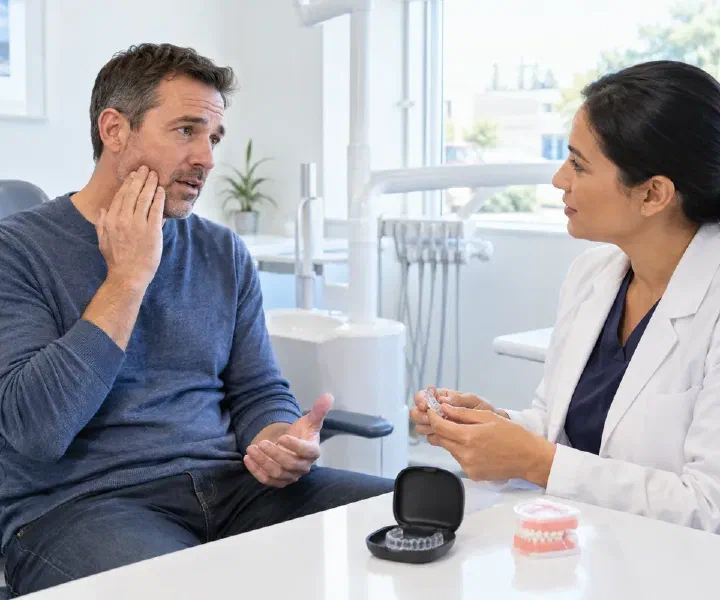
A patient discussing morning jaw stiffness with a dentist

Planning together

Describe what happens from waking through the rest of the day.

The daily pattern can help direct the assessment.

Stiffness, aching, and changes with movement

Explain whether symptoms settle quickly, persist through meals, or worsen with jaw use. Mention restricted opening, catching, or a new bite sensation. Do not force the jaw through painful movement to test it; observations from ordinary activities are more useful than repeatedly provoking the discomfort.

Tooth symptoms and existing devices

Tell the dentist about a particular tooth that hurts, recent restorative work, or a guard or sleep appliance you use. Bring the device to the visit. A morning symptom may involve fit or tooth loading, so it should not be attributed to grinding without checking the mouth and appliance.

Understanding the options

Match the response to the identified concern.

Protection, symptom management, and medical treatment have different roles.

Conservative care for a supported jaw pattern

Guidance may address aggravating habits, comfortable function, or appropriate therapy, with a review point. If an appliance is considered, the intended benefit and evidence limits should be clear. It should not be presented as guaranteed relief for every morning ache or as proof that the bite caused the symptoms.

Specific dental care or coordinated sleep assessment

A cracked tooth, unsuitable restoration, or appliance problem may need focused treatment. Sleep symptoms may require a medical pathway alongside dental care. These steps should be coordinated rather than substituting a dental device for treatment already prescribed by a sleep clinician.

Practical guidance

Avoid self-directed changes that can add another problem.

A cautious interim approach protects the teeth and joints while the cause is clarified.

Do not alter the bite or appliance yourself

Filing a tooth, heating a guard, or advancing a sleep appliance beyond its instructions can cause harm. If a device causes pain or a persistent bite change, contact its provider for review. The appropriate next step depends on the device’s purpose and the treatment plan it belongs to.

Use only the recommended symptom measures

Ask about suitable short-term comfort measures in light of your health and medicines. Avoid aggressive stretching or manipulation, and do not add sedatives or other medication to suppress nighttime symptoms without professional guidance. A morning pattern does not make self-medication a substitute for assessment.

Step by step

Review the response rather than assume one visit settles the cause.

The plan should include a practical way to judge progress.

  1. Establish a baseline and specific goals

    The provider records relevant findings and discusses what improvement would mean, such as easier opening or less discomfort during breakfast. A brief symptom record may help when requested. The goal should be tied to function and the diagnosis rather than a promise to eliminate every sensation immediately.

  2. Check the effect of the agreed measures

    At follow-up, review comfort, tooth findings, appliance fit, and any medical assessment. If symptoms persist or change, the explanation may need revision. Repeating the same intervention without reconsidering the cause is less useful than a clear reassessment of what has and has not responded.

  3. Report a new acute pattern promptly

    Significant swelling, fever, sudden locking, or symptoms after injury need timely attention. Jaw pain with chest symptoms or breathlessness, new neurological signs, or breathing or swallowing difficulty requires emergency medical care. An established morning-pain history should not explain away a different urgent presentation.

Frequently asked questions

Questions about morning jaw pain treatment

Does waking with jaw pain prove that I grind my teeth?

No. Grinding can be relevant, but dental, muscle, joint, appliance, and sleep-related factors may also contribute. The history and examination help distinguish them. Morning timing alone is not enough to establish one cause or select the same treatment for everyone.

Should I buy a nightguard before being assessed?

An assessment can establish whether a guard is appropriate and identify tooth or sleep concerns that need different care. A device should have a defined purpose and suitable fit. It should not be used to delay evaluation of significant pain or restricted opening.

Could my existing guard be contributing?

Its fit, contacts, condition, or suitability may need review, especially if symptoms began after use or dental work changed the teeth. Bring it to the appointment. Do not heat, trim, or force it into place, and report pain or a persistent bite change.

Is morning jaw pain a sign of sleep apnea?

It does not diagnose sleep apnea. Snoring, witnessed breathing pauses, and daytime sleepiness may justify medical sleep assessment, and should be mentioned. Dental screening and a standard guard do not replace the appropriate diagnostic testing and treatment plan.

Will adjusting my bite stop the pain?

A symptom that peaks on waking does not identify a bite defect that needs grinding down. Assessment should first consider muscles, joints, teeth, appliance use, and sleep history. Any proposal to remove tooth structure needs a specific dental indication rather than a promise to cure morning soreness.

Can I stretch the stiffness out forcefully?

Do not force painful or restricted movement. Any exercises should follow assessment and individualized guidance. A sudden change in opening or locking may need a different response, and aggressive self-manipulation can aggravate symptoms.

What if the pain continues despite the initial plan?

Arrange the recommended review and describe what changed or did not improve. The diagnosis, appliance, and other contributing factors may need reassessment or referral. Persistent symptoms should not automatically lead to more invasive dental treatment without a supported reason.

Real patient results

Before & after smile gallery.

Drag the centre line to compare each real case treated by our dental team. Every smile begins with a personal assessment and a plan shaped around the patient.

Areas We Serve

Neighbourhood dental care, close to home.

Located in Cookstown, Innisfil, our dental team welcomes patients from communities across South Simcoe, Barrie, and northern York Region.

Get directions
  • Cookstown
  • Innisfil
  • Simcoe
  • Lake Simcoe
  • Alcona
  • Stroud
  • Lefroy–Belle Ewart
  • Gilford
  • Churchill
  • Sandy Cove
  • Innisfil Heights
  • Fennell’s Corners
  • Bradford
  • Bradford West Gwillimbury
  • Bond Head
  • Newton Robinson
  • New Tecumseth
  • Alliston
  • Beeton
  • Tottenham
  • Adjala–Tosorontio
  • Everett
  • Loretto
  • Barrie
  • Essa
  • Thornton
  • Baxter
  • Angus
  • Egbert
  • Ivy
  • Utopia
  • York Region
  • East Gwillimbury
  • Queensville
  • Holland Landing
  • Sharon
  • Schomberg
  • Nobleton

Don’t see your community listed? Contact us—we regularly welcome patients from throughout the surrounding region.

Google reviews

Kind words from our patients.

Read what patients have shared about their visits to Cookstown Dental Centre.

A dentist having a friendly consultation with a patient in a bright dental clinic

Your next step

Ready to feel good about your next dental visit?

Whether you are new to the clinic or returning for care, our team is here to make booking simple and answer your questions.

Call Book Now WhatsApp

How can we help?

The Cookstown Dental team is here for you.

Need an appointment, have a question, or want to talk through your options? Choose the next step that works best for you.

Send us a note

We’ll get back to you as soon as we can.