Cookstown Dental Centre
The Cookstown Dental Centre team caring for a patient in a treatment room

Cosmetic Dentistry · Cookstown

Investigate one dark tooth before choosing how to lighten it.

Internal tooth bleaching may lighten selected root-treated teeth from within. Review diagnosis, protective sealing, colour limits, risks, and follow-up.

Request an appointment

Let’s find a time that works.

Need urgent dental help? Call (705) 291-2222.

Internal Tooth Bleaching in Cookstown

A darker tooth is a diagnosis question before a shade decision.

One tooth can look darker than its neighbours after injury, previous treatment, or changes within the tooth. Internal bleaching is considered for selected teeth that have had root canal treatment, using a professionally controlled approach inside the crown portion. It is different from applying whitening gel to the outer surfaces of several teeth, and it is not appropriate for every discoloured tooth.

At Cookstown Dental Centre, we assess the cause of the colour change and the condition of the tooth and existing root treatment before discussing options. An endodontic opinion may be needed. The plan includes the access and seal, expected shade response, risks, and later restoration. The aim is to consider a suitable conservative option without promising that a tooth can always be made to match perfectly.


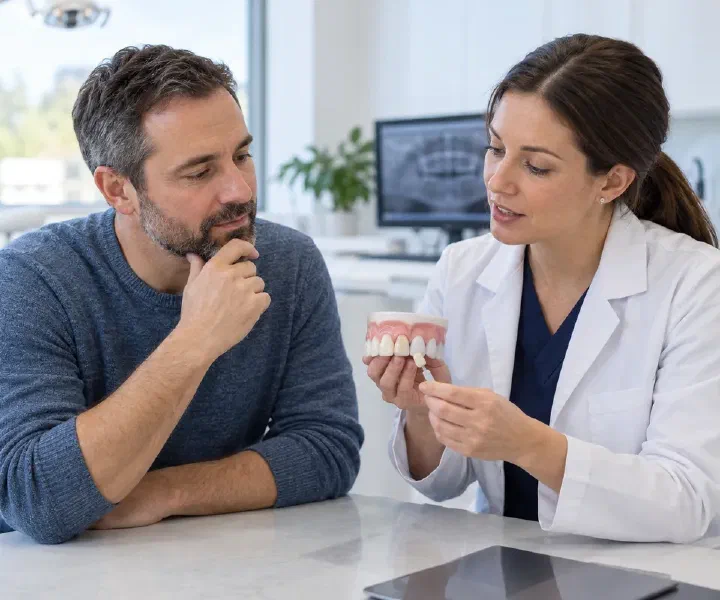
A dentist discussing a single dark tooth with a patient using a tooth model and shade tab

Good to know

Establish why the tooth is darker.

Colour alone does not reveal the condition of the pulp, root, or restoration. Share the history before deciding that bleaching is the next step.

Previous injury or treatment

Tell us about a past knock, root canal, large filling, or previous bleaching attempt. Mention pain, swelling, or a gum bump even if the tooth is currently comfortable. Those details help identify whether the colour concern is accompanied by a condition that requires different care first.

The root-treated tooth

The quality and condition of existing root treatment and the surrounding tissues need assessment. Imaging may be appropriate when it helps answer the clinical question. A darker appearance does not establish that the root treatment is healthy or that it should automatically be repeated; the findings guide that decision.

The structure and restoration

Cracks, leakage, decay, or extensive loss of tooth structure may change the options. The dentist examines whether the tooth can be suitably sealed and restored. Lightening colour cannot rebuild missing structure or resolve a restoration problem that needs attention independently.

Understanding the options

Match the method to the source of the colour.

A single dark tooth may need a different approach from general shade change. We compare the options and their implications before treatment is selected.

Internal and external bleaching

Internal bleaching addresses suitable discoloration from within a root-treated tooth under professional care. External whitening works on the outer surfaces of natural teeth. The dentist explains which source of colour is being targeted and why one method or a carefully planned combination may be considered.

Masking or replacing a surface

Bonding, a veneer, or a crown may be discussed when colour or structure makes bleaching unsuitable or incomplete. These options involve their own preparation and maintenance. The comparison should include the remaining tooth and future care rather than treating a brighter appearance as the only measure of success.

The appointment

A controlled sequence with checks between stages.

The technique and number of visits depend on the tooth. This is a clinician-managed procedure, not a home whitening method to carry out inside a tooth.

  1. Assess and protect

    The clinician confirms suitability, reviews the root filling and seal, and discusses consent and risks. A protective barrier and appropriate access are part of the planned technique. Ask whether specialist care is recommended and what must be confirmed before bleaching material is considered.

  2. Review the colour response

    The selected treatment is applied and monitored according to the clinical plan. The response may vary, and repeated assessment can be needed rather than one fixed treatment duration. Keep appointments and report symptoms or a lost temporary seal; do not reopen the tooth or add a whitening product yourself.

  3. Seal and restore appropriately

    When the planned treatment stage is complete, the tooth needs suitable closure and restoration. The clinician explains timing, shade review, and any further protection required. A cosmetic colour change should not leave the access, restoration, or follow-up unresolved once the tooth looks lighter.

Planning together

Include the risks and limits in your decision.

Understanding uncertainty is part of deciding whether internal bleaching is worthwhile. The clinician can explain how the individual tooth affects the balance.

An imperfect or changing match

The tooth may not reach exactly the same shade as its neighbours, and colour can change again later. Discuss what degree of improvement would be acceptable and what options remain if the result is incomplete. A natural match is a goal, not a guaranteed response to a fixed number of visits.

Tooth and root considerations

Internal bleaching has procedure-specific risks, including a risk of cervical root resorption, which involves loss of tooth structure near the neck of the root. The dentist explains relevant factors and protective measures. That discussion is especially important when the tooth has a history of trauma or other complications.

Ongoing review

Keep the follow-up plan even if the tooth is comfortable and looks improved. Report new pain, swelling, a gum change, or a loose restoration. Maintenance concerns the health and seal of the treated tooth as well as the colour, and further assessment may be needed if something changes.

Frequently asked questions

Questions about internal tooth bleaching

Does every dark tooth need root canal treatment before whitening?

No. The cause and health of the tooth must be assessed first. Root canal treatment should not be assumed necessary simply because a tooth is darker. Internal bleaching is considered in selected root-treated teeth after an appropriate diagnosis.

How is internal bleaching different from whitening trays?

It is a professionally managed treatment inside the crown portion of a suitable root-treated tooth. Trays apply a product externally. The methods address different circumstances, and a home tray product should never be placed inside an opened tooth.

Will it perfectly match the neighbouring teeth?

An exact match cannot be guaranteed. The cause of discoloration, materials already present, and the response to treatment affect the result. Discuss an acceptable degree of improvement and alternatives if the tooth remains noticeably different.

Is the treatment risk-free?

No. Relevant risks include colour relapse and cervical root resorption, among other tooth-specific considerations. The clinician reviews the history, protective measures, and alternatives before recommending treatment. An apparently simple colour change still needs informed consent.

Can I do the internal part at home?

No. Access, protective sealing, material placement, and review require professional management. Do not open a tooth, remove a temporary filling, or place bleach inside it. Contact the treating provider if a seal comes out or instructions are unclear.

Will I need a new restoration afterward?

The access must be appropriately sealed and the tooth’s restorative needs addressed. The exact plan depends on its condition and existing work. Ask about the full sequence and costs rather than considering bleaching separately from the restoration.

When is specialist assessment useful?

An endodontic opinion may be appropriate when the diagnosis, previous root treatment, injury history, or tooth condition needs specialist evaluation. The dentist explains what question the referral is intended to answer before the cosmetic treatment plan is finalized.

Real patient results

Before & after smile gallery.

Drag the centre line to compare each real case treated by our dental team. Every smile begins with a personal assessment and a plan shaped around the patient.

Areas We Serve

Neighbourhood dental care, close to home.

Located in Cookstown, Innisfil, our dental team welcomes patients from communities across South Simcoe, Barrie, and northern York Region.

Get directions
  • Cookstown
  • Innisfil
  • Simcoe
  • Lake Simcoe
  • Alcona
  • Stroud
  • Lefroy–Belle Ewart
  • Gilford
  • Churchill
  • Sandy Cove
  • Innisfil Heights
  • Fennell’s Corners
  • Bradford
  • Bradford West Gwillimbury
  • Bond Head
  • Newton Robinson
  • New Tecumseth
  • Alliston
  • Beeton
  • Tottenham
  • Adjala–Tosorontio
  • Everett
  • Loretto
  • Barrie
  • Essa
  • Thornton
  • Baxter
  • Angus
  • Egbert
  • Ivy
  • Utopia
  • York Region
  • East Gwillimbury
  • Queensville
  • Holland Landing
  • Sharon
  • Schomberg
  • Nobleton

Don’t see your community listed? Contact us—we regularly welcome patients from throughout the surrounding region.

Google reviews

Kind words from our patients.

Read what patients have shared about their visits to Cookstown Dental Centre.

A dentist having a friendly consultation with a patient in a bright dental clinic

Your next step

Ready to feel good about your next dental visit?

Whether you are new to the clinic or returning for care, our team is here to make booking simple and answer your questions.

Call Book Now WhatsApp

How can we help?

The Cookstown Dental team is here for you.

Need an appointment, have a question, or want to talk through your options? Choose the next step that works best for you.

Send us a note

We’ll get back to you as soon as we can.