Cookstown Dental Centre
The Cookstown Dental Centre team caring for a patient in a treatment room

Restorative Dentistry · Cookstown

Replace neighbouring teeth with a bridge planned around implant support.

Implant-supported bridges replace several missing teeth with a connected restoration. Explore support planning, cleaning beneath the bridge, and long-term servicing.

Request an appointment

Let’s find a time that works.

Need urgent dental help? Call (705) 291-2222.

Implant-Supported Dental Bridges in Cookstown

The bridge design and implant positions need to be planned together.

An implant-supported dental bridge replaces more than one missing tooth with a connected restoration supported by implants. It does not necessarily require an implant for every missing tooth. The number and position of supports depend on the space, bone, bite, proposed design, and other clinical factors rather than a simple one-to-one formula.

Planning begins with the teeth that need replacing and how the finished bridge should function and be cleaned. At Cookstown Dental Centre, we discuss the condition of neighbouring teeth, the available support, and alternatives before defining the implant sequence. A bridge can provide a fixed replacement in suitable cases, but its feasibility and maintenance needs are individual. The plan should identify the surgical and restorative stages and explain who will provide each part of care.


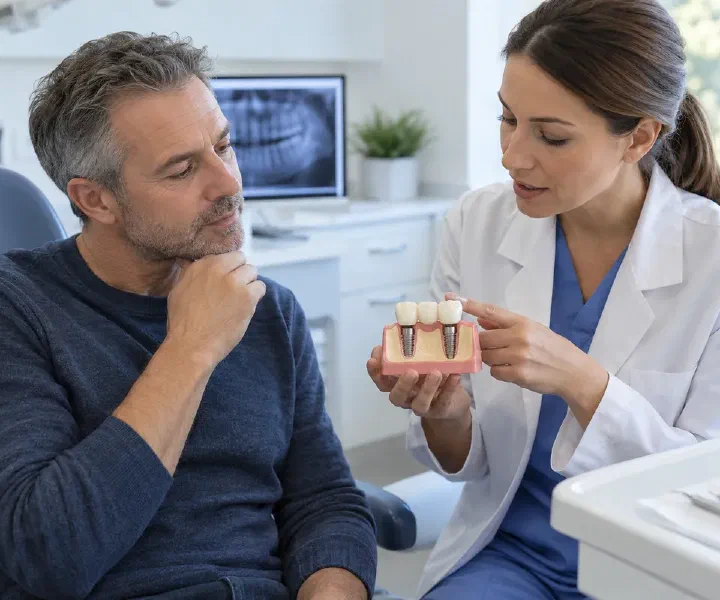
A dentist using an implant-supported bridge model during a patient consultation

What we consider

Map the missing-tooth space before counting implants.

The replacement teeth define the goals; the clinical findings determine the support.

The span and bite relationships

The length of the gap, available space, opposing teeth, and biting forces influence the design. A bridge in one area may have different requirements from another. The provider evaluates these relationships before discussing a specific number of implants or promising a particular restoration arrangement.

Bone and tissue conditions

The ridge must be assessed for the proposed implant positions, with imaging when indicated. Bone or tissue procedures may be part of the discussion if support is insufficient. The final tooth position and cleaning access matter alongside the amount of bone visible on a scan.

Neighbouring natural teeth

An implant-supported bridge can avoid using adjacent teeth as conventional bridge supports in suitable cases. Those teeth still need examination and ongoing care. Their prognosis, existing restorations, and relationship to the gap can influence whether an implant bridge is the most appropriate option.

Understanding the options

Compare the bridge with the alternatives available to you.

The choice should account for surgery, remaining teeth, daily care, and cost.

Implant-supported and tooth-supported fixed options

A conventional bridge relies on prepared natural teeth, while an implant bridge relies on implant support. Each has different requirements and maintenance considerations. The condition of potential supporting teeth and the feasibility of implant surgery help make the comparison meaningful rather than treating one option as universally better.

Separate crowns or a removable replacement

Individual implant crowns may be considered in some spaces, while a removable partial denture offers a different approach. Not every arrangement is suitable in every mouth. Ask how the proposed option affects cleaning, repair, treatment stages, and future changes if another tooth needs attention.

The appointment

Coordinate the surgical and restorative stages.

A fixed result usually follows a sequence of assessment, healing, and verification.

  1. Plan the final bridge and the implant positions

    Clinical records and appropriate imaging guide the proposed support and replacement teeth. Discuss the intended contours, cleaning route, and interim appearance. If several providers are involved, clarify their roles and how information will be shared before the surgical stage begins.

  2. Place the implants and review readiness

    Placement and healing follow the case-specific plan. Grafting or other procedures may change the sequence. An immediate temporary restoration is not automatically part of every bridge case, and elapsed time alone does not determine when the supports are ready for the definitive restoration.

  3. Fit the bridge and check function

    Restorative records guide fabrication, followed by assessment of fit, contacts, appearance, and the connection. The clinician checks the result in the mouth and explains care. Any guard or retainer may need review, and a follow-up plan should be clear when the bridge is completed.

Practical guidance

Plan cleaning underneath as carefully as appearance.

Connected replacement teeth create spaces that need a demonstrated care method.

Reach beneath the bridge

Ask how to clean around the implants and under the connecting tooth surfaces using appropriate tools. The route depends on the design and space. If a recommended method is too difficult, tell the team so the instruction or design can be reviewed rather than leaving deposits inaccessible.

Monitor the tissues and connection

Bleeding, swelling, clicking, movement, or a changed bite need assessment. A bridge can feel comfortable while tissue disease develops, so professional reviews remain important. Do not attempt to open access points, tighten components, or test a loose bridge by chewing on it repeatedly.

Good to know

Understand what future servicing may involve.

A fixed bridge still has materials, connections, and supporting tissues that can change.

Local repair versus a new restoration

A chip or component problem does not always mean every implant must be replaced. The clinician identifies the affected part and assesses repair options. More extensive damage or an unsuitable design may require a new bridge, with the existing implants evaluated separately for continued use.

Records and realistic maintenance planning

Keep information about the implant system and bridge arrangement. Compatible parts and previous records can be helpful if you later move or need a repair. Discuss expected review appointments and possible maintenance costs without relying on a promise that a fixed restoration will never need further treatment.

Frequently asked questions

Questions about implant-supported dental bridges

Does every missing tooth need its own implant?

Not necessarily. An implant-supported bridge can replace several teeth using a planned arrangement of supports. The number and position depend on the span, bone, bite, and design. A clinical assessment is needed before giving a recommendation.

Is an implant bridge removable at home?

A fixed implant bridge stays in place for daily use and cleaning. It may be removed professionally when indicated. Do not try to loosen its connections yourself; ask for a demonstration of cleaning beneath and around the restoration.

Will my neighbouring teeth need crowns?

An implant-supported bridge does not ordinarily rely on neighbouring teeth as its supports. Those teeth may still need treatment for their own conditions. The dentist should separate any recommendation for adjacent teeth from the implant bridge plan.

Can I have the bridge immediately after implant surgery?

Some carefully selected cases may use an early temporary restoration, but this is not appropriate for everyone. Placement, temporary teeth, and definitive loading are separate decisions. Ask for the actual sequence and any backup plan for your case.

How do I clean below connected teeth?

The provider demonstrates tools and techniques suited to the bridge contour and access spaces. There is no single tool that fits every restoration. If you cannot reach an area, explain the difficulty so the routine or design can be reviewed.

What happens if one part of the bridge breaks?

The affected material, connection, and implant support are assessed separately. Some problems may be repairable, while others require replacement of the bridge or additional treatment. Keep detached pieces and contact the clinic rather than using household glue.

Can a bridge be made on implants placed elsewhere?

It may be possible after assessing the implants, support, position, and compatible components. Original records are valuable. The presence of existing implants alone does not establish that they are suitable for the proposed bridge.

Real patient results

Before & after smile gallery.

Drag the centre line to compare each real case treated by our dental team. Every smile begins with a personal assessment and a plan shaped around the patient.

Areas We Serve

Neighbourhood dental care, close to home.

Located in Cookstown, Innisfil, our dental team welcomes patients from communities across South Simcoe, Barrie, and northern York Region.

Get directions
  • Cookstown
  • Innisfil
  • Simcoe
  • Lake Simcoe
  • Alcona
  • Stroud
  • Lefroy–Belle Ewart
  • Gilford
  • Churchill
  • Sandy Cove
  • Innisfil Heights
  • Fennell’s Corners
  • Bradford
  • Bradford West Gwillimbury
  • Bond Head
  • Newton Robinson
  • New Tecumseth
  • Alliston
  • Beeton
  • Tottenham
  • Adjala–Tosorontio
  • Everett
  • Loretto
  • Barrie
  • Essa
  • Thornton
  • Baxter
  • Angus
  • Egbert
  • Ivy
  • Utopia
  • York Region
  • East Gwillimbury
  • Queensville
  • Holland Landing
  • Sharon
  • Schomberg
  • Nobleton

Don’t see your community listed? Contact us—we regularly welcome patients from throughout the surrounding region.

Google reviews

Kind words from our patients.

Read what patients have shared about their visits to Cookstown Dental Centre.

A dentist having a friendly consultation with a patient in a bright dental clinic

Your next step

Ready to feel good about your next dental visit?

Whether you are new to the clinic or returning for care, our team is here to make booking simple and answer your questions.

Call Book Now WhatsApp

How can we help?

The Cookstown Dental team is here for you.

Need an appointment, have a question, or want to talk through your options? Choose the next step that works best for you.

Send us a note

We’ll get back to you as soon as we can.