Cookstown Dental Centre
The Cookstown Dental Centre team caring for a patient in a treatment room

Restorative Dentistry · Cookstown

Give the gums around implants their own care plan.

Bleeding or swelling around an implant deserves attention. Explore tissue monitoring, daily cleaning access, and when implant gum care needs further treatment.

Request an appointment

Let’s find a time that works.

Need urgent dental help? Call (705) 291-2222.

Implant Gum-Care Maintenance in Cookstown

An implant can be cavity-free while the tissues around it need help.

The tissues surrounding a dental implant help form the environment that supports its long-term use. They can become inflamed even though the implant itself cannot develop tooth decay. Bleeding with cleaning, swelling, tenderness, or a change in the gum contour should therefore be discussed rather than accepted as an ordinary part of implant treatment.

Implant gum-care maintenance focuses on those tissues and the factors that affect them. At Cookstown Dental Centre, this includes examining the area, considering previous findings, and reviewing whether you can clean effectively around the restoration. Routine maintenance and treatment for established disease are related but different. If the assessment suggests a problem beyond routine care, the next steps should be explained clearly, including whether additional treatment or referral is appropriate.


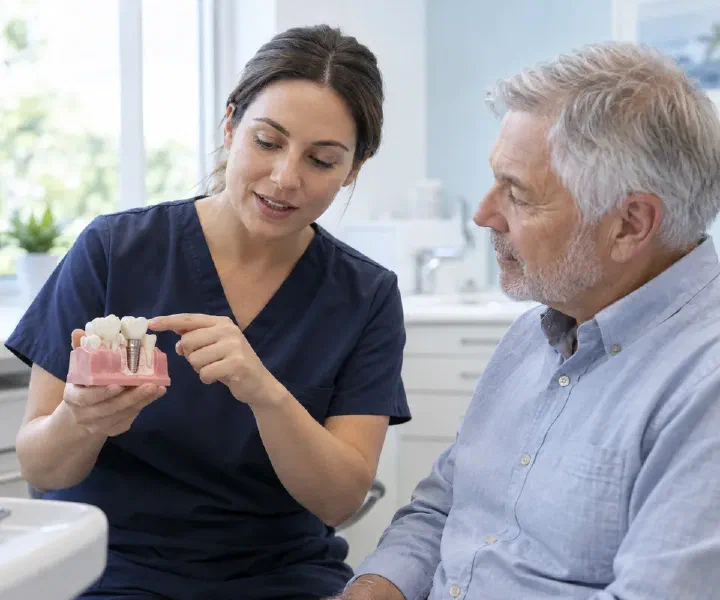
A dental professional explaining healthy gum care around an implant model

Good to know

Understand why the tissue diagnosis matters.

Not every inflammatory finding has the same implications for implant support.

Inflammation around the implant

Peri-implant mucositis describes inflammation in the soft tissues without the progressive supporting bone loss associated with peri-implantitis. An examination is needed to establish the situation. The name should guide care and review, rather than being treated as a diagnosis a patient can make from bleeding alone.

Disease involving supporting bone

Peri-implantitis involves inflammation with progressive loss of supporting bone. It calls for assessment and a treatment plan beyond simply polishing the visible crown. Previous records and appropriate imaging can help interpret changes, and the clinician should explain what is known and what still needs investigation.

What we consider

Look beyond the spot that bleeds.

The assessment combines local findings with your wider care history.

Tissue measurements and previous records

Clinical measurements and appropriate images help establish a useful baseline and identify changes. A single observation is interpreted in context, including the implant’s history. Bring previous records when care has moved between clinics so the provider can compare findings rather than relying only on today’s appearance.

Plaque retention and cleaning access

The contour of the crown, bridge, or denture affects access around the implant. Deposits can accumulate in spaces that are hard to reach. Showing where a brush or interdental tool cannot pass is useful information and may influence the cleaning instructions or restorative assessment.

Health and risk factors

A history of periodontal disease, smoking, medical conditions, and home-care difficulties can influence the plan. Discuss changes honestly so recommendations fit your circumstances. Risk assessment helps set priorities and review intervals; it does not mean that every patient with a risk factor will develop implant disease.

Practical guidance

Make daily tissue care specific to the restoration.

The most useful instruction is one you can perform around your own implant.

Demonstrate the route around the gumline

Ask the team to show brushing and interdental cleaning with tools suited to the space. Gentle, effective access matters more than force. If the method causes difficulty or you cannot reach a surface, request an adjustment to the routine rather than repeatedly traumatizing the same area.

Recognize a change that needs review

New bleeding, discharge, swelling, tenderness, or movement should prompt contact. These signs can have different causes, and a painless implant is not automatically healthy. Keep the area clean as instructed, but do not rely on a rinse or more aggressive brushing to diagnose or resolve a persistent problem.

The appointment

Move from assessment to a monitored response.

Care should include a way to check whether the tissues are improving.

  1. Establish the findings and the likely contributors

    The clinician examines the tissues and restoration, reviews relevant history, and obtains additional records when indicated. You should understand whether the recommendation is preventive maintenance, treatment of inflammation, or investigation of a more complex condition. Those categories should not be blurred into one generic cleaning appointment.

  2. Provide the indicated professional care

    Deposit removal, home-care instruction, and other treatment are selected for the diagnosed condition. If support is affected or the case is complex, additional care or referral may be recommended. The purpose and limits of the proposed step should be clear before treatment proceeds.

  3. Reassess rather than assume success

    Follow-up evaluates the tissue response and whether further care is needed. Improved comfort alone does not provide every measurement of health. Review timing depends on the findings, and the plan may change if bleeding, deposits, or other signs remain despite the initial approach.

Planning together

Keep maintenance connected to the rest of your dental care.

The gums, restoration, and remaining natural teeth influence one another’s care needs.

Coordinate records and appointments

If different providers handle surgery, restoration, and hygiene, clarify who monitors the implant tissues and where records are kept. Shared information can help avoid gaps in follow-up. A completed implant crown does not mean that every future concern belongs only to the original surgeon.

Plan around practical barriers

Tell the team about dexterity changes, discomfort, transport difficulties, or cost concerns that affect attendance and cleaning. These details can shape a realistic plan. Maintenance recommendations are more useful when they account for what you can manage consistently and when extra support may be needed.

Frequently asked questions

Questions about implant gum-care maintenance

Is bleeding around an implant normal?

Bleeding should be assessed rather than assumed to be normal. It may indicate inflammation or another local problem. The clinician examines the tissues and cleaning access to determine the cause and whether preventive care or additional treatment is needed.

What is the difference between mucositis and peri-implantitis?

Mucositis involves soft-tissue inflammation, while peri-implantitis includes progressive supporting bone loss with inflammation. The distinction requires professional assessment. Symptoms alone do not reliably show which condition is present or how much treatment may be necessary.

Can implant gum disease happen without pain?

Yes. Lack of pain does not establish that the tissues and supporting bone are healthy. This is one reason ongoing reviews and comparison with previous findings matter, alongside reporting visible changes such as bleeding or swelling.

Will mouthwash fix bleeding around my implant?

A rinse may be recommended for a particular situation, but it does not replace diagnosis, effective cleaning, or treatment when needed. Persistent bleeding should be examined. Do not keep changing products while delaying an assessment of the underlying cause.

Does this visit include tightening a loose crown?

Tissue care and mechanical repair address different findings, although both may be assessed at the same visit. Tell the clinic about movement when booking. A loose component needs identification and appropriate servicing rather than being treated as a gum problem alone.

Can the crown shape affect gum care?

Yes. Contours and access spaces influence how easily deposits can be removed. The provider can assess whether the cleaning method or restoration needs attention. Difficulty reaching an area should be discussed rather than treated as a failure of effort.

Will I need a specialist?

Some conditions can be managed within routine care, while others may benefit from specialist assessment or treatment. The recommendation depends on the diagnosis and complexity. If referral is advised, ask what question or treatment need it is intended to address.

Real patient results

Before & after smile gallery.

Drag the centre line to compare each real case treated by our dental team. Every smile begins with a personal assessment and a plan shaped around the patient.

Areas We Serve

Neighbourhood dental care, close to home.

Located in Cookstown, Innisfil, our dental team welcomes patients from communities across South Simcoe, Barrie, and northern York Region.

Get directions
  • Cookstown
  • Innisfil
  • Simcoe
  • Lake Simcoe
  • Alcona
  • Stroud
  • Lefroy–Belle Ewart
  • Gilford
  • Churchill
  • Sandy Cove
  • Innisfil Heights
  • Fennell’s Corners
  • Bradford
  • Bradford West Gwillimbury
  • Bond Head
  • Newton Robinson
  • New Tecumseth
  • Alliston
  • Beeton
  • Tottenham
  • Adjala–Tosorontio
  • Everett
  • Loretto
  • Barrie
  • Essa
  • Thornton
  • Baxter
  • Angus
  • Egbert
  • Ivy
  • Utopia
  • York Region
  • East Gwillimbury
  • Queensville
  • Holland Landing
  • Sharon
  • Schomberg
  • Nobleton

Don’t see your community listed? Contact us—we regularly welcome patients from throughout the surrounding region.

Google reviews

Kind words from our patients.

Read what patients have shared about their visits to Cookstown Dental Centre.

A dentist having a friendly consultation with a patient in a bright dental clinic

Your next step

Ready to feel good about your next dental visit?

Whether you are new to the clinic or returning for care, our team is here to make booking simple and answer your questions.

Call Book Now WhatsApp

How can we help?

The Cookstown Dental team is here for you.

Need an appointment, have a question, or want to talk through your options? Choose the next step that works best for you.

Send us a note

We’ll get back to you as soon as we can.