Cookstown Dental Centre
The Cookstown Dental Centre team caring for a patient in a treatment room

Restorative Dentistry · Cookstown

Restore denture retention without overlooking the fit.

Worn implant denture attachments can reduce retention. Learn how compatible inserts, denture fit, implant health, and professional adjustment are assessed.

Request an appointment

Let’s find a time that works.

Need urgent dental help? Call (705) 291-2222.

Implant Denture Attachment Replacement in Cookstown

A denture that no longer clicks securely needs more than a tighter insert.

Removable implant dentures use attachments to help hold the appliance in place. Depending on the system, parts within that attachment arrangement can wear and may need professional replacement. Reduced retention can also come from a changed denture fit, damaged components, or difficulty seating the appliance correctly, so the cause needs checking first.

At Cookstown Dental Centre, the assessment considers the denture, attachment system, and implants together. Replacing a compatible insert may be a relatively focused procedure when the remaining parts are sound. In other cases, the denture base or a larger component needs attention. The aim is manageable, reliable retention that suits your ability to insert and remove the appliance, rather than making the denture as tight as possible.


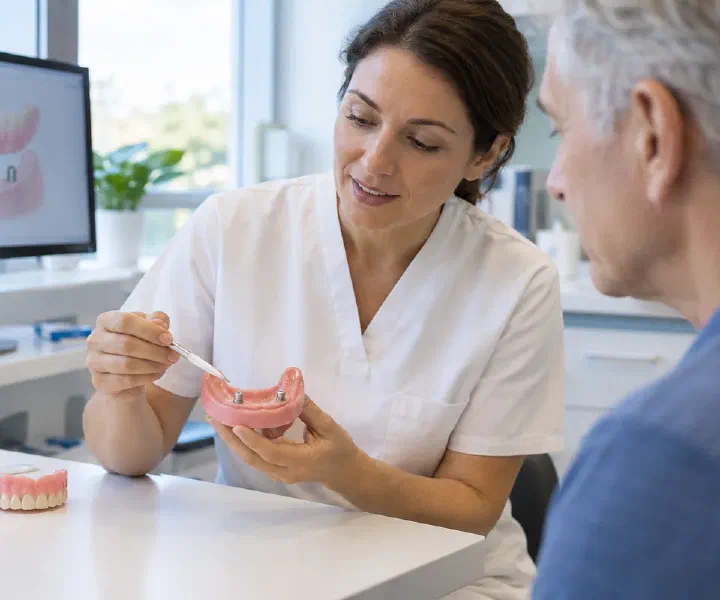
A clinician explaining implant denture attachment components to a patient

Practical guidance

Notice how the denture behaves during ordinary use.

A short description of the change helps direct the appointment.

Retention has gradually faded

An appliance that has become easier to lift out may have worn attachment parts, but that is not the only possibility. Tell the clinician whether the change affects one side or the whole denture. Mention any recent reline, repair, or change in the way it seats.

The denture suddenly will not seat

Do not bite down hard to force an attachment into place. Debris, damage, altered fit, or a component problem may be involved. Bring the appliance and any detached pieces for assessment, and describe whether there was a click, break, or uncomfortable pressure when the difficulty began.

What we consider

Separate attachment wear from a broader problem.

A replacement part should match both the system and the clinical need.

Attachment components

The clinician identifies the system and examines the relevant inserts, housings, and implant-side components. Compatibility matters: similar-looking parts are not necessarily interchangeable. Original records can help, especially if the denture was made elsewhere or a previous repair changed part of the arrangement.

Denture base and bite

A base that rocks or has lost support can place uneven demands on attachments. The dentist evaluates tissue adaptation and contacts as appropriate. New inserts alone may offer limited benefit if the appliance continues to move because its underlying fit or bite needs treatment.

Implants and surrounding tissues

Bleeding, swelling, tenderness, or movement require assessment beyond retention. The attachment should not be tightened to disguise a problem with support. Tissue care, imaging when indicated, or additional implant treatment may be needed before the denture can be considered ready for routine servicing.

Understanding the options

Match the intervention to the worn or altered part.

Some visits involve small components; others require a different scope of work.

Replace serviceable-system retention parts

When the attachment arrangement is sound and the denture fits appropriately, compatible replacement inserts or related parts may restore useful retention. The clinician selects and checks them for the system and your needs. Stronger retention is not automatically better if you cannot remove the denture safely for cleaning.

Correct the denture or larger connection first

A damaged housing, unsuitable base fit, or worn implant-side component may require additional work. The sequence should be explained before parts are changed. Ask which part is responsible for the symptoms and whether a reline, repair, or further assessment is needed alongside attachment maintenance.

The appointment

Check seating and handling after professional replacement.

The appointment should include more than fitting a new part.

  1. Confirm the current arrangement

    Bring implant records and describe past attachment replacements. The clinician checks the appliance and identifies the appropriate components. If availability or compatibility is uncertain, that question needs resolving before a replacement is attempted rather than improvising with a part that appears similar.

  2. Replace and assess the attachment function

    Professional servicing follows the requirements of the identified system. The clinician evaluates seating, retention, and any uneven movement. A new part should not be used to compensate for an unresolved base problem, and the findings may change the proposed treatment during the appointment.

  3. Practise removal and reinsertion

    Demonstrate that you can handle the denture using the recommended technique. Tell the team if your hands, vision, or coordination make the process difficult. The retention and instructions should support daily cleaning and practical use, including caregiver help where appropriate, before you leave with the serviced appliance.

Good to know

Protect the small parts between maintenance visits.

Routine care follows the attachment design and the materials in your appliance.

Clean without altering the components

Ask which tools and cleaning products suit the denture and attachments. Avoid scraping, bending, lubricating, or gluing parts yourself. Residue and damage can affect seating, but aggressive home adjustments can create a different problem and make a professional repair more complicated.

Plan for wear rather than a guaranteed replacement date

Attachment parts do not all wear at the same rate. The system, fit, handling, and function affect maintenance needs. A review schedule can help monitor changes, while a sudden loss of retention should prompt contact sooner instead of waiting for the next routine appointment.

Frequently asked questions

Questions about implant denture attachment replacement

Are attachment inserts supposed to wear?

Some systems use replaceable components that can wear with use. That does not mean every loose denture simply needs a new insert. The denture fit, component condition, and implant health should also be checked before the cause is assumed.

Can I buy replacement inserts and fit them myself?

Professional identification and fitting are important because systems and retention options differ. Incorrect parts or handling can damage the arrangement or make the denture difficult to remove. Contact the clinic rather than attempting a home replacement.

Why is the denture still loose after new attachments?

The base fit, bite, another component, or implant support may also be contributing. An attachment change addresses only the relevant part of the system. Persistent movement needs reassessment instead of progressively stronger inserts without a clear diagnosis.

Should the strongest insert always be used?

No. Retention should suit the design and allow safe daily handling. Excessive resistance may make removal difficult, particularly with reduced hand strength. The clinician checks both security and your ability to insert, remove, and clean the appliance.

Do I need the original implant information?

It can be very helpful for identifying compatible components. Bring an implant card, previous treatment details, or information about the attachment system if available. The team can discuss record transfer when the original treatment was completed elsewhere.

What if a small component comes out at home?

Keep it safely and bring it to the appointment. Avoid using the denture if it cannot be seated or retained safely, and do not glue the component back. Contact the clinic for instructions tailored to the situation.

How often will attachments need replacement?

There is no single schedule for every patient or system. Wear, fit, and handling affect the interval. Ongoing reviews can identify changes, but a new difficulty with retention or seating should be assessed when it occurs.

Real patient results

Before & after smile gallery.

Drag the centre line to compare each real case treated by our dental team. Every smile begins with a personal assessment and a plan shaped around the patient.

Areas We Serve

Neighbourhood dental care, close to home.

Located in Cookstown, Innisfil, our dental team welcomes patients from communities across South Simcoe, Barrie, and northern York Region.

Get directions
  • Cookstown
  • Innisfil
  • Simcoe
  • Lake Simcoe
  • Alcona
  • Stroud
  • Lefroy–Belle Ewart
  • Gilford
  • Churchill
  • Sandy Cove
  • Innisfil Heights
  • Fennell’s Corners
  • Bradford
  • Bradford West Gwillimbury
  • Bond Head
  • Newton Robinson
  • New Tecumseth
  • Alliston
  • Beeton
  • Tottenham
  • Adjala–Tosorontio
  • Everett
  • Loretto
  • Barrie
  • Essa
  • Thornton
  • Baxter
  • Angus
  • Egbert
  • Ivy
  • Utopia
  • York Region
  • East Gwillimbury
  • Queensville
  • Holland Landing
  • Sharon
  • Schomberg
  • Nobleton

Don’t see your community listed? Contact us—we regularly welcome patients from throughout the surrounding region.

Google reviews

Kind words from our patients.

Read what patients have shared about their visits to Cookstown Dental Centre.

A dentist having a friendly consultation with a patient in a bright dental clinic

Your next step

Ready to feel good about your next dental visit?

Whether you are new to the clinic or returning for care, our team is here to make booking simple and answer your questions.

Call Book Now WhatsApp

How can we help?

The Cookstown Dental team is here for you.

Need an appointment, have a question, or want to talk through your options? Choose the next step that works best for you.

Send us a note

We’ll get back to you as soon as we can.