Cookstown Dental Centre
The Cookstown Dental Centre team caring for a patient in a treatment room

Restorative Dentistry · Cookstown

Assess the implant supports before replacing the bridge they carry.

Implant bridge replacement reviews the prosthesis, connections, tissues, and existing implant positions. Compare repair, new design, compatibility, and care.

Request an appointment

Let’s find a time that works.

Need urgent dental help? Call (705) 291-2222.

Implant Bridge Replacement in Cookstown

A new bridge may reuse suitable implants, but their condition must be established first.

An implant-supported bridge can need replacement because of extensive wear, fracture, unsuitable contours, or a change in function or appearance. The implants beneath it may remain useful, or there may be tissue or support problems that change the plan. Replacing the visible bridge and replacing the implants are separate decisions.

At Cookstown Dental Centre, we assess the prosthesis, connecting components, surrounding tissues, and available records before discussing a new design. Existing implant positions can limit what the replacement can achieve. A new bridge should improve identified problems while remaining compatible and cleanable. The proposal should also explain removal, temporary function, and any uncertainty about older systems or findings hidden beneath the current restoration.


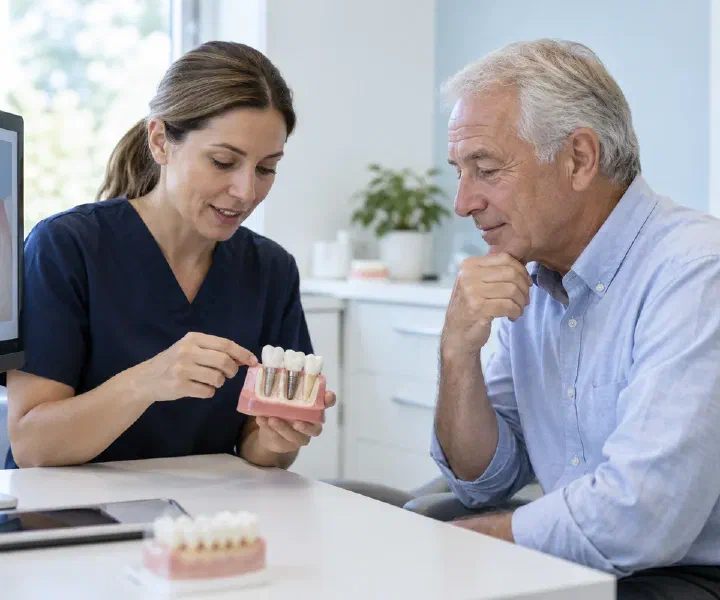
A dentist and older patient examining an implant-supported bridge model

What we consider

Determine which part of the system needs replacement.

The visible bridge is only one component of the implant restoration.

The prosthesis and its material

The clinician examines wear, chips, fractures, fit, and the condition of the framework. A localized defect may still be repairable, while broader damage can justify replacement. The reason should be explained rather than treating every cosmetic change or small chip as evidence that the entire bridge must be remade.

The implants and surrounding tissues

Relevant clinical findings and records help assess tissue health and support. A sound-looking bridge can coexist with inflammation or other concerns. Those problems need an appropriate plan; a new prosthesis alone does not treat every disease process affecting the implants beneath it.

Connections and component identification

The implant system, abutments, screws, and other relevant parts may need identification before removal or fabrication. Bring available records. Compatibility should be established professionally rather than guessed from the appearance of the visible teeth or assumed across different implant brands and designs.

Understanding the options

Compare repair with a new prosthesis on suitable supports.

The extent of damage and the goals determine whether replacement offers a meaningful benefit.

Repairing a serviceable bridge

A limited material or component problem may be managed without remaking the whole restoration when appropriate. The clinician explains the durability, appearance, and limitations of the repair. Preserving the bridge is sensible only if the remaining design, support, and cleaning access remain suitable.

Replacing the bridge while retaining suitable implants

A new prosthesis may address broader wear, damage, or design concerns when the implants can continue to support it. Their existing positions constrain the options. The plan should explain what can realistically improve and whether additional treatment is needed before the same supports are reused.

Planning together

Clarify the removal and interim arrangements.

The procedure should not leave appearance and function between stages unplanned.

How the current bridge is retained

Screw-retained and cemented designs can involve different removal considerations. The clinician assesses access and whether the old bridge can be preserved. Intact removal should not be guaranteed, especially when the system is unfamiliar or the restoration is damaged.

Temporary function and the complete estimate

Discuss what can be used while the replacement is made and any restrictions needed. Ask which components, records, laboratory work, and reviews are included. A fee for a new bridge may not automatically cover treatment of tissue disease or replacement of incompatible or damaged connecting parts.

A closer look

Design the replacement around the actual implant arrangement.

A remake is an opportunity to review function and maintenance within the available limits.

  1. Contours and hygiene access

    The underside and spaces around the bridge should allow a practical cleaning method. Explain which areas were difficult to reach with the old design. The clinician evaluates whether a revised contour can help rather than assuming a new material alone will resolve a maintenance problem.

  2. Bite, materials, and appearance

    The opposing arch and loading influence design and material choices. Shade and tooth form matter, but they must fit the support and space available. Discuss the intended benefit and any compromise caused by existing implant positions instead of expecting an unrestricted redesign.

  3. Future servicing and records

    The connection design should support an appropriate maintenance and repair plan. Ask how the bridge would be assessed or removed if a component problem occurs later. Keep updated records so future care is not dependent on identifying the system again from incomplete information.

The appointment

Check the new bridge and continue tissue care.

Replacing the prosthesis does not end monitoring of the supporting implants.

  1. Fit and assess the completed restoration

    The clinician verifies fit, connections, contacts, appearance, and cleaning access using the appropriate clinical process. Report an altered bite or a space that cannot be cleaned as instructed. The replacement should be assessed as a functioning system, not only a new set of visible teeth.

  2. Maintain the restoration and supports

    Follow the demonstrated routine and attend the individualized review schedule. Report movement, bleeding, swelling, or new damage promptly. A new bridge does not make old implants new or remove the need to monitor their tissues and components over time.

Frequently asked questions

Questions about implant bridge replacement

Does replacing an implant bridge mean removing the implants?

Not necessarily. Suitable implants may continue to support a new prosthesis. Their condition and compatibility need assessment first. Replacing the bridge and replacing an implant are different procedures with different reasons and implications.

Can a chipped implant bridge be repaired instead?

Sometimes a localized defect can be managed conservatively. The material, framework, fit, and loading determine suitability. The clinician should explain repair limits and why replacement is recommended if a smaller intervention would not address the problem.

Why are my original implant records useful?

They can identify the system, components, positions, and previous treatment. That information helps compatible parts and removal methods be planned. The appearance of the bridge alone may not provide enough detail for a reliable replacement proposal.

Can the new bridge look completely different?

Some changes may be possible, but existing implant positions, tissues, space, and bite create limits. Discuss the desired result and maintenance needs. A new prosthesis cannot independently relocate the implants that support it.

Will I have teeth while the replacement is made?

An interim arrangement may be possible depending on the design, removal, and treatment needed. Discuss it before the old bridge is disturbed. Reusing the existing prosthesis temporarily should not be guaranteed without assessing its condition.

Will replacement treat bleeding around the implants?

Not automatically. Bleeding needs tissue assessment and may require a separate care plan. A revised cleanable design can be relevant, but changing the bridge does not replace treatment of an identified inflammatory or bone-support problem.

How is the new bridge maintained?

Use the demonstrated cleaning method and attend tissue and component reviews. Report changes early and keep updated records. Fixed replacement teeth still need maintenance, and future repairs or material replacement may be necessary.

Real patient results

Before & after smile gallery.

Drag the centre line to compare each real case treated by our dental team. Every smile begins with a personal assessment and a plan shaped around the patient.

Areas We Serve

Neighbourhood dental care, close to home.

Located in Cookstown, Innisfil, our dental team welcomes patients from communities across South Simcoe, Barrie, and northern York Region.

Get directions
  • Cookstown
  • Innisfil
  • Simcoe
  • Lake Simcoe
  • Alcona
  • Stroud
  • Lefroy–Belle Ewart
  • Gilford
  • Churchill
  • Sandy Cove
  • Innisfil Heights
  • Fennell’s Corners
  • Bradford
  • Bradford West Gwillimbury
  • Bond Head
  • Newton Robinson
  • New Tecumseth
  • Alliston
  • Beeton
  • Tottenham
  • Adjala–Tosorontio
  • Everett
  • Loretto
  • Barrie
  • Essa
  • Thornton
  • Baxter
  • Angus
  • Egbert
  • Ivy
  • Utopia
  • York Region
  • East Gwillimbury
  • Queensville
  • Holland Landing
  • Sharon
  • Schomberg
  • Nobleton

Don’t see your community listed? Contact us—we regularly welcome patients from throughout the surrounding region.

Google reviews

Kind words from our patients.

Read what patients have shared about their visits to Cookstown Dental Centre.

A dentist having a friendly consultation with a patient in a bright dental clinic

Your next step

Ready to feel good about your next dental visit?

Whether you are new to the clinic or returning for care, our team is here to make booking simple and answer your questions.

Call Book Now WhatsApp

How can we help?

The Cookstown Dental team is here for you.

Need an appointment, have a question, or want to talk through your options? Choose the next step that works best for you.

Send us a note

We’ll get back to you as soon as we can.