Cookstown Dental Centre
The Cookstown Dental Centre team caring for a patient in a treatment room

Restorative Dentistry · Cookstown

Compare immediate implant timing with a staged approach.

Immediate dental implants are placed at tooth removal in selected cases. Understand candidacy, healing, temporary teeth, loading limits, and alternative timing.

Request an appointment

Let’s find a time that works.

Need urgent dental help? Call (705) 291-2222.

Immediate Dental Implants in Cookstown

Immediate describes placement timing, not a universal promise of instant finished teeth.

The phrase immediate dental implant can be confusing because advertisements may use it alongside same-day teeth or rapid treatment. Clinically, immediate placement means placing the implant at the time of extraction. Attaching a temporary restoration and allowing it to carry chewing forces are separate decisions. A final crown, bridge, or denture may still be completed later.

At Cookstown Dental Centre, we explain what the proposed timing means for your case and whether it is appropriate. This page focuses on comparing timing options and expectations. The Extraction and Immediate Implant Placement page covers the coordinated extraction-stage decision in more detail. Both describe overlapping care, not two separate procedures that need to be added together to complete treatment.


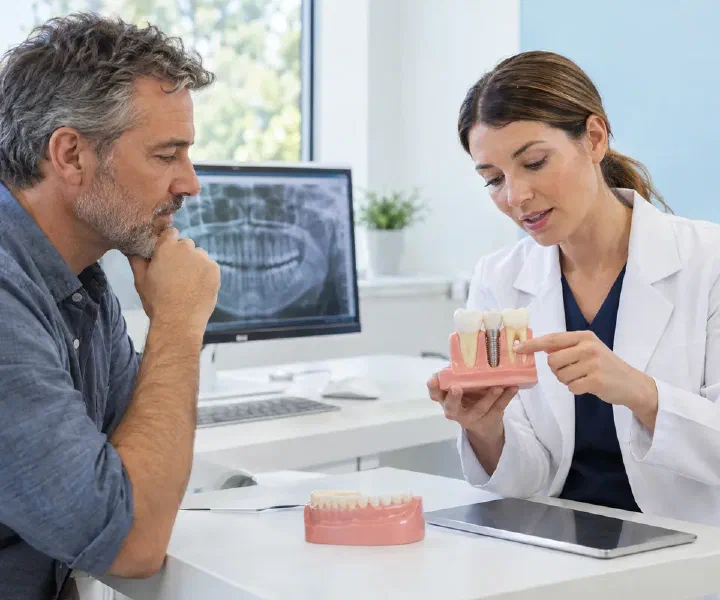
A dentist and patient discussing implant placement timing with a jaw model

Good to know

Separate three events that are often described as immediate.

Understanding the terminology makes a treatment proposal easier to compare.

Implant placement

This is the stage when the implant component is placed in the site. If done at extraction, it is described as immediate placement. The decision depends on the socket, available support, tissues, health, and restorative goal rather than simply the wish to avoid a later surgical appointment.

A temporary tooth or prosthesis

A provisional restoration may be connected early in selected circumstances, or another temporary replacement may be used. It can differ in material, appearance, and permitted use from the final work. A visible tooth after surgery does not establish that every restorative stage is complete.

Functional loading

The amount and timing of force allowed on an implant restoration are planned separately. Initial stability and other clinical factors matter. Follow the specific instructions rather than assuming that a tooth attached on the same day can be used like a healed definitive restoration.

Understanding the options

Compare immediate placement with healing before placement.

The most suitable sequence depends on the site and intended result, not solely on the shortest calendar.

Placement at the extraction visit

Combining these stages may be considered in a selected site with appropriate planning and clinical conditions. Grafting and later healing reviews can still be required. The clinician explains the expected benefit and the possibility that findings during extraction may lead to a different timing.

Placement after an interval

Allowing soft tissue or bone healing before placement may be more appropriate in other situations. Preparatory site management or grafting can be part of that plan. A staged approach should not be described as inferior merely because it involves more time; the clinical reason and expected result matter.

What we consider

Review the factors behind the timing recommendation.

An individual assessment is needed even when another patient had a seemingly similar missing tooth.

The tooth and socket condition

The tooth’s prognosis, extraction difficulty, socket walls, and local disease can affect the proposal. Some details become clearer only when the tooth is removed. The plan should include an appropriate alternative rather than guarantee immediate placement from a preliminary photograph or consultation alone.

The restoration and visible tissues

The desired tooth position, gum appearance, bite, and maintenance access influence where support is needed. A quick placement that compromises the eventual restoration is not a useful goal. The surgical and restorative decisions should be coordinated before the timing is finalized.

Health and practical follow-up

Healing considerations, medications, smoking or nicotine use, and access to review can affect planning. Discuss travel and support needs as well as medical history. Do not choose a faster-sounding route on the assumption that it removes the need for appointments or makes follow-up optional.

Planning together

Ask what the actual agreement includes.

The terms used in a proposal should identify procedures and responsibilities clearly.

Included stages and temporary arrangements

Clarify extraction, grafting, implant placement, temporary teeth, final restoration, and reviews. Ask which costs are separate and what happens if timing changes. A phrase such as immediate implant package should not replace an itemized explanation of the clinical course.

Restrictions and the backup plan

Understand the instructions for eating, cleaning, and appliance use after the proposed procedure. Discuss what will be done if immediate placement or an early tooth is not suitable. A clear alternative helps you make an informed choice without pressure to proceed simply to meet the initial schedule.

The appointment

Let the healing response guide completion.

The later stages remain clinical decisions even when placement occurred at extraction.

  1. Monitor the site and interim restoration

    Attend the planned reviews and report worsening symptoms, swelling, or movement. Follow the prescribed limits for any temporary tooth. Comfort alone is not a test of implant integration, so do not test stability by applying more chewing force than advised.

  2. Confirm readiness for the definitive result

    The clinician assesses the site and records needed for the final restoration. The crown or prosthesis is then checked for fit, contacts, and cleaning access. Maintenance is arranged afterward, because immediate timing does not remove the long-term tissue and component care required by an implant.

Frequently asked questions

Questions about immediate dental implants

What does immediate dental implant mean?

It refers to implant placement at the time a tooth is removed. It does not automatically mean a final tooth or unrestricted chewing that day. The provider should explain placement, temporary restoration, and loading as separate parts of the plan.

Is this different from extraction and immediate implant placement?

The terms overlap. This page focuses on comparing timing and expectations, while the extraction page discusses the coordinated surgical decision. They should not be interpreted as separate treatments that need to be purchased together.

Is immediate placement suitable for every extraction?

No. Socket conditions, anatomy, tissues, health, and the restoration plan determine suitability. A staged approach may be more appropriate, and the decision can change after the tooth is removed and the site is assessed directly.

Will immediate treatment eliminate healing time?

No. Biological healing and clinical reviews are still required. Combining placement with extraction changes the sequence but does not guarantee a fully healed or finished result immediately. Follow the individualized timetable and restrictions.

Can I chew normally on a temporary tooth?

Only within the instructions given for the particular design and treatment. Some early restorations have restricted loading. Do not assume a tooth that looks complete is ready for normal force or use comfort alone to decide when restrictions can end.

Is delayed placement a worse option?

Not inherently. It may be the more suitable approach for the site and goals. The clinician should explain the reason and compare expected stages and limitations rather than present the fastest route as automatically best.

What if the planned immediate implant cannot be placed?

The provider follows the agreed alternative, which may involve site management and later reassessment. Discuss this beforehand, including temporary appearance and costs. Changing timing can be an appropriate response to clinical findings rather than a reason to force the original plan.

Real patient results

Before & after smile gallery.

Drag the centre line to compare each real case treated by our dental team. Every smile begins with a personal assessment and a plan shaped around the patient.

Areas We Serve

Neighbourhood dental care, close to home.

Located in Cookstown, Innisfil, our dental team welcomes patients from communities across South Simcoe, Barrie, and northern York Region.

Get directions
  • Cookstown
  • Innisfil
  • Simcoe
  • Lake Simcoe
  • Alcona
  • Stroud
  • Lefroy–Belle Ewart
  • Gilford
  • Churchill
  • Sandy Cove
  • Innisfil Heights
  • Fennell’s Corners
  • Bradford
  • Bradford West Gwillimbury
  • Bond Head
  • Newton Robinson
  • New Tecumseth
  • Alliston
  • Beeton
  • Tottenham
  • Adjala–Tosorontio
  • Everett
  • Loretto
  • Barrie
  • Essa
  • Thornton
  • Baxter
  • Angus
  • Egbert
  • Ivy
  • Utopia
  • York Region
  • East Gwillimbury
  • Queensville
  • Holland Landing
  • Sharon
  • Schomberg
  • Nobleton

Don’t see your community listed? Contact us—we regularly welcome patients from throughout the surrounding region.

Google reviews

Kind words from our patients.

Read what patients have shared about their visits to Cookstown Dental Centre.

A dentist having a friendly consultation with a patient in a bright dental clinic

Your next step

Ready to feel good about your next dental visit?

Whether you are new to the clinic or returning for care, our team is here to make booking simple and answer your questions.

Call Book Now WhatsApp

How can we help?

The Cookstown Dental team is here for you.

Need an appointment, have a question, or want to talk through your options? Choose the next step that works best for you.

Send us a note

We’ll get back to you as soon as we can.