Cookstown Dental Centre
The Cookstown Dental Centre team caring for a patient in a treatment room

Specialized Care · Cookstown

Assess the jaw contribution to headaches without overlooking other causes.

Headaches and jaw tension can occur together, but the cause needs assessment. Review symptom patterns, conservative dental care, and when medical evaluation matters.

Request an appointment

Let’s find a time that works.

Need urgent dental help? Call (705) 291-2222.

Headaches Associated with Jaw Tension in Cookstown

A headache near the temples is not automatically a dental diagnosis.

Headaches can occur alongside jaw muscle tenderness, clenching, or difficulty with chewing. In some situations, jaw function is relevant to the pain pattern; in others, a headache disorder or another medical condition needs attention. The fact that two symptoms occur together does not prove that changing the bite or providing a nightguard will resolve both.

At Cookstown Dental Centre, we review how the headache relates to jaw use, where the discomfort is felt, and what dental or muscle findings are present. The aim is to identify an appropriate dental role while recognizing when medical assessment is needed. A sudden exceptionally severe headache, new weakness or speech difficulty, or a headache with other acute neurological symptoms requires urgent medical attention rather than waiting for a dental consultation.


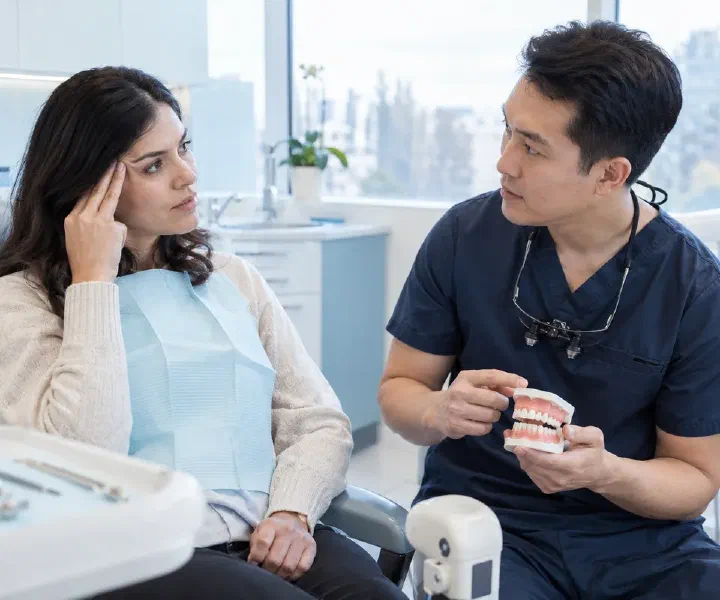
A patient describing temple discomfort and jaw tension to a dentist

Planning together

Describe the headache and jaw symptoms as separate patterns.

The relationship between them is something to investigate, not assume.

Timing, triggers, and ordinary function

Note whether pain changes with chewing, clenching, waking, concentration, or periods of reduced jaw use. Describe the headache’s duration and effect on activities. A brief history can help the clinician decide what needs assessment without asking you to repeatedly provoke symptoms to prove a connection.

Associated symptoms and previous assessment

Mention nausea, light sensitivity, visual changes, neurological symptoms, neck concerns, medication use, and any existing headache diagnosis. Bring relevant information from medical care when available. Dental assessment should complement that care rather than replace it because tenderness is also found in a chewing muscle.

The dental assessment

Check the possible dental and jaw findings.

The examination should look for explanations and for reasons to consider another pathway.

Muscle tenderness and jaw function

The clinician assesses relevant muscles, comfortable movement, and joint symptoms. Reproduction of familiar discomfort can contribute information, but a tender area alone does not prove every headache is caused by the jaw. The findings need to fit the history and be interpreted with appropriate diagnostic limits.

Teeth and local sources of pain

A cracked tooth, pulp problem, infection, or a recent restoration may need investigation when symptoms suggest it. Pain can be referred or difficult to localize. The dentist should identify a supported tooth-related problem before recommending an irreversible procedure intended to relieve a broader headache pattern.

Clenching, wear, and appliance history

Daytime habits, grinding reports, tooth wear, and existing guards are considered where relevant. Wear can be old or have several causes. Bring any appliance and explain whether it changes symptoms, but do not assume that a visible wear pattern establishes the medical cause of headaches.

Understanding the options

Separate conservative jaw care from treatment of a headache disorder.

The two may be coordinated, but they are not interchangeable.

A supported jaw-related care plan

When the findings indicate a jaw or muscle component, conservative measures and selected referral may be discussed. Goals can include more comfortable function and reduction of aggravating habits. Any appliance trial should have a defined purpose, realistic evidence limits, and a review rather than a promise of headache elimination.

Medical evaluation and ongoing headache care

Persistent, changing, or otherwise concerning headaches may need medical assessment. A known headache condition may continue to require its own treatment even if jaw discomfort improves. The dentist can help coordinate information without advising you to stop prescribed medication or substitute a dental device for medical management.

Practical guidance

Be cautious about broad claims linking the bite to headaches.

A plausible explanation is not the same as evidence for irreversible treatment.

Permanent bite changes are not a routine headache solution

Grinding teeth, placing crowns, or moving teeth should not be promoted as a general cure for TMD-related symptoms or unexplained headaches. A distinct restorative indication may still justify care. Ask what finding supports the proposed change and which conservative alternatives have been considered.

A guard can have a limited, specific role

Protection from loading may be appropriate in selected cases, but a standard guard is not a guaranteed treatment for headaches or sleep apnea. Its fit and effects need review. Stop and contact the provider if an appliance causes pain or a persistent unwanted change in the bite.

Step by step

Review the response and revise the plan when the pattern changes.

Follow-up should assess both function and the original headache concern.

  1. Agree on what improvement would mean

    The plan may track headache frequency, jaw comfort, or ability to chew, depending on the assessment. Clarify the review point and what remains uncertain. Different symptoms may respond differently, so improvement in one should not automatically be described as proof of a single cause for all of them.

  2. Share practical observations at follow-up

    Record useful changes without constant symptom checking or forceful jaw exercises. Tell the clinician what helped and what did not. Lack of progress can justify revisiting the diagnosis or referral rather than escalating automatically to more invasive dental treatment.

  3. Seek urgent help for a new warning pattern

    Sudden severe headache, new neurological symptoms, significant illness, or headache following major injury needs urgent medical evaluation. A prior jaw-tension explanation should not be used to dismiss a new or markedly different presentation. Continue ordinary medical follow-up for persistent concerns even without emergency features.

Frequently asked questions

Questions about headaches associated with jaw tension

Can jaw tension contribute to a headache?

It can be relevant in some cases, but headaches have many possible causes. The relationship is assessed through the history and clinical findings. Coexisting jaw tenderness does not establish that every headache is dental or that a bite change will resolve it.

Will a nightguard cure my headaches?

That should not be promised. An appliance may have a defined protective or conservative role in selected care, with evidence limits and review. A headache disorder may still need medical assessment and treatment even when a guard is appropriate for the teeth.

Does temple pain prove that I clench?

No. The location can overlap with several conditions. Clenching history and muscle findings may contribute information, but they do not replace an appropriate headache assessment. New or changing symptoms should be discussed rather than assigned to a habit without examination.

Should I have my bite adjusted?

Permanent bite changes are not a routine treatment for unexplained headaches or TMD. A specific dental restoration problem may need focused care, but the purpose should be clear. Ask about evidence, alternatives, and diagnostic uncertainty before an irreversible proposal aimed at headache relief.

Can I continue my prescribed headache medication?

Follow your medical prescriber’s instructions and tell the dental team what you take. Do not stop or alter medication independently because a jaw contribution is being considered. Coordination helps keep dental recommendations compatible with the existing treatment plan.

What information should I bring?

A description of timing, triggers, duration, associated symptoms, existing diagnoses, and current medicines is useful. Bring an existing dental appliance if relevant. A short practical record can help, but do not delay urgent medical care to complete a symptom diary.

When is a headache an emergency?

Seek urgent medical help for a sudden exceptionally severe headache, new weakness, speech or other neurological changes, or another serious acute pattern. Headache after major injury or with significant illness also needs medical assessment rather than waiting for dental care.

Real patient results

Before & after smile gallery.

Drag the centre line to compare each real case treated by our dental team. Every smile begins with a personal assessment and a plan shaped around the patient.

Areas We Serve

Neighbourhood dental care, close to home.

Located in Cookstown, Innisfil, our dental team welcomes patients from communities across South Simcoe, Barrie, and northern York Region.

Get directions
  • Cookstown
  • Innisfil
  • Simcoe
  • Lake Simcoe
  • Alcona
  • Stroud
  • Lefroy–Belle Ewart
  • Gilford
  • Churchill
  • Sandy Cove
  • Innisfil Heights
  • Fennell’s Corners
  • Bradford
  • Bradford West Gwillimbury
  • Bond Head
  • Newton Robinson
  • New Tecumseth
  • Alliston
  • Beeton
  • Tottenham
  • Adjala–Tosorontio
  • Everett
  • Loretto
  • Barrie
  • Essa
  • Thornton
  • Baxter
  • Angus
  • Egbert
  • Ivy
  • Utopia
  • York Region
  • East Gwillimbury
  • Queensville
  • Holland Landing
  • Sharon
  • Schomberg
  • Nobleton

Don’t see your community listed? Contact us—we regularly welcome patients from throughout the surrounding region.

Google reviews

Kind words from our patients.

Read what patients have shared about their visits to Cookstown Dental Centre.

A dentist having a friendly consultation with a patient in a bright dental clinic

Your next step

Ready to feel good about your next dental visit?

Whether you are new to the clinic or returning for care, our team is here to make booking simple and answer your questions.

Call Book Now WhatsApp

How can we help?

The Cookstown Dental team is here for you.

Need an appointment, have a question, or want to talk through your options? Choose the next step that works best for you.

Send us a note

We’ll get back to you as soon as we can.