Cookstown Dental Centre
The Cookstown Dental Centre team caring for a patient in a treatment room

Restorative Dentistry · Cookstown

Bring multiple dental needs into a coordinated restoration plan.

Full-mouth rehabilitation can combine disease control, tooth repair, and replacement. Set priorities, compare scope, stage care, and understand maintenance.

Request an appointment

Let’s find a time that works.

Need urgent dental help? Call (705) 291-2222.

Full-Mouth Rehabilitation in Cookstown

A broad plan should explain why each part is needed.

Full-mouth rehabilitation describes coordinated care for several dental problems affecting the mouth’s overall function, health, or appearance. It may involve damaged teeth, missing teeth, failing restorations, gum concerns, or substantial wear. It is not a single procedure and does not mean that every tooth must receive the same treatment.

At Cookstown Dental Centre, we begin with the diagnoses and your priorities, then consider how the different needs interact. Urgent care, disease control, reconstruction, and replacement may occur in stages. Some cases benefit from specialist involvement. A useful plan distinguishes necessary treatment from optional changes and explains the consequences of each choice. The goal is a maintainable result with clear decision points rather than a package whose scope is assumed before the mouth is assessed.


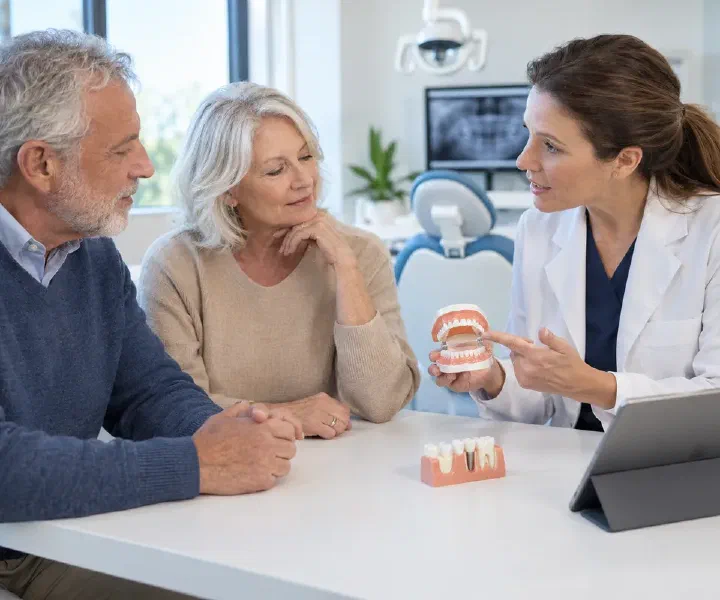
A dentist discussing coordinated restorative care with an older couple

What we consider

Identify the needs that must be coordinated.

A comprehensive plan starts by separating the problems and understanding how they affect one another.

Active disease and symptoms

Decay, infection, gum disease, and pain may need priority before definitive restoration. The clinician explains which findings require prompt care and which can be planned later. A cosmetic or reconstructive goal should not distract from stabilizing the conditions that determine whether the final work has a sound foundation.

Damaged or heavily restored teeth

Each tooth needs an assessment of remaining structure, pulp condition, support, and restorability. Some may be repaired conservatively, while others need broader protection or another decision. Rehabilitation should not use one restoration type across the mouth simply because a large treatment plan is being considered.

Missing teeth and overall function

Spaces, worn contacts, and existing appliances can influence chewing and the design of replacement teeth. The clinician considers the whole arrangement before choosing implants, bridges, or dentures. The most visible gap may not be the only priority, and replacement choices should be coordinated with the teeth that remain.

Care that fits

Set goals that are meaningful and proportionate.

Your priorities help determine the scope and the order of care.

Comfort and everyday eating

Explain which activities are difficult and what improvement would matter most. A plan can be clinically extensive without promising unrestricted function or a perfect result. The dentist should connect each proposed procedure to a defined problem and explain the likely benefit and remaining limitations.

Appearance and personal preferences

Discuss the features you want changed and those you would prefer to preserve. Optional colour or shape changes should be distinguishable from health needs. A comprehensive consultation should not assume that a uniformly bright or completely redesigned smile is the goal of every person seeking functional restoration.

A realistic treatment commitment

Appointments, health, budget, and maintenance capacity are legitimate planning factors. A staged approach may help, but its sequence must remain clinically workable. The clinician explains what can be phased and which decisions depend on another stage rather than divide procedures arbitrarily without considering their relationship.

The appointment

Use stages with a reason to review before moving on.

The plan should respond to disease control, healing, and the results of earlier care.

  1. Stabilize and clarify prognosis

    Treat urgent concerns and assess the teeth and tissues that will support later work. Further records or specialist opinions may be needed. The purpose is to avoid committing to a final design around teeth whose outlook remains uncertain or conditions that have not yet been managed.

  2. Plan and evaluate the reconstruction

    Records, models, digital planning, or provisional work may be useful according to the case. The clinician explains what each stage can demonstrate and what remains uncertain. A preview or temporary restoration supports decisions; it should not be presented as a guarantee of every feature of the final result.

  3. Complete definitive care and review function

    Restorations and replacements are coordinated around the achieved condition and agreed goals. Fit, contacts, tissues, appearance, and cleaning access are reviewed. Any change in findings or priorities should be discussed before the next major commitment rather than allowing the original plan to continue automatically.

Understanding the options

Compare a comprehensive proposal with a more limited approach.

Different scopes can be reasonable if their benefits and compromises are understood.

Focused care for selected priorities

A smaller plan may address urgent problems and particular functional goals while leaving other stable features unchanged. The clinician explains the consequences and monitoring required. Limited care should be a considered choice, not an incomplete version of a larger plan whose unresolved issues have not been discussed.

A broader coordinated rehabilitation

This may be appropriate when multiple areas depend on one another for a useful result. The recommendation should justify the additional treatment and preparation. More procedures are not automatically better; the expected benefit and long-term maintenance need to support the proposed scope.

Planning together

Make responsibility, costs, and maintenance reviewable.

A complex course of care should remain understandable outside the consultation room.

The team and complete estimate

Clarify who coordinates the plan and provides each specialist or restorative stage. Ask what the estimate includes, what may change with findings, and what temporary work is planned. Separate quotes should describe compatible goals rather than leave you comparing procedures that assume different endpoints.

The ongoing care after rehabilitation

Discuss cleaning, reviews, protection, repairs, and replacement of restorative materials over time. The original causes of wear or disease may still need management. A large investment in treatment does not make the mouth maintenance-free, so the future care burden belongs in the decision from the beginning.

Frequently asked questions

Questions about full-mouth rehabilitation

Does full-mouth rehabilitation mean crowns on every tooth?

No. The term describes coordinated care, not one mandatory procedure. Each tooth and replacement need should be assessed individually. The plan may include conservative repairs, disease treatment, appliances, or leaving healthy areas unchanged.

How is this different from bite reconstruction?

A rehabilitation plan can bring several types of care together—for example, stabilizing gum health, replacing missing teeth, and restoring worn surfaces. Reconstructing the bite may be one component. Neither label tells you which procedures are necessary without a diagnosis for each problem.

Can I complete treatment in stages?

Often staging can be discussed, but the order must respect clinical dependencies. Ask which parts can function independently and how temporary care is maintained. A staged estimate should not conceal an unfinished condition that needs timely attention.

Will specialist care be needed?

That depends on the findings. Periodontal, endodontic, orthodontic, surgical, or prosthodontic input may help selected cases. The dentist should explain the specific question each referral addresses and who coordinates the overall plan.

Can I choose health and function without a cosmetic makeover?

Yes. Explain your priorities clearly. Optional appearance changes should be separated from clinically indicated care, and healthy features do not need alteration simply because several other teeth require treatment.

Will rehabilitation cure jaw pain or headaches?

That should not be promised. Those symptoms can have multiple causes and may need a separate assessment. The clinician should distinguish identified dental problems from benefits that remain uncertain when discussing a broad restorative plan.

How do I judge whether the scope is reasonable?

Ask why each procedure is included, what alternatives exist, which parts are optional, and what happens if you choose a smaller plan. A written explanation and, where helpful, another opinion can make the reasoning easier to compare.

Real patient results

Before & after smile gallery.

Drag the centre line to compare each real case treated by our dental team. Every smile begins with a personal assessment and a plan shaped around the patient.

Areas We Serve

Neighbourhood dental care, close to home.

Located in Cookstown, Innisfil, our dental team welcomes patients from communities across South Simcoe, Barrie, and northern York Region.

Get directions
  • Cookstown
  • Innisfil
  • Simcoe
  • Lake Simcoe
  • Alcona
  • Stroud
  • Lefroy–Belle Ewart
  • Gilford
  • Churchill
  • Sandy Cove
  • Innisfil Heights
  • Fennell’s Corners
  • Bradford
  • Bradford West Gwillimbury
  • Bond Head
  • Newton Robinson
  • New Tecumseth
  • Alliston
  • Beeton
  • Tottenham
  • Adjala–Tosorontio
  • Everett
  • Loretto
  • Barrie
  • Essa
  • Thornton
  • Baxter
  • Angus
  • Egbert
  • Ivy
  • Utopia
  • York Region
  • East Gwillimbury
  • Queensville
  • Holland Landing
  • Sharon
  • Schomberg
  • Nobleton

Don’t see your community listed? Contact us—we regularly welcome patients from throughout the surrounding region.

Google reviews

Kind words from our patients.

Read what patients have shared about their visits to Cookstown Dental Centre.

A dentist having a friendly consultation with a patient in a bright dental clinic

Your next step

Ready to feel good about your next dental visit?

Whether you are new to the clinic or returning for care, our team is here to make booking simple and answer your questions.

Call Book Now WhatsApp

How can we help?

The Cookstown Dental team is here for you.

Need an appointment, have a question, or want to talk through your options? Choose the next step that works best for you.

Send us a note

We’ll get back to you as soon as we can.