Cookstown Dental Centre
The Cookstown Dental Centre team caring for a patient in a treatment room

Restorative Dentistry · Cookstown

Understand a full-arch implant restoration that stays in place between visits.

Fixed implant dentures need planned support, cleaning access, and ongoing servicing. Compare removable options, materials, temporary stages, and maintenance.

Request an appointment

Let’s find a time that works.

Need urgent dental help? Call (705) 291-2222.

Fixed Implant Dentures in Cookstown

Fixed describes how the restoration is retained, not a promise of maintenance-free teeth.

The term fixed implant denture is often used for a full-arch replacement secured to implants and removed by a clinician when indicated, rather than by the wearer each day. Its design differs from an implant-retained overdenture that is intended to be removed at home. Both can be useful in suitable cases, but they have different cleaning, repair, and support requirements.

At Cookstown Dental Centre, we assess whether a fixed restoration fits your anatomy, health, goals, and ability to maintain it. The plan must connect implant placement with the final teeth and the space needed for cleaning. A full-arch proposal should also address any remaining natural teeth and reasonable alternatives. It should not be presented as one standard package that guarantees the same result for every mouth.


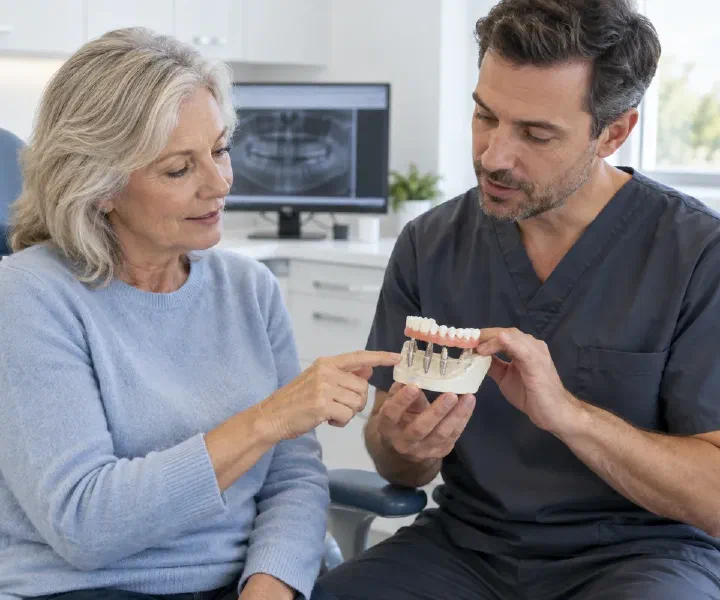
A dentist and older patient reviewing a fixed full-arch implant restoration model

Understanding the options

Compare fixed and removable implant designs before choosing.

Retention is only one part of how an appliance works in daily life.

A fixed full-arch restoration

This remains attached during normal home use and needs cleaning around and beneath the replacement teeth. The clinician explains access, materials, and professional servicing. Not removing it each day does not automatically make it easier to clean, especially if dexterity or the available space creates difficulty.

A removable implant-assisted denture

This is designed to be removed by the wearer and may use attachments for retention. It has different handling, base support, and component care needs. The decision should compare comfort, hygiene, repair, cost, and suitability rather than assume the fixed option is always the preferred or more natural choice.

What we consider

Plan the teeth and their support as one system.

The restoration design determines more than the number of implants.

Bone, tissues, and implant distribution

The clinician assesses available support, relevant anatomy, and the intended load and prosthesis. Implant number and position should follow the individual plan. A familiar advertised configuration does not establish that the same arrangement is appropriate for every arch or that additional procedures can be avoided.

Space, appearance, and speech

The replacement teeth and any gum-coloured material need room and an appropriate relationship to the lips and opposing arch. Speech and smile display may influence the design. These features should be reviewed before surgery where possible rather than left as details to solve after implant positions are fixed.

Access for cleaning and future repair

The underside and surrounding spaces must be maintainable. Materials and connection design can affect servicing and replacement. Ask how you will clean the actual restoration and what professional removal or repairs might involve before choosing a design based only on its appearance in a photograph.

Planning together

Review the commitment before an irreversible stage.

Full-arch treatment deserves a clear explanation of scope, alternatives, and responsibilities.

Remaining teeth and alternatives

If extractions are proposed, understand the prognosis of the teeth and the options for preserving suitable ones. A full-arch implant plan should not bypass that discussion. Ask why the recommended scope is necessary and whether a less extensive replacement could reasonably meet your goals.

The entire estimate and care team

Clarify records, extractions, grafting if relevant, surgery, temporary work, final restoration, and follow-up. Identify who provides each stage and handles complications or repairs. A placement package may not cover every later prosthetic need, so the complete agreement should be reviewable before treatment begins.

The appointment

Distinguish the temporary stage from the definitive result.

The sequence depends on site conditions, stability, healing, and the selected restoration.

  1. Prepare and place according to the plan

    Health and oral conditions are assessed, records are collected, and any preparatory treatment is coordinated. The surgical provider explains timing and alternatives if findings change. A fixed temporary restoration at an early stage is not suitable for every case and should not be guaranteed before assessment.

  2. Protect healing and review temporary function

    If a temporary prosthesis is used, follow its loading and cleaning instructions. It may have different material and functional limits from the final restoration. Report movement, breakage, or tissue concerns promptly rather than treating a visible set of teeth as proof that healing and treatment are complete.

  3. Fit the final restoration and arrange reviews

    The definitive work is checked for fit, contacts, appearance, and hygiene access. The clinician explains maintenance and any protective appliance. Completion includes a workable care plan, not only fastening the teeth to implants and assuming that no further service will be needed.

Practical guidance

Maintain the tissues and components over time.

A fixed prosthesis remains dependent on biological support and serviceable materials.

Practise the demonstrated cleaning method

Use the tools and technique recommended for the design and explain any areas you cannot reach. A caregiver may need instruction with your agreement. Persistent access problems should be reviewed rather than managed by forceful cleaning or ignored because the restoration cannot be removed at home.

Report mechanical or tissue changes

Bleeding, swelling, a changed bite, clicking, or chipped material needs assessment. The cause may involve tissues or components and should not automatically be called implant failure. Regular reviews help distinguish supportive care from a repair or disease treatment that requires a different plan.

Frequently asked questions

Questions about fixed implant dentures

Can I remove fixed implant dentures myself?

They are generally intended to remain attached during home use and be removed by a clinician when indicated. Do not attempt to loosen screws or remove the restoration. A removable implant overdenture is a different design with different instructions.

Are fixed implant dentures easier to clean?

Not necessarily. Cleaning beneath the restoration can require specific tools and dexterity. Ask for a demonstration and discuss support needs. The design should be maintainable in your routine rather than chosen solely because it stays in place.

How many implants are needed?

The number and arrangement depend on the arch, anatomy, restoration, loading, and clinical plan. A standard advertised number is not a diagnosis. The provider should explain why the proposed support suits the individual case.

Will all remaining teeth have to be removed?

Not automatically. Each relevant tooth’s prognosis and reasonable preservation options should be considered before a full-arch plan is accepted. Ask why the proposed scope is recommended and whether a less extensive approach is appropriate.

Can fixed teeth be fitted on the day of surgery?

A temporary restoration may be considered in selected circumstances, but suitability and loading requirements must be assessed. It is not guaranteed for every case. The final restoration and unrestricted function may come later in the sequence.

Will the restoration last forever?

No restoration is maintenance-free or guaranteed permanent. Materials, screws, tissues, and supporting implants need review, and repairs or replacement can be necessary. Discuss those responsibilities and costs before treatment rather than assuming the initial procedure covers all future care.

What if part of the bridge feels loose?

Contact the clinic promptly and follow advice about use. Do not tighten or test it yourself. Movement may involve a prosthetic component or another concern, and an assessment is needed to identify the affected part and appropriate treatment.

Real patient results

Before & after smile gallery.

Drag the centre line to compare each real case treated by our dental team. Every smile begins with a personal assessment and a plan shaped around the patient.

Areas We Serve

Neighbourhood dental care, close to home.

Located in Cookstown, Innisfil, our dental team welcomes patients from communities across South Simcoe, Barrie, and northern York Region.

Get directions
  • Cookstown
  • Innisfil
  • Simcoe
  • Lake Simcoe
  • Alcona
  • Stroud
  • Lefroy–Belle Ewart
  • Gilford
  • Churchill
  • Sandy Cove
  • Innisfil Heights
  • Fennell’s Corners
  • Bradford
  • Bradford West Gwillimbury
  • Bond Head
  • Newton Robinson
  • New Tecumseth
  • Alliston
  • Beeton
  • Tottenham
  • Adjala–Tosorontio
  • Everett
  • Loretto
  • Barrie
  • Essa
  • Thornton
  • Baxter
  • Angus
  • Egbert
  • Ivy
  • Utopia
  • York Region
  • East Gwillimbury
  • Queensville
  • Holland Landing
  • Sharon
  • Schomberg
  • Nobleton

Don’t see your community listed? Contact us—we regularly welcome patients from throughout the surrounding region.

Google reviews

Kind words from our patients.

Read what patients have shared about their visits to Cookstown Dental Centre.

A dentist having a friendly consultation with a patient in a bright dental clinic

Your next step

Ready to feel good about your next dental visit?

Whether you are new to the clinic or returning for care, our team is here to make booking simple and answer your questions.

Call Book Now WhatsApp

How can we help?

The Cookstown Dental team is here for you.

Need an appointment, have a question, or want to talk through your options? Choose the next step that works best for you.

Send us a note

We’ll get back to you as soon as we can.