Cookstown Dental Centre
The Cookstown Dental Centre team caring for a patient in a treatment room

Restorative Dentistry · Cookstown

Restore a suitable cavity with an individually made inlay.

A dental inlay fits within a prepared tooth defect without covering its cusps. Compare direct fillings, material choices, fabrication, fit, and ongoing care.

Request an appointment

Let’s find a time that works.

Need urgent dental help? Call (705) 291-2222.

Dental Inlays in Cookstown

An inlay is an indirect restoration, not a smaller name for every filling.

A dental inlay is made outside the mouth or through an appropriate digital fabrication process, then fitted into a prepared defect within the tooth’s cusps. It may be considered for a suitable restoration when the remaining tooth structure and clinical conditions support that design. It differs from an onlay, which extends over one or more cusps, and from a crown, which provides broader coverage.

At Cookstown Dental Centre, we assess the defect, remaining walls, contacts, and bite before discussing an inlay. The choice should be justified against a direct filling and any need for cusp protection. A custom-made restoration is not automatically better for every cavity. The goal is an appropriate fit and seal with a design that preserves sound structure and can be maintained.


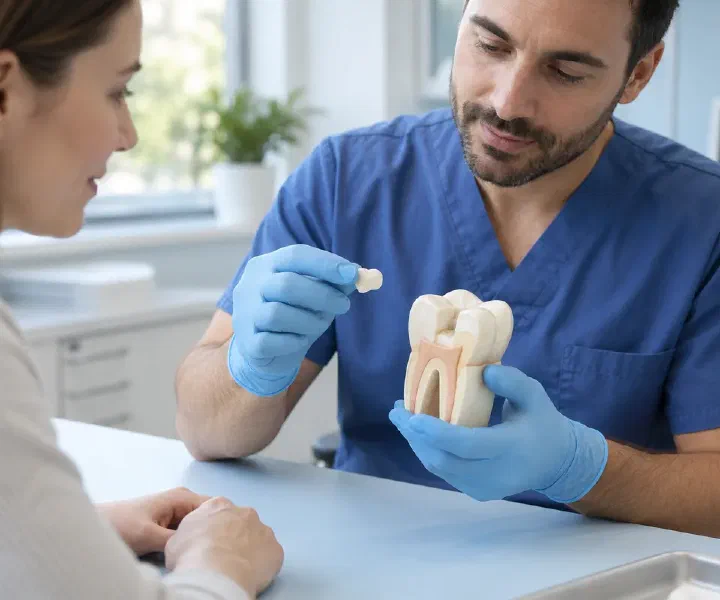
A clinician explaining an inlay with a large molar model

Understanding the options

Choose the amount of coverage the tooth actually needs.

The names describe different designs, and the distinction matters to the preparation and protection provided.

An inlay within the cusps

An inlay restores a selected internal defect while leaving the cusps outside its coverage. The surrounding structure must be suitable for that approach. The dentist checks for cracks or weakened walls that could make an internal restoration insufficient, even if the visible cavity looks neatly contained.

A filling, onlay, or crown

A direct filling may be appropriate for another suitable defect, while an onlay or crown may be considered when more protection is justified. These choices differ in preparation and fabrication. Ask why the recommended design fits your tooth rather than treating the most expensive or extensively made option as automatically preferable.

What we consider

Assess the foundation and placement conditions.

A precise-looking restoration still needs a tooth that can support it and a suitable method of securing it.

Remaining tooth structure

The dentist evaluates the size, location, and depth of the defect and any existing restoration. A thin cusp or crack can change the recommendation. The final design should reflect the tooth after indicated damaged material is managed, not only the appearance of the old filling before treatment starts.

Margins and moisture control

The location of the prepared edges affects access, isolation, and the chosen material and cementation technique. A deep or difficult margin may limit the available approach. The clinician explains those practical considerations rather than promising that a digitally measured restoration will compensate for every clinical challenge.

Bite and neighbouring contacts

The inlay needs an appropriate chewing surface and contact with adjacent teeth where involved. Food trapping, grinding, and previous restoration failure deserve discussion. An accurate internal fit is only one aspect of a result that must also work comfortably and remain cleanable in daily use.

A closer look

Understand the material and fabrication choices.

The proposed method should be explained in relation to the tooth and the services available for the case.

  1. Material selected for the site

    Ceramic, metal, or other appropriate indirect materials may be considered depending on the clinical plan. Their appearance, preparation requirements, and handling differ. The dentist explains which option is proposed and why, rather than suggesting every tooth-coloured inlay has identical properties or suitability.

  2. Laboratory or digital workflow

    Records guide fabrication through the selected workflow, which may involve a laboratory or a suitable digital process. Appointment timing depends on the method and availability. A same-day result should not be assumed simply because a scan is used; scanning and manufacturing are separate parts of the sequence.

The appointment

Check the tooth at preparation and the restoration at fitting.

The treatment sequence should allow the design to respond to actual findings.

  1. Prepare and confirm the design

    The indicated damaged material is managed and the remaining tooth is reassessed. If a weakened cusp or more extensive defect is found, an onlay or another restoration may be recommended. Significant changes should be explained before proceeding beyond the agreed treatment scope.

  2. Record and protect between stages

    An impression or scan is taken according to the workflow, and temporary protection may be needed while the inlay is made. Follow the instructions for eating and cleaning during that period. Report loss or discomfort of the temporary restoration rather than leaving the prepared tooth unreviewed until the fitting date.

  3. Fit, secure, and review contacts

    The inlay is assessed for fit and function and secured using the appropriate technique. The clinician checks the bite and finish. Ask about the initial care instructions and report a contact that feels high or persistent sensitivity so the tooth and restoration can be reviewed.

Practical guidance

Maintain the tooth around the restoration.

An inlay replaces a defect but does not remove the need for decay prevention or monitoring.

Clean the margins and contact area

Use the recommended brushing and interdental routine and ask about any area that catches food or is difficult to clean. Decay can still develop around a restoration. A custom fit does not make the remaining tooth maintenance-free or remove the factors that caused the original defect.

Review damage or changing symptoms

A rough edge, new biting discomfort, or a loose restoration needs assessment. The response may involve adjustment, repair, replacement, or another investigation depending on the cause. Do not assume that every symptom means the inlay has failed, but do not ignore a persistent change because the restoration is relatively new.

Frequently asked questions

Questions about dental inlays

What is the difference between an inlay and an onlay?

An inlay fits within the cusps, while an onlay covers one or more cusps. The tooth’s remaining structure determines whether extra coverage is useful. The terms describe different designs rather than simply different sizes of the same filling.

Is an inlay always better than a direct filling?

No. A direct filling may be appropriate for many defects. The dentist should explain why an indirect restoration offers a useful benefit in your case and compare preparation, material, appointments, maintenance, and cost.

Can an inlay protect a cracked cusp?

An inlay does not cover the cusp in the way an onlay can. A crack or weakened cusp needs assessment and may change the design. The restoration should be chosen for the structural findings rather than used to fill the space without considering protection.

Will I need a temporary filling?

Possibly, depending on the fabrication sequence. If there is an interval between preparation and fitting, temporary protection may be provided. Follow the specific care instructions and contact the clinic if it loosens, breaks, or becomes uncomfortable.

Can an inlay be made in one visit?

That depends on the clinical suitability, workflow, and equipment or laboratory arrangements available. Do not assume same-day fabrication from the use of a digital scan. The clinician can explain the actual sequence and estimated timing for your case.

Will the inlay match the tooth colour?

A tooth-coloured material may be chosen where suitable, but material options and matching limits should be discussed. Appearance is one part of the decision alongside fit, strength requirements, and preservation of the remaining tooth.

How is an inlay maintained?

Continue cleaning and recommended examinations, and report roughness, food trapping, or new symptoms. The clinician checks the restoration and surrounding tooth over time. There is no universal replacement date; treatment follows the actual condition.

Real patient results

Before & after smile gallery.

Drag the centre line to compare each real case treated by our dental team. Every smile begins with a personal assessment and a plan shaped around the patient.

Areas We Serve

Neighbourhood dental care, close to home.

Located in Cookstown, Innisfil, our dental team welcomes patients from communities across South Simcoe, Barrie, and northern York Region.

Get directions
  • Cookstown
  • Innisfil
  • Simcoe
  • Lake Simcoe
  • Alcona
  • Stroud
  • Lefroy–Belle Ewart
  • Gilford
  • Churchill
  • Sandy Cove
  • Innisfil Heights
  • Fennell’s Corners
  • Bradford
  • Bradford West Gwillimbury
  • Bond Head
  • Newton Robinson
  • New Tecumseth
  • Alliston
  • Beeton
  • Tottenham
  • Adjala–Tosorontio
  • Everett
  • Loretto
  • Barrie
  • Essa
  • Thornton
  • Baxter
  • Angus
  • Egbert
  • Ivy
  • Utopia
  • York Region
  • East Gwillimbury
  • Queensville
  • Holland Landing
  • Sharon
  • Schomberg
  • Nobleton

Don’t see your community listed? Contact us—we regularly welcome patients from throughout the surrounding region.

Google reviews

Kind words from our patients.

Read what patients have shared about their visits to Cookstown Dental Centre.

A dentist having a friendly consultation with a patient in a bright dental clinic

Your next step

Ready to feel good about your next dental visit?

Whether you are new to the clinic or returning for care, our team is here to make booking simple and answer your questions.

Call Book Now WhatsApp

How can we help?

The Cookstown Dental team is here for you.

Need an appointment, have a question, or want to talk through your options? Choose the next step that works best for you.

Send us a note

We’ll get back to you as soon as we can.