Cookstown Dental Centre
The Cookstown Dental Centre team caring for a patient in a treatment room

Restorative Dentistry · Cookstown

Clean around the implant restoration with the right access and technique.

Implant cleaning removes deposits while checking tissue health and access. Learn how professional care differs from home cleaning and when inflammation needs more.

Request an appointment

Let’s find a time that works.

Need urgent dental help? Call (705) 291-2222.

Dental Implant Cleaning in Cookstown

An implant cannot decay, but the tissues around it still need care.

Plaque and deposits can collect around implant crowns, bridges, and denture components. Professional implant cleaning uses an approach suited to the restoration and surrounding tissues. It also provides an opportunity to identify bleeding, difficult access, or another concern that routine brushing has not resolved. Cleaning should not be treated as proof that every implant problem has been addressed.

At Cookstown Dental Centre, we review the type of restoration, your home-care routine, and the tissue findings before selecting care. A stable implant with deposits has different needs from an area showing signs of disease or a loose component. The appointment should explain what was found, how to clean the specific design at home, and whether further assessment or a different treatment plan is needed.


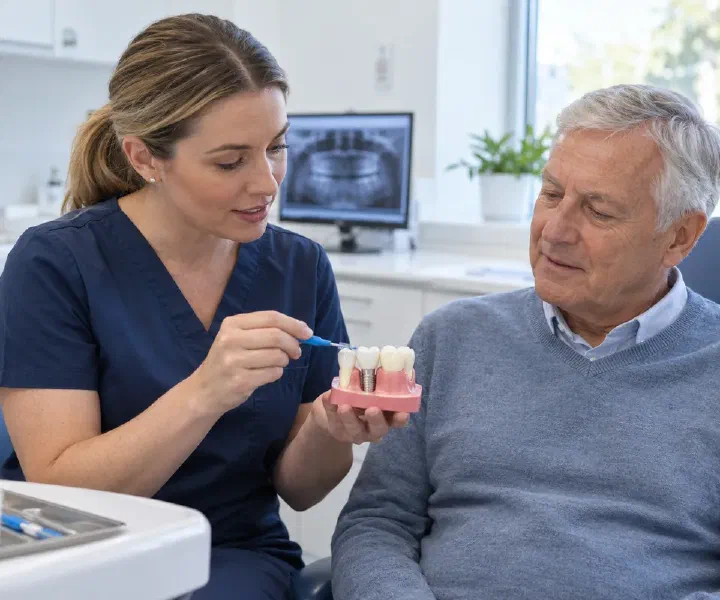
A hygienist demonstrating cleaning around an implant crown on a model

Care that fits

Identify the surfaces that need daily access.

The cleaning method depends on what the implant supports and how the restoration is shaped.

A single implant crown

The contour near the gum and the contacts with neighbouring teeth influence access. The clinician can demonstrate a suitable interdental method rather than assume natural-tooth flossing advice transfers unchanged to every crown. If an area repeatedly traps food, the restoration and contact may need assessment as well as cleaning.

An implant bridge or fixed full-arch restoration

Cleaning beneath connected replacement teeth can require specific tools and technique. Ask for a demonstration with your actual design or an appropriate model. A narrow or inaccessible space should be discussed with the restorative provider rather than accepted as something that more forceful home cleaning will solve.

A removable implant denture

The denture, attachments, and tissues need coordinated care according to the system. Removal and handling are part of the instruction when appropriate. Cleaning the appliance outside the mouth does not replace cleaning the attachment areas, and worn retention components may need a separate maintenance assessment.

What we consider

Check the tissues before choosing the cleaning approach.

Deposits, inflammation, and mechanical problems can coexist but require different responses.

Bleeding and tissue changes

The clinician assesses relevant signs around the implant and compares findings with previous records where available. Bleeding should not be dismissed because implants are artificial. It may indicate inflammation requiring closer evaluation, and the presence or absence of pain alone does not establish tissue health.

Deposits and restoration surfaces

The amount and location of plaque or calculus influence professional cleaning. Instruments and materials are selected with the implant restoration in mind. A technique used on one surface may not suit another, so patients should not attempt to scrape hard deposits from implant components with improvised tools.

Stability and access concerns

A loose crown, damaged attachment, or poorly cleanable contour can limit what a hygiene procedure alone achieves. Tell the clinician about clicking, movement, or food packing. Those findings may require restorative or periodontal assessment in addition to removing deposits.

Step by step

What a professional implant-cleaning visit may include.

The exact care follows the findings and the maintenance plan for your restoration.

  1. Review and assess

    The clinician asks about symptoms, cleaning, medical changes, and previous implant care and examines the relevant tissues and restoration. Records or imaging may be indicated for a specific concern. Bring implant information if available, especially when maintenance is being transferred from another provider.

  2. Remove indicated deposits and review access

    Suitable professional techniques are used and difficult home-care areas are discussed. Ask to practise a recommended method if it feels awkward. The goal is a maintainable routine, not simply a clean surface at the end of the appointment with no realistic way to reach it afterward.

  3. Explain findings and the next interval

    You should know whether the tissues appear stable, whether another assessment is needed, and when to return. Recall timing is individualized. A fixed cleaning schedule should not override new bleeding, swelling, or movement that needs attention before the next routine appointment.

Understanding the options

Distinguish maintenance from treatment of disease.

The next step depends on the extent of inflammation and supporting tissue findings.

Routine supportive cleaning

When the implant and tissues are stable, cleaning and practical coaching help support ongoing maintenance. The clinician monitors for change and adjusts the plan to your risk and access needs. A good visit does not mean future care can be stopped because the implant itself cannot develop a cavity.

Further assessment or treatment

Signs of peri-implant disease may require a more focused plan or specialist input. Professional cleaning can be part of care, but it is not a universal cure for bone loss or every inflammatory problem. The clinician explains the findings and why the recommended treatment extends beyond routine hygiene.

Practical guidance

Make home care workable and report changes early.

The best method is one that is suitable for the design and can be performed effectively.

Use the demonstrated tools appropriately

Follow the advice for brushes, interdental aids, or other devices chosen for your restoration. More pressure is not necessarily more effective. Tell the clinician if dexterity, vision, or gagging makes the routine difficult so suitable adaptations or support can be discussed.

Watch for a change between visits

Report persistent bleeding, swelling, discharge, an altered taste, or movement rather than waiting for pain. These findings do not all have the same cause. Prompt assessment can distinguish a tissue problem from a mechanical issue and guide the right care.

Frequently asked questions

Questions about dental implant cleaning

Do implants need professional cleaning if they cannot get cavities?

Yes. Plaque can affect the tissues around an implant, and the restoration needs monitoring. The absence of decay in the implant material does not protect the surrounding gums and bone from disease or eliminate mechanical maintenance.

Can I clean an implant crown exactly like a natural tooth?

Some habits may be similar, but the contour and access can require a specific technique. Ask for a demonstration suited to your restoration. The clinician can recommend appropriate tools rather than assuming one method fits every implant design.

Is bleeding around an implant normal?

Persistent or recurring bleeding should be assessed. It may indicate inflammation, but the cause and extent need examination. Do not dismiss it simply because the area is painless or because the implant has been present for many years.

Will the crown be removed at every cleaning?

Not necessarily. Access and the clinical findings determine whether removal is indicated, and that decision depends on the restoration. Routine removal should not be assumed. Ask what is needed for your design and why.

Can a water flosser replace all other cleaning?

The appropriate routine depends on the restoration and your needs. A device may be useful as part of care, but it should not automatically replace every recommended method. Ask the clinician to explain which surfaces each tool is intended to reach.

How often should implant cleaning be scheduled?

The interval is based on tissue health, risk, restoration design, and home-care effectiveness. Follow the individualized plan and report new symptoms between visits. A general six-month assumption may not suit every implant patient.

Will cleaning cure peri-implantitis?

Not necessarily. Disease involving supporting bone may need a more involved treatment plan and specialist assessment. The clinician should distinguish routine maintenance from treatment of an identified disease rather than promise that one cleaning resolves every implant concern.

Real patient results

Before & after smile gallery.

Drag the centre line to compare each real case treated by our dental team. Every smile begins with a personal assessment and a plan shaped around the patient.

Areas We Serve

Neighbourhood dental care, close to home.

Located in Cookstown, Innisfil, our dental team welcomes patients from communities across South Simcoe, Barrie, and northern York Region.

Get directions
  • Cookstown
  • Innisfil
  • Simcoe
  • Lake Simcoe
  • Alcona
  • Stroud
  • Lefroy–Belle Ewart
  • Gilford
  • Churchill
  • Sandy Cove
  • Innisfil Heights
  • Fennell’s Corners
  • Bradford
  • Bradford West Gwillimbury
  • Bond Head
  • Newton Robinson
  • New Tecumseth
  • Alliston
  • Beeton
  • Tottenham
  • Adjala–Tosorontio
  • Everett
  • Loretto
  • Barrie
  • Essa
  • Thornton
  • Baxter
  • Angus
  • Egbert
  • Ivy
  • Utopia
  • York Region
  • East Gwillimbury
  • Queensville
  • Holland Landing
  • Sharon
  • Schomberg
  • Nobleton

Don’t see your community listed? Contact us—we regularly welcome patients from throughout the surrounding region.

Google reviews

Kind words from our patients.

Read what patients have shared about their visits to Cookstown Dental Centre.

A dentist having a friendly consultation with a patient in a bright dental clinic

Your next step

Ready to feel good about your next dental visit?

Whether you are new to the clinic or returning for care, our team is here to make booking simple and answer your questions.

Call Book Now WhatsApp

How can we help?

The Cookstown Dental team is here for you.

Need an appointment, have a question, or want to talk through your options? Choose the next step that works best for you.

Send us a note

We’ll get back to you as soon as we can.