Cookstown Dental Centre
The Cookstown Dental Centre team caring for a patient in a treatment room

Specialized Care · Cookstown

Treat deposits below the gumline with a diagnosis and reassessment plan.

Deep dental cleaning addresses selected periodontal needs below the gumline. Understand the assessment, appointment sequence, home care, and review of healing.

Request an appointment

Let’s find a time that works.

Need urgent dental help? Call (705) 291-2222.

Deep Dental Cleaning in Cookstown

Deep cleaning describes a treatment need, not simply a more thorough polish.

Deep dental cleaning commonly refers to nonsurgical periodontal care, including scaling and root planing when indicated. It targets deposits on root surfaces below the gumline in areas where the periodontal assessment supports that treatment. It is different from choosing a more intensive routine cleaning simply because more time has passed since the last visit.

At Cookstown Dental Centre, the recommendation follows examination of the gums, pocket and attachment findings, relevant images, and your health history. The plan identifies which areas need treatment, how comfort will be managed, and how the response will be reviewed. Removing deposits is an important part of disease management, but home care, risk factors, and ongoing maintenance influence the result. Some areas may need additional treatment or specialist assessment after the initial response is evaluated.


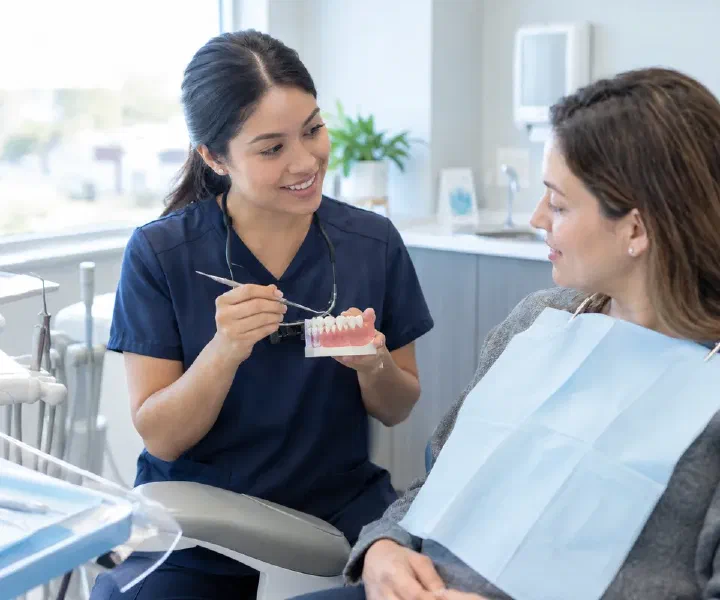
A hygienist explaining below-gum cleaning with a periodontal teaching model

Good to know

Know what the treatment aims to do.

The procedure is directed at diseased sites and the conditions that sustain inflammation.

Remove deposits from indicated root surfaces

Professional instruments and techniques are selected for access and the clinical situation. The work may extend below the visible gumline, with appropriate comfort measures. It should be explained in terms of the diagnosed sites rather than described as scraping every root regardless of its condition.

Create conditions for a better tissue response

Reducing deposits and improving daily plaque control can support management of inflammation. The response varies with disease extent and other factors. The plan should include reassessment because the initial procedure does not guarantee that every pocket will resolve or that no further periodontal care will be needed.

The appointment

Plan the appointments and check the response afterward.

Treatment and reassessment serve different purposes.

  1. Agree on areas, comfort, and sequencing

    The team explains which parts of the mouth need care and whether treatment is staged across visits. Local anaesthesia or other suitable comfort measures may be discussed. Mention anxiety, medical changes, or difficulty tolerating longer appointments so the plan can account for those needs.

  2. Complete the indicated nonsurgical care

    The provider removes deposits and manages the selected root surfaces using the appropriate technique. You receive instructions for cleaning and expected postoperative symptoms. If significant pain, swelling, or another unexpected concern develops, contact the clinic rather than assume every reaction is a routine part of deep cleaning.

  3. Reassess healing and remaining treatment needs

    Follow-up compares relevant tissue findings and evaluates home-care access. Persistent inflammation or deeper sites may require additional care or referral. The reassessment should determine the next step rather than merely repeat the initial procedure without considering whether the expected response occurred.

Practical guidance

Support the professional treatment with a workable home routine.

The best instruction is specific to the spaces you need to clean.

Learn brushing and interdental methods for your mouth

Ask for a demonstration around the affected areas, restorations, and exposed roots. Tool selection depends on the space and your ability. If pain or access problems prevent effective cleaning, tell the team so the method can be adjusted instead of continuing an unsuitable routine.

Discuss sensitivity and other early changes

Some patients notice tenderness or sensitivity after treatment, and gum contours may change as inflammation settles. Follow the aftercare advice and report persistent or worsening symptoms. The provider can assess whether the response fits the treatment or whether another tooth or tissue problem needs attention.

Understanding the options

Understand the difference between initial treatment and ongoing maintenance.

Completion of deep cleaning is not the end of periodontal care.

Maintenance after a suitable response

When the findings support ongoing management, a personalized maintenance schedule helps monitor tissues and remove deposits as needed. The interval depends on the condition and risk rather than a universal date. Daily care and review remain important even when bleeding and discomfort have improved.

Further treatment when disease remains

Some sites may need additional nonsurgical care, surgical assessment, or specialist input. The recommendation should identify the persistent finding and intended benefit. More advanced treatment is not automatic for every patient, but neither should unresolved disease be ignored because the first cleaning course has been completed.

Frequently asked questions

Questions about deep dental cleaning

Is deep cleaning the same as scaling and root planing?

The terms often overlap when describing nonsurgical treatment of indicated periodontal sites. Ask which areas and procedures are planned for your diagnosis. The labels should not imply two separate mandatory treatments when they describe the same course of care.

How is it different from a routine cleaning?

The treatment is based on periodontal findings and targets deposits on root surfaces below the gumline where indicated. A routine preventive visit has a different scope. The recommendation should follow assessment rather than simply the length of time since your last cleaning.

Will my mouth be numbed?

Comfort measures, including local anaesthesia when appropriate, are discussed according to the areas and treatment needed. Tell the team about anxiety, sensitivity, or past experiences. The plan should help you tolerate care without assuming every patient needs the same approach.

Will it bring back all the bone I have lost?

That should not be promised. The aim is to manage deposits and inflammation and assess the tissue response. Existing support loss influences ongoing care, and selected defects may need other evaluation or treatment beyond nonsurgical cleaning.

Why do I need another assessment afterward?

Reassessment shows how the tissues responded and whether further care is needed. Feeling cleaner or having less bleeding is useful but does not provide every measurement. The next maintenance or treatment decision should be based on the follow-up findings.

Can I have all the treatment in one visit?

The sequence depends on the extent, comfort needs, clinical findings, and practical circumstances. Some care may be staged. The team can explain the recommended appointments after assessment rather than promise a single schedule for every patient.

Will I need periodontal maintenance afterward?

Ongoing review is usually important after treatment for periodontal disease. The schedule reflects your condition, risk, and cleaning needs. Maintenance is intended to monitor and manage the treated situation, not to imply that the disease has been permanently cured by one cleaning course.

Real patient results

Before & after smile gallery.

Drag the centre line to compare each real case treated by our dental team. Every smile begins with a personal assessment and a plan shaped around the patient.

Areas We Serve

Neighbourhood dental care, close to home.

Located in Cookstown, Innisfil, our dental team welcomes patients from communities across South Simcoe, Barrie, and northern York Region.

Get directions
  • Cookstown
  • Innisfil
  • Simcoe
  • Lake Simcoe
  • Alcona
  • Stroud
  • Lefroy–Belle Ewart
  • Gilford
  • Churchill
  • Sandy Cove
  • Innisfil Heights
  • Fennell’s Corners
  • Bradford
  • Bradford West Gwillimbury
  • Bond Head
  • Newton Robinson
  • New Tecumseth
  • Alliston
  • Beeton
  • Tottenham
  • Adjala–Tosorontio
  • Everett
  • Loretto
  • Barrie
  • Essa
  • Thornton
  • Baxter
  • Angus
  • Egbert
  • Ivy
  • Utopia
  • York Region
  • East Gwillimbury
  • Queensville
  • Holland Landing
  • Sharon
  • Schomberg
  • Nobleton

Don’t see your community listed? Contact us—we regularly welcome patients from throughout the surrounding region.

Google reviews

Kind words from our patients.

Read what patients have shared about their visits to Cookstown Dental Centre.

A dentist having a friendly consultation with a patient in a bright dental clinic

Your next step

Ready to feel good about your next dental visit?

Whether you are new to the clinic or returning for care, our team is here to make booking simple and answer your questions.

Call Book Now WhatsApp

How can we help?

The Cookstown Dental team is here for you.

Need an appointment, have a question, or want to talk through your options? Choose the next step that works best for you.

Send us a note

We’ll get back to you as soon as we can.