Cookstown Dental Centre
The Cookstown Dental Centre team caring for a patient in a treatment room

Restorative Dentistry · Cookstown

Repair a chipped edge while preserving the rest of the tooth.

A small chip can need polishing, bonding, or a deeper assessment. Review injury history, edge shape, bite contacts, and care for a natural-looking repair.

Request an appointment

Let’s find a time that works.

Need urgent dental help? Call (705) 291-2222.

Chipped Tooth Repair in Cookstown

A chip deserves an examination before it is treated as a purely cosmetic detail.

A chipped tooth may feel rough against the tongue or look shorter in a photograph. The defect can be limited to an edge, but the cause and depth still matter. A new chip after an injury may need different follow-up from a stable corner that has been rough for years. Sensitivity, cracks, and the condition of an existing filling can also influence the treatment.

At Cookstown Dental Centre, we assess the tooth and discuss how much change is appropriate. Some small irregularities can be smoothed, while others are better restored with an additive repair. The aim is to preserve useful structure and create a comfortable contour, with attention to the bite. A small repair should not quietly become a more extensive cosmetic procedure without explaining why that extra work is justified.


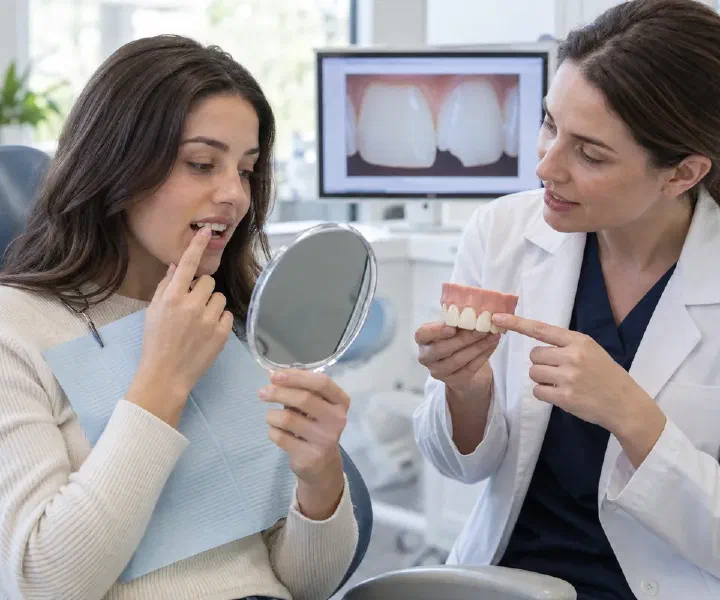
A patient and dentist discussing a small front-tooth chip with a handheld mirror

Care that fits

Begin with the chip’s history and effect.

Your description helps distinguish a simple edge concern from an injury or recurring structural problem.

A recent impact or accident

Explain how the tooth was struck and whether it loosened, bled, or changed position. Even a modest visible chip can occur with other injury. The dentist checks the relevant tissues and may recommend follow-up of pulp health rather than treating the repaired edge as proof that every effect of the accident has resolved.

A chip during ordinary chewing

A tooth or filling that breaks under a usual load may have an existing weakness. The clinician assesses decay, cracks, restorations, and contacts. The food involved does not necessarily explain the entire failure, so the plan should address the condition of the tooth as well as the missing piece.

A rough edge that affects appearance or comfort

Describe whether the area catches the tongue, irritates the lip, or mainly concerns you visually. The desired change can be modest. A stable healthy variation may sometimes be monitored, and treatment should reflect your priorities rather than assume that every uneven edge needs a veneer or crown.

Understanding the options

Choose between smoothing and adding shape.

These options affect tooth structure differently and should be compared before treatment.

Conservative polishing or recontouring

A very small irregularity may be suitable for smoothing when enough enamel remains and the bite allows it. Removed enamel does not grow back. The dentist explains how the contour would change and whether shortening the tooth is a reasonable trade-off for the amount of improvement expected.

Bonding or another repair

Adding composite can restore selected missing shape without simply shortening the surrounding edge. It requires appropriate support, contouring, and maintenance. A deeper defect may need a different restoration or additional treatment, so bonding should not be promised before the extent of damage and loading are assessed.

What we consider

Plan an edge that works with its neighbours.

The repair needs more than a colour match to remain useful in everyday function.

Length and proportion

The dentist considers the original tooth shape, neighbouring edges, and the amount of material needed. A small addition can change the apparent balance of the smile. Discuss the desired endpoint clearly so the repair restores a suitable contour without creating an unnecessarily long or bulky corner.

Bite contacts and habits

Front and back teeth carry different forces, and a repaired edge may meet an opposing tooth during movement. Explain grinding, nail biting, or repeated damage where relevant. The clinician assesses those contacts and discusses protection rather than guaranteeing that a bonded corner can withstand every habit or hard object.

Shade and surface finish

Tooth colour, translucency, and texture affect how a repair blends. Existing whitening plans can influence shade choices. A close match may be possible, but materials can change over time, so maintenance and realistic appearance limits should be included in the original conversation.

Step by step

What the repair appointment may include.

The exact approach follows the defect and the agreed level of intervention.

  1. Examine and confirm the scope

    The tooth is assessed for damage, symptoms, and any relevant injury findings. The clinician explains whether polishing, bonding, another restoration, or monitoring is reasonable. If there is uncertainty about a deeper crack or pulp problem, that should be addressed rather than hidden by an immediate cosmetic repair.

  2. Shape and check the selected treatment

    When repair proceeds, the surface and contour are finished and relevant contacts are reviewed. Let the dentist know if an edge feels rough or the bite feels different. The procedure should conclude with practical care instructions and any recommended follow-up, especially when trauma caused the original chip.

Practical guidance

Keep the repaired corner under review.

Small repairs can be maintained, but repeated failure is a reason to reconsider the cause.

Avoid using teeth as tools

Opening packaging or biting hard objects can overload both natural enamel and repair material. Follow the clinician’s advice and any appropriate protective plan. This does not require avoiding normal function indefinitely; it means recognizing that a repaired corner has limits and should not be deliberately stress-tested.

Report recurring chipping or new symptoms

A repair that repeatedly breaks, a tooth that darkens, or sensitivity that persists needs reassessment. The cause may involve the bite, underlying structure, or an earlier injury. Polishing or rebonding the same area repeatedly may not be the best long-term answer if those factors remain unresolved.

Frequently asked questions

Questions about chipped tooth repair

Can a tiny chip be left alone?

Sometimes a small, stable defect can be monitored if it is healthy and does not create a problem you want addressed. The dentist should still assess it, particularly after an injury. Observation is a decision based on findings, not simply the absence of pain.

Is bonding always better than smoothing?

No. The amount of missing structure, desired shape, and bite determine the trade-offs. Smoothing removes enamel, while bonding adds material that needs maintenance. The clinician explains which approach is appropriate and whether either would create an undesirable compromise.

Will the tooth need freezing for a small repair?

That depends on the procedure, depth, sensitivity, and individual circumstances. The dentist discusses comfort measures before treatment. A small visible chip does not establish the full extent of care or guarantee that every person will experience the procedure the same way.

Can the original fragment be reattached?

In selected circumstances it may be considered after assessing the fragment and tooth. Bring it if available, but do not glue it yourself. The condition, fit, and clinical situation determine whether reuse is reasonable.

Will bonding match my natural tooth?

The dentist selects and shapes material to suit the surrounding tooth, but an exact invisible match in every light cannot be guaranteed. Shade, translucency, and later staining influence appearance. Discuss any planned whitening before choosing the repair colour.

Why does the same corner keep chipping?

A repeated pattern can involve bite contacts, habits, restoration limits, or an underlying crack or weakness. The dentist should investigate the cause. A different design or treatment may be more appropriate than repeatedly adding the same small piece of material.

Do I need follow-up after a chipped tooth injury?

Often follow-up is recommended according to the injury and examination. Pulp or root changes may not be fully apparent immediately. Attend the advised reviews and report discolouration, swelling, looseness, or new discomfort even if the edge repair still looks good.

Real patient results

Before & after smile gallery.

Drag the centre line to compare each real case treated by our dental team. Every smile begins with a personal assessment and a plan shaped around the patient.

Areas We Serve

Neighbourhood dental care, close to home.

Located in Cookstown, Innisfil, our dental team welcomes patients from communities across South Simcoe, Barrie, and northern York Region.

Get directions
  • Cookstown
  • Innisfil
  • Simcoe
  • Lake Simcoe
  • Alcona
  • Stroud
  • Lefroy–Belle Ewart
  • Gilford
  • Churchill
  • Sandy Cove
  • Innisfil Heights
  • Fennell’s Corners
  • Bradford
  • Bradford West Gwillimbury
  • Bond Head
  • Newton Robinson
  • New Tecumseth
  • Alliston
  • Beeton
  • Tottenham
  • Adjala–Tosorontio
  • Everett
  • Loretto
  • Barrie
  • Essa
  • Thornton
  • Baxter
  • Angus
  • Egbert
  • Ivy
  • Utopia
  • York Region
  • East Gwillimbury
  • Queensville
  • Holland Landing
  • Sharon
  • Schomberg
  • Nobleton

Don’t see your community listed? Contact us—we regularly welcome patients from throughout the surrounding region.

Google reviews

Kind words from our patients.

Read what patients have shared about their visits to Cookstown Dental Centre.

A dentist having a friendly consultation with a patient in a bright dental clinic

Your next step

Ready to feel good about your next dental visit?

Whether you are new to the clinic or returning for care, our team is here to make booking simple and answer your questions.

Call Book Now WhatsApp

How can we help?

The Cookstown Dental team is here for you.

Need an appointment, have a question, or want to talk through your options? Choose the next step that works best for you.

Send us a note

We’ll get back to you as soon as we can.