Cookstown Dental Centre
The Cookstown Dental Centre team caring for a patient in a treatment room

Specialized Care · Cookstown

Manage the effects of clenching and grinding with a considered plan.

Bruxism care looks at tooth damage, daytime habits, sleep history, and symptoms. Explore protection, conservative management, and when other assessment may help.

Request an appointment

Let’s find a time that works.

Need urgent dental help? Call (705) 291-2222.

Bruxism Treatment in Cookstown

Protecting the teeth and understanding the pattern are related goals.

Bruxism describes clenching or grinding activity, which may occur while awake or during sleep. Some people notice jaw fatigue, damaged restorations, or a partner reporting grinding sounds; others have wear without obvious symptoms. The appearance of wear alone does not establish when it happened or prove that active sleep bruxism is the only cause.

At Cookstown Dental Centre, we assess the teeth, restorations, muscle and joint symptoms, and relevant history before discussing care. The plan may involve awareness of daytime habits, a suitable protective appliance, repair of specific damage, or coordination for sleep or medical concerns. Treatment should have an explicit purpose. A nightguard may help protect teeth, but it should not be promised as a cure for all grinding, headaches, jaw pain, or sleep-disordered breathing.


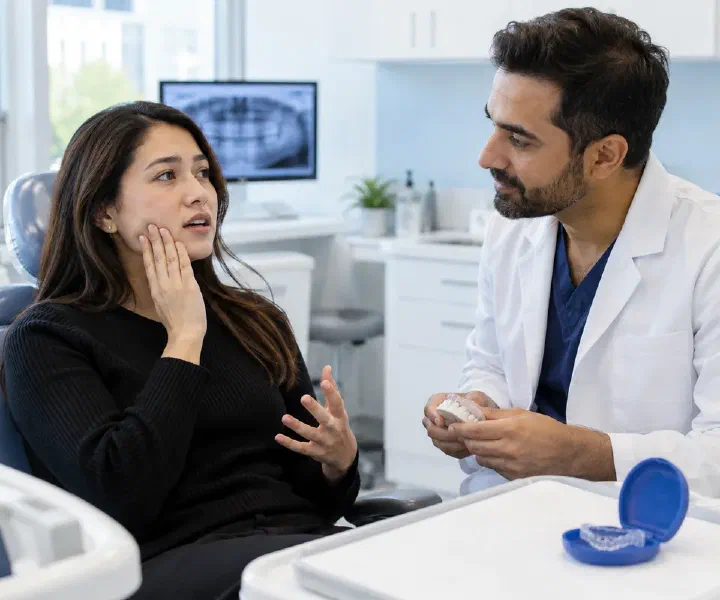
A patient describing jaw tension while a dentist discusses protective care

Understanding the options

Distinguish waking habits from activity during sleep.

Similar dental effects can arise in different circumstances.

Awake clenching or sustained contact

Some people hold their teeth together while concentrating, driving, or working. Discuss when you notice tension and whether a change in routine seems relevant. Awareness and conservative guidance may help with this pattern, but persistent pain still needs assessment rather than being assumed to be a habit alone.

Sleep-related grinding or clenching

You may hear about grinding from another person or notice morning symptoms, but these reports do not measure every aspect of sleep activity. The clinician considers the history and dental findings. Snoring, witnessed breathing pauses, or daytime sleepiness can warrant a separate medical sleep assessment rather than a standard guard-only response.

What we consider

Assess damage and symptoms without attributing everything to bruxism.

The mouth can have several problems at the same time.

Wear, chips, and restoration failures

The dentist examines which surfaces are affected and whether cracks, erosion, or decay also contribute. A repeated fracture can need a specific restorative solution. The plan should distinguish evidence of loading from other damage patterns so a protective device does not become a substitute for treating an affected tooth.

Muscle and joint findings

Tenderness, jaw fatigue, clicking, and limited movement require interpretation in their own right. Bruxism and TMD can coexist, but one label does not explain every facial symptom. The clinician may recommend a focused jaw assessment or referral when the pattern does not fit a simple tooth-protection concern.

Health, medication, and sleep history

Relevant conditions, medications, stimulants, and sleep symptoms can inform the discussion. Do not change prescribed treatment independently. The dentist can identify when coordination is appropriate without claiming to diagnose a sleep disorder from tooth wear or to resolve a medical issue through dental treatment alone.

Care that fits

Choose care with a defined purpose and realistic limits.

A useful plan may combine protection, practical guidance, and selected treatment.

Protect suitable teeth and restorations

A professionally assessed appliance may be considered when protection from loading is appropriate. The design and fit should suit the teeth, restorations, and symptoms. It needs review and cannot guarantee that the activity stops or that every restoration is protected from all future fracture.

Reduce avoidable loading during the day

Guidance may include noticing sustained tooth contact and avoiding habits that aggravate symptoms. Recommendations should fit the assessment rather than demand constant self-monitoring. If discomfort persists, the plan should be reviewed instead of assuming that greater effort alone will resolve a condition that has not been fully assessed.

Step by step

Coordinate protection with any repair work.

An appliance and the teeth it covers need to fit the same treatment sequence.

  1. Identify urgent tooth concerns first

    A painful crack, fractured cusp, loose restoration, or infection needs appropriate assessment and care. Those problems should not wait indefinitely while a guard is made. Explain new biting pain or swelling so the clinic can distinguish immediate treatment needs from longer-term protection planning.

  2. Plan the appliance around the current restorations

    Records and fitting are timed according to any planned changes in tooth shape. A guard made before extensive restorative work may need modification or replacement. The clinician should explain this sequence and check the final fit rather than ask you to force an old appliance over new crowns.

  3. Review use, comfort, and evidence of further damage

    Follow-up considers symptoms, appliance condition, and whether the intended goals are being met. Report pain, a persistent bite change, or a device that no longer seats. A fitted guard is a monitored part of care, not proof that every contributing factor has been permanently resolved.

Good to know

Avoid treatments that promise more than the diagnosis supports.

The response should remain proportionate to the problem being managed.

Irreversible bite changes need a separate justification

Reshaping teeth, rebuilding the bite, or moving teeth is not a general cure for bruxism or TMD. A specific restorative problem may warrant treatment, but its purpose should be clear. Ask about conservative options and the evidence behind any broader irreversible proposal.

Persistent symptoms may call for another pathway

Ongoing facial pain, sleep concerns, or unexplained damage may benefit from additional dental, medical, or specialist assessment. Referral can refine the diagnosis and coordinate care. It should not be interpreted as a reason to continue ineffective treatment indefinitely or accept a guarantee from an unrelated procedure.

Frequently asked questions

Questions about bruxism treatment

Is bruxism the same as teeth grinding?

Grinding is one form of bruxism; clenching and sustained tooth contact can also be part of the discussion. Awake and sleep-related activity may differ. The assessment considers the pattern and effects rather than treating every patient with tooth wear identically.

Will a nightguard stop me grinding?

A guard provides a surface against which the teeth can contact; it is not a reliable off-switch for jaw-muscle activity. Its value is judged by the protective goal, your tolerance, and subsequent tooth findings. Awake clenching and sleep-related concerns may need separate attention.

Does tooth wear prove that I grind in my sleep?

No. Wear may be old or involve acid exposure and other factors. History and examination help interpret the pattern. Sleep symptoms may need separate assessment, especially when snoring, breathing pauses, or daytime sleepiness are reported.

Can bruxism cause every headache or jaw ache?

No. Those symptoms can have several causes and require appropriate assessment. Bruxism may be relevant in some cases, but a dental finding should not automatically replace consideration of medical or other facial-pain conditions.

Should my bite be adjusted to cure grinding?

Worn teeth do not establish that an uneven bite caused the bruxism. Removing sound enamel to change the bite is therefore not a general solution. A clearly identified problem with a recent restoration is assessed separately from a proposal to reshape otherwise serviceable teeth.

Can I use the same appliance for grinding and sleep apnea?

A standard protective nightguard is not automatically an appliance for obstructive sleep apnea. The purposes and designs differ. Sleep-apnea treatment needs the appropriate medical diagnosis, dental suitability assessment, and coordinated follow-up rather than substituting one device for another.

What if symptoms continue despite wearing a guard?

Arrange review of the fit, use, diagnosis, and other contributing factors. Persistent pain or new damage may need another approach or referral. Do not keep wearing a device that causes pain or a persistent bite change without asking for assessment.

Real patient results

Before & after smile gallery.

Drag the centre line to compare each real case treated by our dental team. Every smile begins with a personal assessment and a plan shaped around the patient.

Areas We Serve

Neighbourhood dental care, close to home.

Located in Cookstown, Innisfil, our dental team welcomes patients from communities across South Simcoe, Barrie, and northern York Region.

Get directions
  • Cookstown
  • Innisfil
  • Simcoe
  • Lake Simcoe
  • Alcona
  • Stroud
  • Lefroy–Belle Ewart
  • Gilford
  • Churchill
  • Sandy Cove
  • Innisfil Heights
  • Fennell’s Corners
  • Bradford
  • Bradford West Gwillimbury
  • Bond Head
  • Newton Robinson
  • New Tecumseth
  • Alliston
  • Beeton
  • Tottenham
  • Adjala–Tosorontio
  • Everett
  • Loretto
  • Barrie
  • Essa
  • Thornton
  • Baxter
  • Angus
  • Egbert
  • Ivy
  • Utopia
  • York Region
  • East Gwillimbury
  • Queensville
  • Holland Landing
  • Sharon
  • Schomberg
  • Nobleton

Don’t see your community listed? Contact us—we regularly welcome patients from throughout the surrounding region.

Google reviews

Kind words from our patients.

Read what patients have shared about their visits to Cookstown Dental Centre.

A dentist having a friendly consultation with a patient in a bright dental clinic

Your next step

Ready to feel good about your next dental visit?

Whether you are new to the clinic or returning for care, our team is here to make booking simple and answer your questions.

Call Book Now WhatsApp

How can we help?

The Cookstown Dental team is here for you.

Need an appointment, have a question, or want to talk through your options? Choose the next step that works best for you.

Send us a note

We’ll get back to you as soon as we can.