Cookstown Dental Centre
The Cookstown Dental Centre team caring for a patient in a treatment room

Restorative Dentistry · Cookstown

Plan the extraction site with future tooth replacement in mind.

Alveolar ridge preservation considers bone changes after tooth removal. Explore grafting choices, healing, future implants, and the limits of preserving a socket.

Request an appointment

Let’s find a time that works.

Need urgent dental help? Call (705) 291-2222.

Alveolar Ridge Preservation in Cookstown

Preservation aims to support a future plan, not freeze the bone in place.

The bone around a tooth changes after that tooth is removed. Alveolar ridge preservation describes measures used at an extraction site to help limit loss of ridge dimensions when appropriate. The term overlaps with socket preservation. It does not mean the site will remain exactly the same, that an implant must follow, or that further grafting will never be needed.

At Cookstown Dental Centre, the decision begins with the tooth’s prognosis and the intended replacement options. We discuss the condition of the socket, the surrounding tissues, and whether preservation could support the longer-term restorative goal. Some cases need coordinated surgical or specialist assessment. This page focuses on why preservation is considered and how the decision fits into the broader plan before and after extraction.


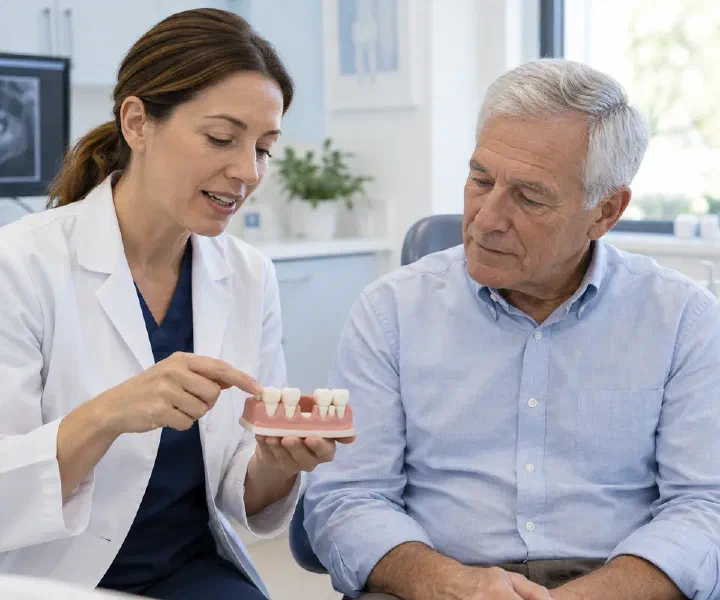
A dentist and patient reviewing a missing-tooth site on a jaw model

Care that fits

Connect preservation to a specific future need.

A grafting decision is more meaningful when the intended use of the site is understood.

A possible future implant

Preserving the ridge may help maintain a more useful site for a later implant in selected cases. It does not guarantee sufficient bone or suitable implant placement. The clinician should explain the expected purpose and the possibility that later assessment may still recommend additional grafting or a different replacement option.

A bridge or removable replacement

Ridge shape can also influence the appearance and fit of non-implant restorations. The discussion should consider the planned tooth replacement rather than assume grafting is relevant only to implants. Its benefit needs to be weighed against the procedure, healing, cost, and the likelihood that it will improve the eventual result.

A replacement decision that is not yet final

You may need time to compare options after a tooth is found to be unrestorable. Ask how delaying a decision could affect the site and which measures preserve reasonable choices. Uncertainty about the future does not make every graft necessary, but it is a legitimate part of the planning conversation.

What we consider

Assess the socket and the person before choosing a technique.

The site conditions and health history influence what can be recommended and when.

Existing bone and tissue condition

The shape of the socket, missing walls, inflammation, and nearby structures can affect the procedure. An extraction site with a larger defect may need a different approach from an intact socket. The clinician explains what can be assessed beforehand and what may only become clear when the tooth is removed.

Medical history and healing considerations

Share medications, smoking or nicotine use, previous healing problems, and relevant medical treatment. These factors can change timing, consent, and follow-up. Do not stop prescribed medication yourself; any coordination with another clinician should be based on the planned procedure and your actual health circumstances.

The restorative and surgical sequence

Ask who will remove the tooth, provide any graft, and assess the site for the next stage. When several providers are involved, their goals should be aligned. A future restoration needs an appropriate site, so the preservation procedure should not be planned independently of its intended use.

Understanding the options

Understand the options and their limits.

The recommendation should explain why a particular approach is useful in this site.

Preservation at the time of extraction

Selected graft material and, where appropriate, a membrane or other technique may be considered when the tooth is removed. The clinician explains the material, purpose, and healing expectations. This is a surgical decision with uncertainty, not a guarantee that the final ridge dimensions will match the original tooth socket.

Healing without preservation or grafting later

In some situations the site may be allowed to heal before the replacement plan is reassessed. Later augmentation may be considered if needed. Compare the likely trade-offs in complexity, timing, and available options rather than assuming that one sequence is universally preferable for every extraction.

Planning together

Discuss the details before the extraction appointment.

Clear consent includes the reason for the procedure and the decisions that may follow it.

Material choice and procedure scope

Ask what type of graft material is proposed, its source, and whether other materials are involved. Discuss any personal preferences or relevant sensitivities. The clinician should explain alternatives and what would happen if the site does not support the planned technique once it can be examined directly.

Healing and practical arrangements

Understand the expected follow-up, temporary tooth options, and any changes to eating or cleaning that will be prescribed. If a removable appliance is planned, it must not place unsuitable pressure on the healing site. Coordinate those details before the extraction rather than treating them as separate aftercare problems.

Costs and later stages

Clarify what the preservation fee includes and which later assessments or procedures are separate. An estimate for grafting does not necessarily include an implant or final tooth. A staged plan should make the remaining decisions visible so the first procedure is understood in its full context.

The appointment

Allow healing to guide the next decision.

The calendar is an estimate; the site needs assessment before the next definitive stage.

  1. Protect and review the healing area

    Follow the surgeon’s specific instructions and attend the planned checks. Report worsening pain, persistent bleeding, swelling, or another concern according to the advice provided. Do not disturb the site to see how the graft looks; healing is assessed clinically rather than by inspecting loose-looking surface material at home.

  2. Reassess the replacement plan

    The clinician evaluates healing and obtains appropriate records when planning the next stage. The actual bone and tissue conditions determine whether the intended restoration remains suitable. Additional grafting, a different timing, or another replacement option may still need discussion even when preservation has been completed as planned.

Frequently asked questions

Questions about alveolar ridge preservation

Is ridge preservation the same as socket preservation?

The terms commonly overlap for measures used to help preserve the extraction-site ridge. The exact technique depends on the site. Ask what procedure is proposed rather than assuming the two names describe separate treatments that should both be performed.

Does preservation guarantee I can have an implant?

No. Implant suitability still depends on healed bone, surrounding structures, tissues, health, and the restorative plan. Preservation may support later options, but additional grafting or a different replacement approach can still be necessary after reassessment.

Must every extracted tooth site be grafted?

No. The benefit depends on the site and future goals. The clinician should explain why preservation is recommended in your case and compare it with healing without grafting. A routine label should not replace an individual decision.

Can I wear a temporary denture during healing?

Possibly, if it is planned and adjusted to avoid inappropriate pressure on the site. Discuss this before extraction. Follow the specific instructions from the treating clinician and seek review if the appliance rubs or becomes difficult to wear.

Where does the graft material come from?

Different materials have different sources and properties. The clinician should identify the proposed material and explain relevant alternatives during consent. Raise personal preferences or medical concerns before the procedure rather than assuming all grafts use the same material.

How long before the site is ready for the next step?

Healing time varies with the procedure, site, and individual response. The clinician provides an estimate and reassesses the area before proceeding. A calendar date alone does not establish that the bone and tissues are ready for an implant or another restoration.

What if I later choose a bridge instead of an implant?

The replacement plan can be reconsidered, but discuss the implications with the clinician. Preservation does not commit you to an implant. The value and design of the original procedure should have been explained in relation to the plausible future options.

Real patient results

Before & after smile gallery.

Drag the centre line to compare each real case treated by our dental team. Every smile begins with a personal assessment and a plan shaped around the patient.

Areas We Serve

Neighbourhood dental care, close to home.

Located in Cookstown, Innisfil, our dental team welcomes patients from communities across South Simcoe, Barrie, and northern York Region.

Get directions
  • Cookstown
  • Innisfil
  • Simcoe
  • Lake Simcoe
  • Alcona
  • Stroud
  • Lefroy–Belle Ewart
  • Gilford
  • Churchill
  • Sandy Cove
  • Innisfil Heights
  • Fennell’s Corners
  • Bradford
  • Bradford West Gwillimbury
  • Bond Head
  • Newton Robinson
  • New Tecumseth
  • Alliston
  • Beeton
  • Tottenham
  • Adjala–Tosorontio
  • Everett
  • Loretto
  • Barrie
  • Essa
  • Thornton
  • Baxter
  • Angus
  • Egbert
  • Ivy
  • Utopia
  • York Region
  • East Gwillimbury
  • Queensville
  • Holland Landing
  • Sharon
  • Schomberg
  • Nobleton

Don’t see your community listed? Contact us—we regularly welcome patients from throughout the surrounding region.

Google reviews

Kind words from our patients.

Read what patients have shared about their visits to Cookstown Dental Centre.

A dentist having a friendly consultation with a patient in a bright dental clinic

Your next step

Ready to feel good about your next dental visit?

Whether you are new to the clinic or returning for care, our team is here to make booking simple and answer your questions.

Call Book Now WhatsApp

How can we help?

The Cookstown Dental team is here for you.

Need an appointment, have a question, or want to talk through your options? Choose the next step that works best for you.

Send us a note

We’ll get back to you as soon as we can.